nestmaker / CC BY-SA 2.0, via Wikimedia Commons
Astilboides tabularis: giant leaves for shady gardens
Astilboides tabularis
Want to see Astilboides tabularis: giant leaves for shady gardens in your garden?
Full design in HD: €7.99
Look after your Astilboides tabularis with the GardenWorld app
Identify plants with your camera and get a care calendar with reminders for this plant.


Overview
Astilboides tabularis is a perennial for anyone who wants something dramatic in a shady garden. It comes from the mountain forests of north-east China and North Korea, where it grows along streams and on damp, shaded slopes. It belongs to the saxifrage family (Saxifragaceae) and used to be called Rodgersia tabularis, a name you will still find on older labels. It is sometimes sold as shieldleaf rodgersia, though most nurseries simply call it astilboides.
The leaves are what make it special. Each one is almost perfectly round, held like a parasol on a long stalk, and grows 60 to 90 cm across, occasionally more in a damp spot. A mature plant reaches 1 to 1.5 m in height and spread. It gives a shady border instant structure and an almost tropical feel, yet it is completely hardy.
If you are unsure how such a large foliage plant fits into a smaller garden, you can have a garden design made on gardenworld.app that places Astilboides tabularis alongside ferns, hostas and other shade lovers. The plant is not known to be toxic to people or pets and is not considered invasive anywhere in Europe.
Appearance and bloom cycle
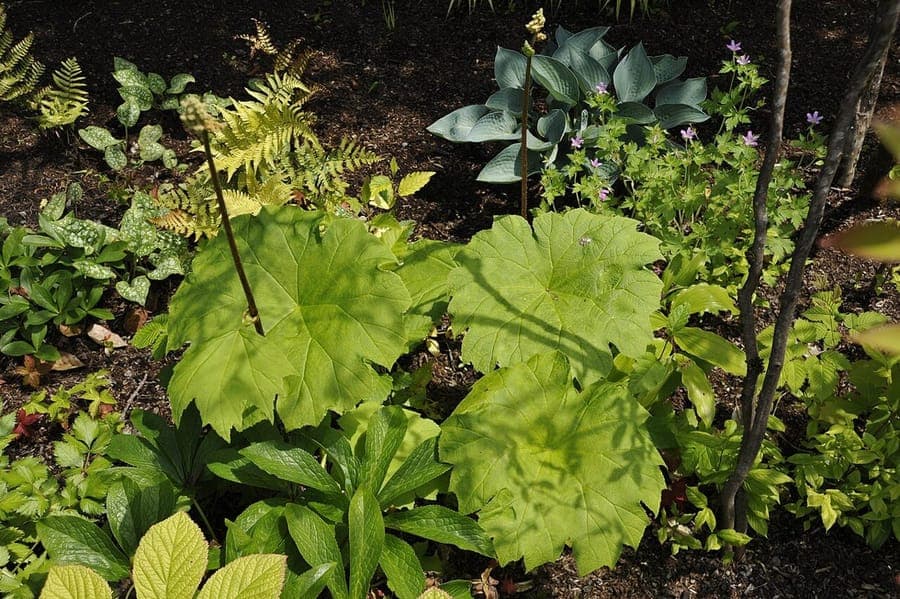
In April the young leaves push through the soil as crumpled, hairy knobs. Within a few weeks they unfold into fresh, pale green discs with shallowly lobed, toothed edges. The stalk is attached to the centre of the leaf, like a mushroom. The surface feels slightly rough and downy. The photo shows those round, pale green leaves clearly, with the first flower stems still in bud between them.
In June and July upright stems up to about 1.5 m rise above the foliage, carrying loose, slightly nodding plumes of tiny creamy-white flowers. They resemble astilbe flowers, hence the name Astilboides, meaning "like Astilbe". The flowers are lovely, but the leaves remain the star. After flowering, brown seed heads form that you can leave in place.
In autumn the foliage turns yellow-brown and dies back. Over winter the plant retreats entirely to a thick underground rhizome.
Ideal location
Astilboides tabularis wants partial to light shade. Morning sun is fine, but strong midday sun scorches the large leaves, leaving them with brown edges and a limp look. The wetter the soil, the more sun the plant tolerates. Beside a pond or stream in Britain it can sometimes cope with half a day of sun.
Choose a spot sheltered from strong wind. Leaves nearly a metre across catch a lot of wind and tear easily. A position among shrubs, at the edge of a woodland area or in the lee of a north-facing wall is ideal.
Give the plant room: allow at least 1 m between its crown and its neighbours. It slowly spreads into a broad clump and does not enjoy being moved after a few years.
Soil requirements
Soil is the key to success. Astilboides tabularis wants deep, humus-rich ground that stays moist all the time without sitting waterlogged for long. A loam with plenty of organic matter is ideal. On light, sandy soil, dig a generous amount of compost, leaf mould or well-rotted manure into the top 30 to 40 cm at planting time.
The plant prefers slightly acidic to neutral soil, roughly pH 5.5 to 7. It struggles on dry, chalky ground. A mulch of bark chips or leaf compost, as in the photo, keeps the soil cool and damp and tops up the organic matter every year.
Plant in spring or early autumn. Dig a generous hole, set the rhizome just below the surface and water in well.
Watering
Water is the big requirement. Never let the soil dry out, especially in the first year. In dry summer weather, give a thorough soaking of 10 to 20 litres per plant once or twice a week. Drooping leaves on a warm afternoon are the first sign of thirst; if they have not recovered by evening, the soil is too dry.
In a naturally damp spot, such as a pond edge or a low-lying part of the garden, an established plant needs little extra water. In dry summers, which are becoming more common, extra watering is still needed. Water in the morning or evening and at the base of the plant. Feeding is hardly necessary: a layer of compost in spring is enough.
Free preview
Want to see Astilboides tabularis: giant leaves for shady gardens in your garden? Make a free preview of your design.
Pruning
Astilboides tabularis needs very little pruning. Cut spent flower stems off at the base after flowering if you do not want seed heads, or leave them for winter structure. Damaged or scorched leaves can simply be removed in summer; the plant will not replace them, but it will look tidier.
In late autumn, once the foliage has died back, cut everything down to just above ground level. Alternatively, leave the dead leaves in place as winter protection and clear them in spring.
Division is possible in early spring, just as the first buds appear. Use a sharp spade to cut away a piece of rhizome with at least one bud and replant it straight away. Only divide when necessary, as the plant looks its best after years of undisturbed growth.
Maintenance calendar
March-April: Clear away dead leaves and spread a layer of compost or leaf mould. Divide if needed. Protect the young leaves from slugs.
May: The leaves unfold. Keep the soil moist and check for slug damage.
June-July: Flowering time. Water thoroughly once or twice a week in dry spells.
August-September: Keep watering in dry weather. Remove spent stems or leave them standing.
October-November: The foliage colours and dies back. Cut it down or leave it as winter cover. A good time to plant new specimens.
December-February: Dormant period. No work needed.
To see each month's garden jobs at a glance, the plant calendar on gardenworld.app is a handy guide.
Winter hardiness
Astilboides tabularis is extremely hardy. Severe winters are normal in its native range, and the plant tolerates frost down to roughly -25 to -30 °C. Everything above ground dies back, while the rhizome overwinters safely in the soil. In Britain and the Low Countries no winter protection is needed.
The only risk is late frost in April or May, just after the young leaves have emerged. They can turn brown and shrivel. If a frosty night is forecast, lay horticultural fleece over the young shoots. Even if the first leaves are damaged, the plant usually sprouts again, although the leaves will stay a little smaller that year.
Slugs are the biggest enemy in spring. They chew holes in the soft young leaves, and those holes expand into large, ragged gaps as the leaf grows. Check in the evening and pick slugs off by hand, or use ferric phosphate slug pellets.
Companion plants
Astilboides tabularis is the star of a shady border, and it works best with plants that heighten the contrast. Finely cut ferns such as the shuttlecock fern (Matteuccia struthiopteris) make a superb counterpoint to the big round leaves. Blue-grey hostas such as Hosta sieboldiana suit it beautifully too, just as in the photo.
For a lush bog garden combine it with Rodgersia podophylla, the umbrella plant (Darmera peltata) and Ligularia dentata with its orange late-summer daisies. Astilbe japonica and the giant cowslip (Primula florindae) add colour at eye level. Low ground cover such as lungwort (Pulmonaria) and hardy geraniums fills the edges.
Avoid planting drought lovers such as lavender or sun-loving grasses nearby: their needs are too different.
Final thoughts
Astilboides tabularis is not a plant for every garden, but in a damp, sheltered spot in partial shade it is unforgettable. The enormous round leaves, the creamy summer plumes and complete hardiness make it a focal point that returns year after year and gets better with age. Give it space, humus-rich soil and plenty of water, keep an eye out for slugs in spring, and you will have a piece of mountain forest in your own garden.
Frequently asked questions about Astilboides tabularis
Is Astilboides tabularis winter hardy?
Astilboides tabularis is extremely hardy. Severe winters are normal in its native range, and the plant tolerates frost down to roughly -25 to -30 °C.
When and how do you prune Astilboides tabularis?
Astilboides tabularis needs very little pruning. Cut spent flower stems off at the base after flowering if you do not want seed heads, or leave them for winter structure.
How much water does Astilboides tabularis need?
Water is the big requirement. Never let the soil dry out, especially in the first year.
Where does Astilboides tabularis grow best?
Astilboides tabularis wants partial to light shade. Morning sun is fine, but strong midday sun scorches the large leaves, leaving them with brown edges and a limp look.
What soil does Astilboides tabularis need?
Soil is the key to success. Astilboides tabularis wants deep, humus-rich ground that stays moist all the time without sitting waterlogged for long.

See it in your garden
See Astilboides tabularis in your garden
One photo of your garden and a few questions. You see the result in about a minute.
Try it with a photoIdentify this plant in your own garden. Identify a plant
Similar plants
Darmera peltata: complete guide
Darmera peltata
Discover the giant umbrella plant with spectacular shield-shaped leaves. Perfect for moist gardens and shaded spots. Read our full care and cultivation guide.
Rodgersia: complete guide
Rodgersia podophylla
Discover all about Rodgersia (Rodgersia podophylla): from appearance and bloom to location, care, and hardiness. Create a shade habitat garden.
Hosta sieboldiana: complete guide
Hosta sieboldiana
Hosta sieboldiana growing guide: large blue-green shade plant from Japan. Complete care tips, placement and maintenance for shady gardens and woodland areas.
