
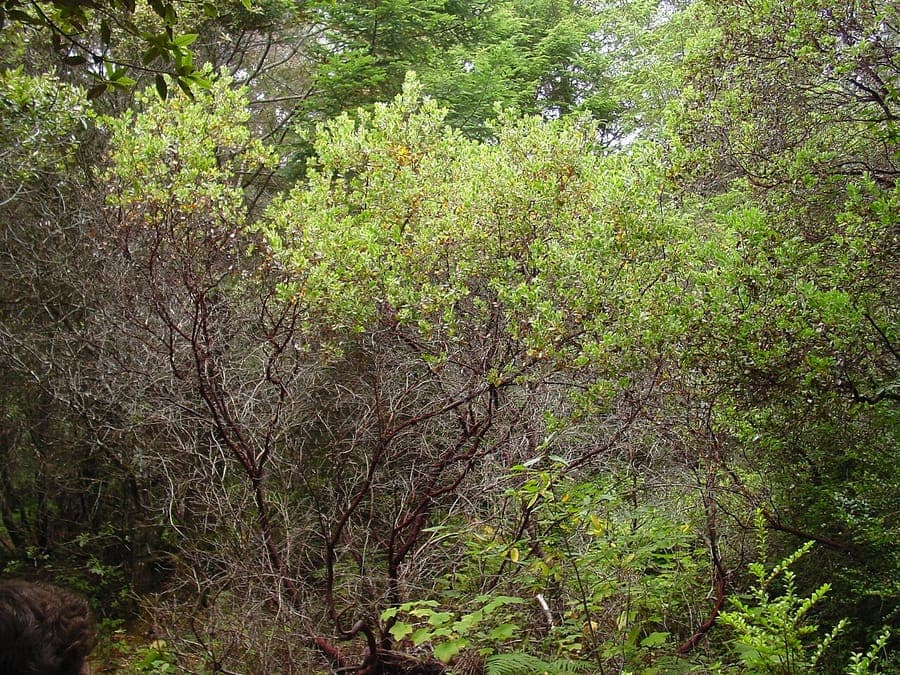
No machine-readable author provided. NoahElhardt assumed (based on copyright claims). / CC BY-SA 2.5, via Wikimedia Commons
Hairy manzanita: complete guide
Arctostaphylos columbiana
Want to see Hairy manzanita: complete guide in your garden?
1 minute, no credit card
Overview
Arctostaphylos columbiana, commonly known as hairy manzanita or Columbia manzanita, is a slow-growing, evergreen shrub or small tree in the heath family (Ericaceae). It is native to the Pacific coast of North America, from British Columbia in southern Canada through Washington and Oregon into northern California. Other English names for this species include bristly bearberry and bristly manzanita, reflecting its distinctive hairy stems.
The genus Arctostaphylos comprises over 60 species in western North America, most endemic to California. Hairy manzanita represents one of the more northerly-ranging members, growing in chaparral, open forest margins, dry slopes, and coastal scrub communities where it thrives on well-drained, acidic, nutrient-poor soils often derived from sandstone or volcanic parent material. Its natural range is characterised by Mediterranean-type climates with dry summers and wet winters.
The plant grows as a multi-stemmed large shrub or small tree, typically reaching 1–3 metres in height over many years. It is noted for its ornamental smooth, peeling reddish-brown to mahogany bark on older wood, dense white flower clusters in early spring, and small apple-like berries that attract birds. The species was formally described by botanists Piper and Beattie in 1915.
For gardeners seeking a structurally interesting, low-maintenance evergreen for acidic, dry conditions, hairy manzanita is a standout choice. At gardenworld.app, you can explore design concepts for dry, open front gardens where architectural evergreen shrubs like Arctostaphylos provide permanent structure with minimal care.
Appearance & bloom cycle
Hairy manzanita is a multi-stemmed shrub with an open, architecturally distinctive branching habit. In youth it is bushy and compact; with age the woody structure becomes more sculptural, with gnarled, contorted branches. The bark is one of its most notable features: smooth, polished, and deep reddish-brown to mahogany on mature wood, exfoliating in thin papery sheets to reveal fresh bark beneath. This peeling quality is characteristic of the entire Arctostaphylos genus and provides winter interest when other plants are dormant.
Leaves are leathery, oval to oblong, 3–6 cm long, grey-green to green on the upper surface, with a notably hairy underside on young growth. The young stems and leaves are densely covered in fine, sometimes glandular hairs - the feature that gives the species its common name. This pubescence distinguishes it from the closely related Arctostaphylos uva-ursi (bearberry), which has smooth stems.
Flowering occurs early in the season, typically February to April, before or alongside the emergence of new leaf growth. The flowers are small, urn-shaped (urceolate), white to pale pink, and borne in dense hanging clusters at stem tips. This flower form is characteristic of the heath family and closely resembles that of Pieris, Leucothoe, and Erica. The flowers are nectar-rich and attract early-season pollinators - bees, moths, and hummingbirds in their North American range.
After pollination, small, round berries develop: 8–12 mm in diameter, maturing from green to brownish-red or brown. These are mealy in texture - the name manzanita is Spanish for little apple - and while not palatable to humans, they are an important food source for birds, bears, and small mammals in the wild.
Ideal location
Hairy manzanita thrives in full sun to light partial shade. In nature it occupies open, dry slopes and forest margins with maximum light exposure. In the garden, choose a south or south-west facing position with good air movement. A position with some afternoon shade is acceptable in very hot, dry climates.
The plant performs best in dry, open garden situations: gravel gardens, heather beds, dry borders, and raised areas with sharp drainage. In group plantings, space at 150–200 cm to allow the sculptural branching habit to develop. As a specimen shrub in a border, allow 2–3 m of clear space around it. It does not tolerate foot traffic - position it as a visual focal point.
In North-Western European gardens, the sandy, peaty soils of heath landscapes (Veluwe, Drenthe, Flemish sand ridge) are naturally appropriate. Avoid heavy clay soils and waterlogged positions: standing water around the root crown is the primary cause of plant failure.
Soil requirements
Arctostaphylos columbiana has a clear soil profile requirement: excellent drainage combined with an acidic to neutral pH of 5.0–7.3. The species performs best in the 5.5–6.5 range. In its native range it grows on poor, acidic podzols, stony soils with low organic matter, and volcanic substrates.
Rich, fertile garden soil is unsuitable: excess nitrogen promotes rank foliage growth at the expense of flowers and makes the plant more susceptible to disease. The ideal growing medium is a mix of ericaceous (acid) compost with added coarse pine bark and sharp sand in a 2:1:1 ratio. This approximates the well-drained, mildly acidic substrate the plant evolved on.
Adjusting existing soil: incorporate 3–5 cm of acidic peat or ericaceous compost annually until the desired pH is reached, verifying with an annual pH test. Mulch around the plant with pine bark or rough wood chip to maintain soil acidity and regulate moisture. Avoid calcareous soil, chalk, or limestone-derived substrates entirely - the plant will fail on alkaline ground.
Fertiliser requirements are minimal. A single light spring application of ericaceous feed (formulated for rhododendrons and azaleas) is sufficient for the year. Excess nitrogen must be avoided - it is counterproductive for flowering.
Free design
Want to see Hairy manzanita: complete guide in your garden? Make a free design now.
Watering
Once established, hairy manzanita is highly drought tolerant. Along its native Pacific coast it survives long, dry summers without supplemental irrigation. In garden conditions, the establishment period requires the most attention; after that, the plant needs minimal watering.
In the first year after planting: water weekly, allowing the top 5 cm of soil to dry fully between waterings. Never keep the root zone permanently moist - the plant must develop its natural drought resilience. In the second year and beyond, reduce irrigation substantially. Established plants need supplemental water only during prolonged drought exceeding six weeks, and then one deep morning watering is sufficient.
In North-Western European gardens with regular summer rainfall, established hairy manzanita rarely needs watering. Autumn and winter drainage is more critical: ensure water does not pool at the base of the plant, particularly during the wet season. A gravel ring (5 cm deep) around the crown improves immediate drainage and protects the root zone in cold winters.
Avoid evening watering on the foliage: wet leaves in cool conditions promote fungal disease in the dense, pubescent foliage.
Pruning
Arctostaphylos columbiana naturally forms an attractive shrub shape and requires minimal pruning. Routine maintenance consists of:
Removing dead wood in early spring (April), after the frost risk has passed. Cut back dead or damaged branches to the first active growing point or back to the main stem. Use a clean, sharp pruning saw or secateurs disinfected between cuts to prevent disease transmission through fresh wounds.
Formative or corrective pruning: if the plant grows too large, shorten the longest stems back to a lateral branch after flowering (April-May). Avoid hard cutting into old wood - manzanitas regenerate poorly from bare old stems. Small, incremental corrections are far preferable to drastic reduction.
Never remove more than 20% of the total leaf volume per pruning session. Keep cut surfaces as small as possible and always cut back to a lateral.
Maintenance calendar
January–February: Check for frost and moisture damage. Remove dead leaves and debris around the base. Ensure drainage channels remain clear during the wet season.
March: Flowering begins. Top-dress with a 5–8 cm layer of pine bark mulch. Apply a light ericaceous fertiliser around the root zone, keeping it away from the stems.
April: Prune out dead wood after frost risk has passed. Correct plant structure after flowering. New shoot growth begins.
May: Leaf growth and fruit development. Keep soil lightly moist if dry. Check young shoot tips for aphids.
June–August: Dry season. Mature plants need little to no water. Young plants (first year) water deeply once weekly during prolonged dry spells.
September: Berries ripen; attractive to birds. No pruning until the following spring.
October–November: Renew pine bark mulch. Check drainage before the winter wet season.
December: Dormancy period. Protect young plants at temperatures below -8 degrees C with a temporary fleece layer or conifer branch cover.
Winter hardiness
Arctostaphylos columbiana is hardy in USDA zones 7–9. In its native Pacific coastal range across British Columbia, Washington, Oregon, and northern California, it survives temperatures of -15 to -18 degrees C. For the Netherlands, Belgium, and northern Germany (USDA zones 7b–8a), the species is borderline hardy - fully hardy for established plants in well-drained positions, but vulnerable during the first two to three years of establishment.
An established, mature plant in appropriately drained soil should survive most North-Western European winters without protection. In heavy, waterlogged clay soil, the combination of winter wet and cold causes root rot even at modest temperatures below freezing. On the correct, free-draining substrate, frost risk is minimal.
Protect young first-year plants at below -8 degrees C with a windbreak or temporary fleece. Do not use straw as a winter mulch - it holds too much moisture. Pine bark or coarse grit is preferable. The plant is also susceptible to late spring frost once new growth has emerged: protect vulnerable young shoots with a temporary fleece layer at forecast April frosts.
In the long term, the warming trend in the North-Western European climate is making this Pacific coast species increasingly viable as a garden plant in Belgium, the Netherlands, and the UK.
Companion plants
Hairy manzanita belongs to the community of acid-soil, drought-tolerant Pacific coast plants and fits naturally alongside species with identical soil and light requirements:
- Gaultheria shallon (salal): another low-growing Ericaceae from the same Pacific coastal range; forms dense evergreen mats; same drought tolerance and acid-soil preference as Arctostaphylos.
- Vaccinium ovatum (evergreen huckleberry): an evergreen blueberry relative with small edible black berries; same soil and light preferences.
- Calluna vulgaris (common heather): classic acid-soil groundcover that provides a low-growing carpet beneath taller manzanita shrubs.
- Pinus mugo (dwarf mountain pine): compact conifer suited to the same dry, poor soils; provides structural contrast as a background plant.
- Ceanothus thyrsiflorus (blue blossom): a shrub with blue-violet flower clusters from the same dry Pacific coastal habitat; provides striking colour contrast.
- Erica cinerea (bell heather): low-growing acid-loving heather that thrives in the light shade beneath Arctostaphylos branches.
Combine hairy manzanita with its natural companions for a cohesive dry, acid-soil planting plan tailored to your garden's specific conditions.
Closing
Hairy manzanita is a remarkable, underutilised shrub for European gardens. Its combination of early white flowers, spectacular peeling mahogany bark, leathery evergreen foliage, and exceptional drought tolerance makes it a standout structural plant for acid-soil, dry garden schemes. It rewards patience - growth is slow - but once established, it provides decades of architectural beauty with very little maintenance. For a front garden design incorporating this and other drought-tolerant evergreens, visit gardenworld.app and see how the right plant selection can transform a difficult, dry space into a year-round landscape.
Want to see Hairy manzanita: complete guide in your garden? Make a free design now.
Upload a photo, pick a style, and get a photorealistic design with plant list in under a minute.
10,000+ gardens designed already
No credit card required


Similar plants
Zenobia pulverulenta: complete guide
Zenobia pulverulenta
Everything about Zenobia pulverulenta (honeycup): siting, acid soil, pruning and the fragrant white bells, in this complete care guide.
Dwarf huckleberry: complete guide
Gaylussacia dumosa
Everything about dwarf huckleberry (Gaylussacia dumosa): acidic soil, partial shade, pruning and care for this compact North American berry shrub.
Drooping leucothoe: complete guide
Leucothoe fontanesiana
Everything about drooping leucothoe (Leucothoe fontanesiana): shade tolerance, soil, watering, pruning, hardiness and companion plants.