
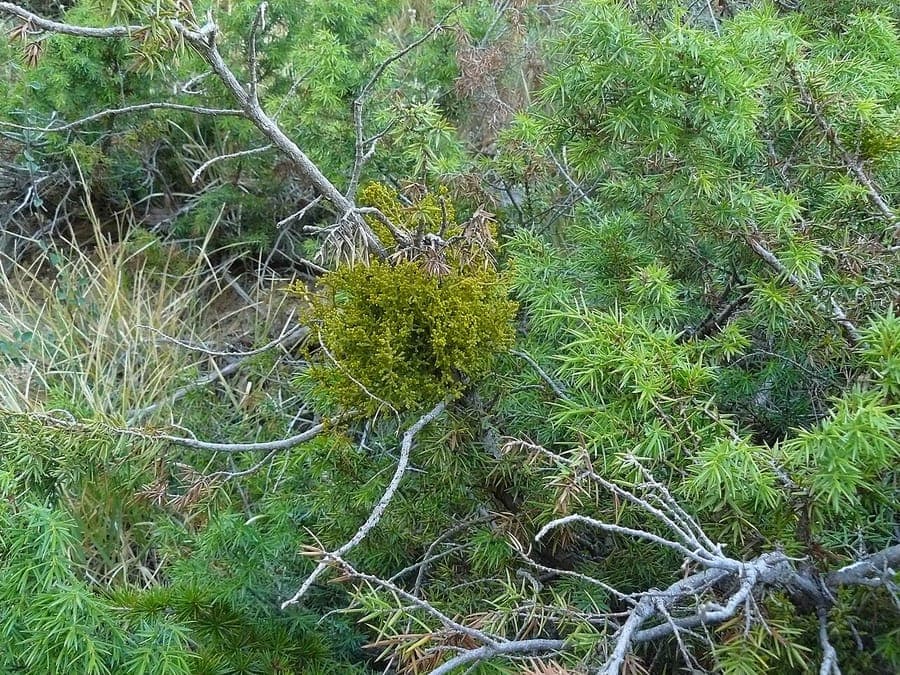
Elie plus / CC BY-SA 3.0, via Wikimedia Commons
Juniper Dwarf Mistletoe: complete guide
Arceuthobium oxycedri
Want to see Juniper Dwarf Mistletoe: complete guide in your garden?
1 minute, no credit card
Overview
Arceuthobium oxycedri, commonly known as juniper dwarf mistletoe, is a small hemiparasitic plant in the Santalaceae family. Dwarf mistletoes are among the most specialised flowering plants in the world: they grow directly from the woody tissue of their host tree, tapping into the xylem to draw water and dissolved minerals without ever touching the soil. This species has the widest distribution of any European dwarf mistletoe, extending from the western Mediterranean through Spain, France, Greece, and the Caucasus all the way to Central Asia and the foothills of the Himalayas.
Garden enthusiasts often encounter Arceuthobium oxycedri as an unexpected discovery on ornamental juniper plants, particularly on Juniperus oxycedrus, the prickly juniper. The plant itself is inconspicuous - a few centimetres of jointed, yellowish-green stems emerging from the bark - but its effects on the host can be dramatic over time, leading to the formation of dense, broom-like galls called witches' brooms.
For anyone maintaining juniper plants in their garden or on a Mediterranean-style terrace, understanding this parasite is important for keeping host plants healthy and preventing spread. At gardenworld.app you can find design advice for Mediterranean garden styles that feature juniper as a structural plant.
Appearance and Bloom Cycle
The plant forms small, branched shoots between 2 and 8 cm tall emerging directly from the bark of infected juniper branches. Stems are jointed, fleshy, and greenish-yellow to olive in colour. True leaves are absent; instead, minute scale-like structures ring each node. The plant relies heavily on its host for carbon compounds, performing only limited photosynthesis on its own.
Flowers are tiny and petal-less, appearing in September and October. Male flowers carry three stamens; female flowers are even smaller. Pollination occurs through insects and wind. Once fertilised, a small blue-green berry develops over an extended period, taking about a year to fully ripen. When ripe, the fruit expels its seed explosively - sometimes shooting the seed two to four metres - coated in a sticky substance called viscin that allows it to adhere to nearby bark.
One of the most visible symptoms of infection is witches' broom formation: infected tissue responds to the parasite's hormonal signals by producing dense clusters of short, abnormally branched shoots. These brooms can reach 30 to 50 cm in diameter and are often the first sign a gardener notices.
Ideal Location
Arceuthobium oxycedri is an obligate parasite: it cannot survive without a host. In natural settings, the primary host is Juniperus oxycedrus, though several other juniper species can also be infected. The plant is found on dry, rocky, calcareous slopes and open Mediterranean scrubland, typically at elevations between sea level and around 1,800 metres.
In a garden setting, the plant has no value as an ornamental species. If you notice unusual compact swellings or witches' broom clusters on your juniper, especially on specimens grown in a warm, sheltered spot, it is worth investigating whether Arceuthobium is the cause. Plants that are weakened by drought, mechanical damage, or poor growing conditions are more susceptible to infection.
The species is adapted to USDA hardiness zones 7 to 10, matching the range of its preferred host plants.
Soil
As a parasite, Arceuthobium oxycedri has no direct soil requirements of its own. It is the host plant's relationship with the soil that matters. Juniperus oxycedrus thrives in well-drained, dry to moderately moist soils with a pH between 5.5 and 6.5. Waterlogged or heavy clay soils stress the juniper and make it more vulnerable to parasitic attack.
Gardeners wishing to grow juniper in regions where this parasite is present should prioritise soil drainage above all else. Raised beds or gravel mulches that prevent waterlogging are highly effective. A well-nourished, vigorous juniper growing in appropriate soil conditions is far better placed to tolerate a minor infection without suffering serious long-term damage.
Free design
Want to see Juniper Dwarf Mistletoe: complete guide in your garden? Make a free design now.
Watering
Juniper plants are drought-adapted and require minimal supplemental water once established. Arceuthobium oxycedri drains water and minerals directly from the host's vascular system. During summer droughts, when the host is already under water stress, the additional burden imposed by the parasite can tip the balance and cause branch dieback.
In hot, dry periods, providing a deep, infrequent watering to established juniper plants is advisable. Allow the soil to dry out between sessions to avoid root rot, but ensure the plant does not remain severely drought-stressed for extended periods. Healthy host plants are best positioned to contain and compartmentalise parasitic infection.
Pruning
Pruning is the primary management tool for Arceuthobium infection in garden settings. The key point is that the parasite's haustoria - internal root-like structures - penetrate far into the vascular tissue of the host branch, extending well beyond the visible external growth. When removing infected branches, cut at least 20 to 30 cm below the lowest visible sign of infection.
Burn all removed material immediately; do not compost it. The sticky seeds can be dispersed by wind or contact if material is left lying around. Clean all cutting tools with alcohol between cuts to avoid transferring plant material to healthy branches.
If infection has spread throughout a major portion of the plant, full removal of the specimen is the safest option. This is particularly true if other juniper plants are growing nearby and could be exposed to seed dispersal.
Maintenance Calendar
- January-February: Inspect juniper plants for witches' broom clusters and greenish swellings on branches; the parasite is clearly visible in winter when foliage is reduced.
- March-April: Prune out infected branches before the growing season begins; burn removed material and disinfect tools.
- May-August: Monitor host plant health; avoid mechanical damage to bark which creates entry points for infection.
- September-October: Flowering and seed dispersal period; minimise foot traffic around infected specimens and avoid activities that disturb seeds.
- November-December: Rest period; apply a balanced fertiliser to support host plant vitality through winter.
Winter Hardiness
Arceuthobium oxycedri is a Mediterranean species adapted to warm, dry summers and mild winters. It is not reliably hardy in climates that experience sustained frost below -10 degrees Celsius. The species is native to Mediterranean Europe, North Africa, and Central Asia, and is not found naturally in northern or central European climates.
Gardeners in north-western Europe have very little risk of encountering this parasite spontaneously. The risk arises primarily from importing juniper plants from nurseries in warmer regions. Buy juniper plants only from reputable suppliers and inspect new arrivals carefully before placing them near established specimens.
Companion Plants
Because Arceuthobium oxycedri is a parasite rather than a garden plant, companion planting is relevant here in the context of what grows around the host juniper. In a Mediterranean dry garden, Juniperus oxycedrus pairs well with Cistus ladanifer, Rosmarinus officinalis, Pistacia lentiscus, and Lavandula stoechas - none of which are susceptible to Arceuthobium infection.
For rock gardens and gravel borders in a drought-tolerant style, Artemisia, Sedum, and Thymus are excellent companions for juniper. Keeping the planting open and airy, rather than densely packed, reduces the chance of seed landing on adjacent juniper plants. If you want help planning a Mediterranean garden composition, gardenworld.app offers personalised garden design tools and plant suggestions.
Avoiding large monocultures of juniper reduces the risk of rapid spread if a single plant becomes infected.
Closing
Arceuthobium oxycedri is one of nature's most specialised parasitic plants - a reminder that plants are not always the passive actors in an ecosystem. For gardeners, the takeaway is clear: monitor juniper plants regularly, especially specimens growing in warm, sheltered spots; act quickly when witches' brooms appear; and maintain host plant vitality through good drainage and appropriate care. Early intervention makes all the difference between a minor inconvenience and the loss of a valuable garden specimen.
Want to see Juniper Dwarf Mistletoe: complete guide in your garden? Make a free design now.
Upload a photo, pick a style, and get a photorealistic design with plant list in under a minute.
10,000+ gardens designed already
No credit card required


Similar plants
Meadow Flax: complete guide
Thesium pyrenaicum
Cultivate Meadow Flax (Thesium pyrenaicum): delicate alpine plant, white flowers, acid soil preference, sparse nutrition, and Pyrenean mountain garden care.
Thesium humile: complete guide
Thesium humile
Discover Low Bastard Toadflax, a modest herb with fine foliage and tiny white flowers. Perfect wild plant for Mediterranean drought gardens.
White Osyris: complete guide
Osyris alba
Discover Osyris alba, a Mediterranean shrub with fine grey-green foliage and red berries. Ideal for dry, sunny gardens and wildlife gardens.