
Wikimedia Commons / Public domain, via Wikimedia Commons
Meadow Flax: complete guide
Thesium pyrenaicum
Want to see Meadow Flax: complete guide in your garden?
1 minute, no credit card
Overview
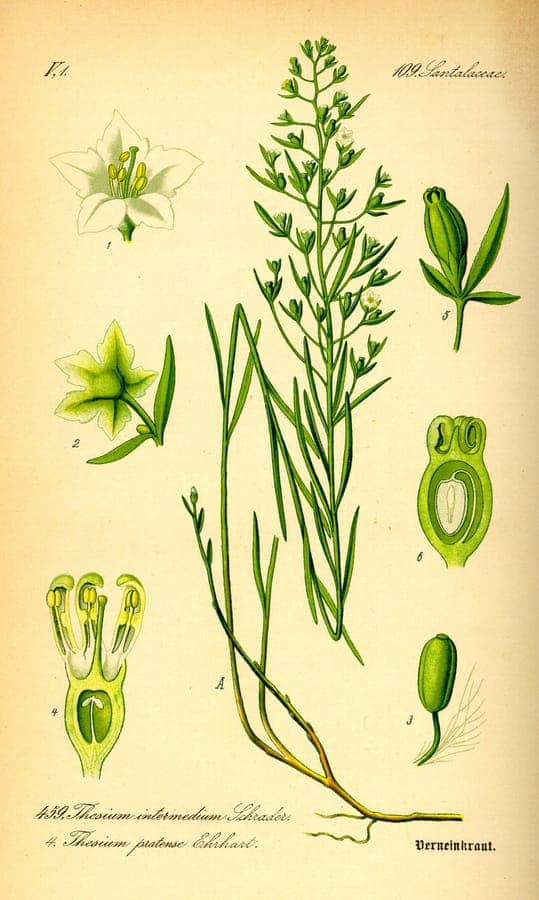
Meadow Flax (Thesium pyrenaicum) is a slender, delicate alpine plant from the Santalaceae family, naturally occurring in the Pyrenees and other mountain meadows across Western and Central Europe. This subtle plant is less well-known than bolder companions, yet offers an elegance and airiness larger plants cannot match. With fine, thin stems and small white flowers, Meadow Flax imparts an ethereal quality to alpine gardens.
Appearance and bloom
Meadow Flax is a slender, upright plant reaching only 30-50 cm tall with a very thin, branched stem system. The stems are green and appear fragile, yet are sturdy enough for their thin, linear leaves. The foliage is exceptionally fine: narrow, linear leaves of 2-4 mm width, green to grey-green in colour. In June-August, very small (3-5 mm), five-petalled white flowers appear scattered along the stems in loose, airy flower clusters. While not showy, their collective effect is subtly elegant. The seed capsules that follow are also interesting for dried flower displays.
Ideal location
Meadow Flax grows best in full sun to light shade, requiring 5 hours of direct daily sunlight. The plant tolerates dense shade poorly and will not flower. Plant on warm, southwest-facing slopes where moisture evaporation is normal. The plant prefers windy, open locations over sheltered corners, mimicking its natural mountain meadow habitat.
Soil
Meadow Flax is an acid-loving plant preferring nutrient-poor, acid soils (pH 5.0-5.5). This is absolutely critical. In neutral to alkaline gardens (pH greater than 6.5), the plant will struggle and die. Plant only in nutrient-poor sandy-gritty soils, possibly amended with peat or heather mulch. Avoid rich, compost-amended soils. The plant is a semi-parasite on other plant roots, making specific soil preparation essential.
Watering
Meadow Flax prefers dry to moderately moist conditions. Water only when soil feels completely dry (at least 5 cm depth). In typical European mountain climates with regular rainfall, supplemental watering is rarely needed. In dry summers (no rain over 3 weeks), water lightly once to keep soil moist, not wet. Overwatering is far more dangerous than underwatering.
Free design
Want to see Meadow Flax: complete guide in your garden? Make a free design now.
Pruning
Meadow Flax requires no pruning. The plant grows autonomously in an airy form. Simply remove dead stems in March. Seed capsules can be left intact for natural seed dispersal or for interesting autumn texture in the garden.
Maintenance calendar
January-February: Winter dormancy. No activity. March: Check for dead stems; remove gently if present. April-May: Plant emerges from dormancy. No intervention needed. June-August: Peak flowering period. Enjoy subtle white blooms. September-October: Seed set complete. Seed capsules begin ripening. November-December: Plant returns to dormancy. Water only in extreme drought.
Winter hardiness
Meadow Flax is winter hardy to USDA Zone 5-6 (-15 to -10 degrees C). In all Dutch, Belgian, and French gardens, the plant survives winters unprotected. In German highlands and Scandinavia, winter protection may help in severe years: apply 10 cm mulch of pine needles or heather mulch around the base in November.
Companion plants
Meadow Flax combines beautifully with other nutrient-poor, acid-loving alpine plants: Valeriana supina (Dwarf Valerian) with matching acid preference, Silene species (Catchfly) for complementary pink-white flowers, Saxifraga species (Saxifrage) for matching nutrient-poor profile, Sedum species for dry-tolerant succulents, Linaria alpina (Alpine Toadflax) for matching slender forms. Avoid heavy feeders like Syringa josikaea and Primula rosea requiring richer soils.
Closing
Meadow Flax is an elegant alpine plant for gardeners preferring subtle, airy forms on nutrient-poor acid soils. With slender stems, delicate flowers, and mountain meadow character, this plant offers uncommon charm. Correctly placed in nutrient-poor, acid soils, Meadow Flax becomes a long-lived, virtually maintenance-free addition. Use gardenworld.app to find the perfect placement for your Meadow Flax in alpine gardens.
Want to see Meadow Flax: complete guide in your garden? Make a free design now.
Upload a photo, pick a style, and get a photorealistic design with plant list in under a minute.
No credit card required


Similar plants
Juniper Dwarf Mistletoe: complete guide
Arceuthobium oxycedri
Full profile of Arceuthobium oxycedri, the juniper dwarf mistletoe: biology, host range, identification, and garden management advice.
Thesium humile: complete guide
Thesium humile
Discover Low Bastard Toadflax, a modest herb with fine foliage and tiny white flowers. Perfect wild plant for Mediterranean drought gardens.
White Osyris: complete guide
Osyris alba
Discover Osyris alba, a Mediterranean shrub with fine grey-green foliage and red berries. Ideal for dry, sunny gardens and wildlife gardens.