Emőke Dénes / CC BY-SA 4.0, via Wikimedia Commons
Crystal anthurium: caring for a velvet-leaved houseplant
Anthurium crystallinum
Want to see Crystal anthurium: caring for a velvet-leaved houseplant in your garden?
Full design in HD: €7.99
Look after your Crystal anthurium with the GardenWorld app
Identify plants with your camera and get a care calendar with reminders for this plant.


Overview
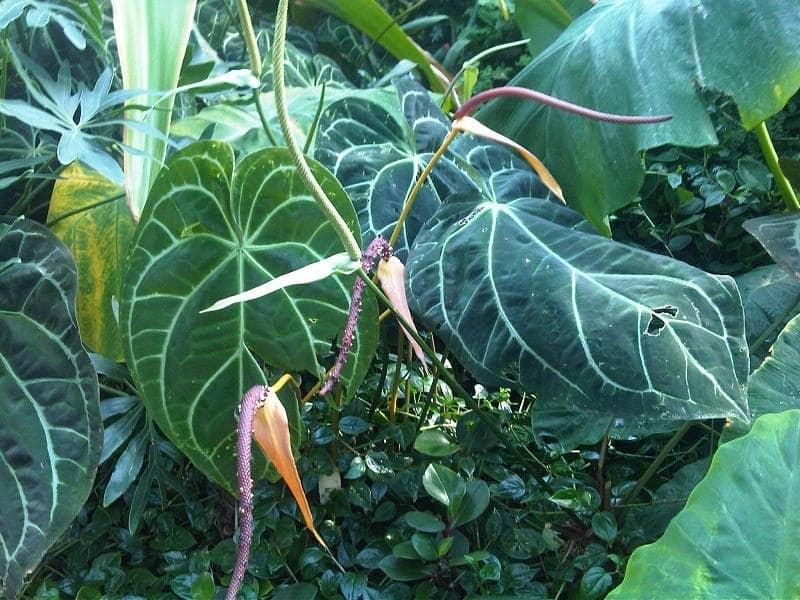
Crystal anthurium (Anthurium crystallinum) is grown for its leaves, not its flowers. Each leaf is a broad, dark green heart with a soft, velvety surface, and across it run wide silvery white veins that seem to sparkle when the light catches them. That shimmer gave the species its name: crystallinum means crystal-like. Few foliage plants look quite so much like a piece of embroidered fabric.
The species is native to the humid rainforests of Central and South America, from Panama down to Peru. In the wild it grows on the forest floor, on mossy rocks and sometimes low on tree trunks as an epiphyte, always in deep shade and in air that is almost saturated with moisture. That background explains everything it needs at home: soft light, an open, airy root run and, above all, high humidity.
Crystal anthurium is often confused with Anthurium clarinervium, a close relative with similar markings. The leaves tell them apart. On crystallinum they are larger, thinner and more elongated, whereas clarinervium has smaller, rounder hearts that feel almost like cardboard. New crystallinum leaves also unfurl in a striking bronze or pinkish copper before turning green. The familiar flamingo flower (Anthurium andraeanum) belongs to the same genus, but it is a flowering plant with quite different needs.
Appearance and flowering
Indoors, Anthurium crystallinum usually reaches 40 to 70 cm in height and a similar spread. On a well-grown plant the leaves are 20 to 40 cm long, and in a warm glasshouse they can grow larger still. They hang from long, rounded stalks and tilt slightly forwards, which shows off the pattern from above. Each new leaf emerges from a thin sheath, opens coppery red or pink, turns bronze-green and only after several weeks settles into deep velvet green with white veins.
The flowers are modest. A narrow, strap-like spathe, green to pink or purplish, sits beneath a slender spadix. In the photo you can see these narrow orange-pink spathes with purple spadices among the large leaves. Many growers cut the flower stems off early so the plant puts its energy into foliage. If you leave them, small purplish berries may follow pollination, though that rarely happens in a living room.
Position in the home
Choose a warm, settled spot away from draughts. This plant dislikes being moved around, and any sudden change in light or humidity can cost it a leaf or two. A table a little way back from a window works well, as does a bathroom with natural light. A glass cabinet fitted with a small fan is ideal if you want the leaves to stay flawless.
Keep it well away from radiators, air conditioning and doors that are opened often. Warm, dry air from heating is the quickest route to brown, crispy leaf edges. Avoid places where people or pets brush past regularly, too, because the velvety surface marks and scratches easily.
Light
Crystal anthurium needs bright but filtered light. About two metres from an east or west window suits it, or behind a sheer curtain near a south-facing window. Direct midday sun scorches the leaves within hours and leaves pale, papery patches. Too little light shows up as long, floppy stalks, smaller leaves and markings with less contrast.
In the dark months a simple LED grow light makes a real difference. Hang it 40 to 60 cm above the plant and run it for ten to twelve hours a day.
Humidity
This is the crucial point. Anthurium crystallinum grows best at 60 to 80 % relative humidity. In an ordinary living room in winter, humidity often sits around 35 to 45 %, and at that level new leaves struggle to open: they get stuck in their sheath or tear as they unfold.
A humidifier near the plant is the most reliable answer. A tray of clay pebbles and water under the pot helps a little, as does grouping plants together. Misting only has a brief effect and can leave lime marks on velvety leaves, so if you do mist, use rainwater or demineralised water. Make sure there is some air movement, though, because still, damp air in a closed cabinet encourages fungal and bacterial spots.
Free preview
Want to see Crystal anthurium: caring for a velvet-leaved houseplant in your garden? Make a free preview of your design.
Potting mix and repotting
The roots of this anthurium are thick, fleshy and need air. Standard compost packs down and holds too much water. Make your own open mix instead, for example equal parts orchid bark, coir or peat-free compost and perlite, plus a handful of horticultural charcoal.
Use a pot with good drainage holes. A clear plastic nursery pot inside a decorative outer pot lets you check on the roots. Repot in spring, roughly every two years, or when roots circle the pot, moving up only a few centimetres in diameter. Don't bury the plant deeper than before: the stem with its aerial roots should sit on or just above the surface of the mix.
Watering and feeding
Keep the mix lightly moist, never sodden and never bone dry. Water once the top 2 to 3 cm feel dry. In summer that is often once a week, in winter every ten to fourteen days. Use water at room temperature, ideally rainwater or soft water, and always let the excess drain away. Wet feet lead to root rot, which shows as yellowing lower leaves and soft stalks.
From April to September give a foliage plant feed at half strength every two weeks. Too much fertiliser builds up salts in the mix and causes brown leaf tips, so flush the pot through generously with plain water twice a year.
Propagation
The easiest ways to propagate Anthurium crystallinum are division and stem cuttings. Mature plants sometimes produce offsets at the base, which you can separate with a piece of root when repotting and pot up on their own. A plant that has become tall and bare can also be shortened: cut off a section of stem with at least one node and an aerial root, and lay it on damp sphagnum moss. Keep it warm, at 22 to 26 °C, under a clear cover. New roots appear after a few weeks, followed later by a first leaf.
Care calendar
March–April: The growing season begins. Repot if needed, start feeding and remove old, damaged leaves.
May–June: The best time to divide or take stem cuttings. Check the undersides of the leaves for thrips and spider mite.
July–August: Protect from strong sun and from heat above 30 °C. Keep humidity high and water regularly.
September–October: Reduce feeding. Get the humidifier ready for the heating season.
November–February: Water sparingly, stop feeding and add light with a grow lamp. If you like to keep everything in one place, put watering, feeding and repotting into the plant calendar on gardenworld.app.
Temperature and winter care
Crystal anthurium grows best between 20 and 27 °C. Growth stops below 16 °C, and below 12 °C the leaves and roots are damaged. It therefore stays indoors all year. A summer outside is not a good idea: wind, slugs, rain and swings between day and night temperatures all spoil the leaves. If you have a conservatory or garden room, you can have a garden design made on gardenworld.app so that indoors and outdoors flow together, with this anthurium in a warm, sheltered spot on the inside of the glass.
Toxicity to pets
The ASPCA lists anthuriums as toxic to cats and dogs. The leaves and stems contain insoluble calcium oxalate crystals. When an animal chews the plant, these needle-shaped crystals pierce the tissues of the mouth, causing burning of the mouth, tongue and lips, heavy drooling, vomiting and difficulty swallowing. Keep the plant out of reach of cats, dogs and small children, and wear gloves when taking cuttings or repotting, as the sap can irritate skin. If you notice swelling or breathing problems, contact a vet straight away.
Companion plants
Crystal anthurium looks lovely in a group with other plants that like warmth and moisture, and together they raise the humidity around one another. Peace lily (Spathiphyllum wallisii) adds calm, glossy green. Monstera adansonii brings a playful contrast with its holed leaves. Aglaonema commutatum has silvery green markings that echo the white veins. Low down at the base, the spikemoss Selaginella kraussiana thrives in the same conditions. For colour, add a red Anthurium andraeanum. Bear in mind that these companions are also toxic to pets.
Final thoughts
Crystal anthurium is not a plant for a windowsill above a radiator, but give it a warm, humid and shaded home and you will have one of the finest foliage plants there is. Every new leaf that slowly shifts from coppery pink to velvet green feels like a small reward. Provide filtered light, a loose mix, soft water and, above all, plenty of humidity, and it will keep growing steadily for many years.

See it in your garden
See Crystal anthurium in your garden
One photo of your garden and a few questions. You see the result in about a minute.
Try it with a photoIdentify this plant in your own garden. Identify a plant
Similar plants
Peace lily: complete guide
Spathiphyllum wallisii
How to grow a peace lily (Spathiphyllum wallisii): light, watering, repotting, getting it to flower again, and why it is toxic to cats and dogs.
Monstera adansonii: complete guide
Monstera adansonii
Tarovine - an elegant climbing plant with unique perforated leaves. Tropical, easy-care, and hugely popular as an indoor plant.
Chinese Evergreen: complete guide
Aglaonema commutatum
Chinese Evergreen is a popular houseplant with silver-spotted leaves. This tropical plant grows to 60 centimeters and is perfect for semi-shaded interiors. Very easy to maintain.
