Nadiatalent / CC BY-SA 4.0, via Wikimedia Commons
Velvet cardboard anthurium (Anthurium clarinervium): care
Anthurium clarinervium
Want to see Velvet cardboard anthurium (Anthurium clarinervium): care in your garden?
Full design in HD: €7.99
Look after your Velvet cardboard anthurium with the GardenWorld app
Identify plants with your camera and get a care calendar with reminders for this plant.


Overview
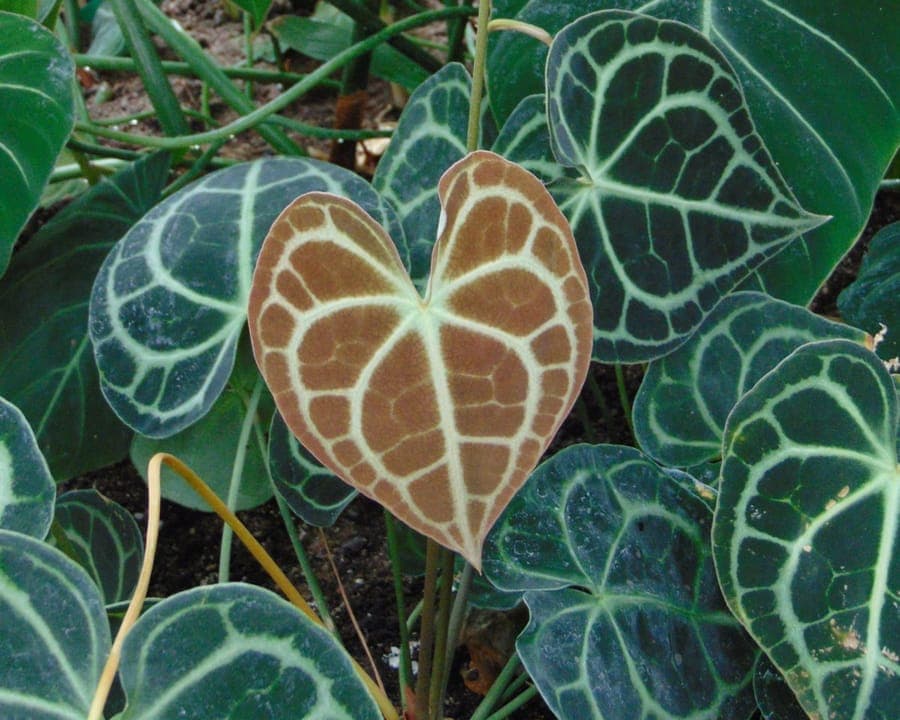
Say anthurium and most people picture the flamingo flower with its glossy red spathes. Anthurium clarinervium is a very different kind of anthurium: it is grown not for its flowers but for its leaves. They are heart-shaped, thick and stiff like card, with a dark green velvety surface on which silvery-white veins draw an almost graphic pattern. That texture explains its common name, velvet cardboard anthurium. A mature leaf looks more like something from a design studio than from a forest.
The species belongs to the arum family (Araceae) and is native to the Mexican state of Chiapas. There it grows on limestone outcrops and in the remnants of forest on those rocks, at 800 to 1,200 m. It roots into crevices and into the thin layer of humus that collects between the stones. That tells you a great deal about its care: its roots are used to plenty of air, fast drainage and an alternation of wet and dry.
Indoors it stays compact, which makes it well suited to a windowsill, a low cabinet or a glass growing cabinet. It grows slowly and needs some attention, but it is less difficult than its reputation as a collector's plant suggests.
Appearance and growth
In the wild the leaves are roughly 11 to 25 cm long and 6 to 17 cm wide; indoors they usually stay towards the smaller end. They are broadly heart-shaped with deep, rounded lobes at the base and hang from sturdy stalks of about the same length. The upper surface is matt green to almost black-green and feels velvety, while the underside is paler. New leaves often emerge copper-brown or pinkish-brown, as in the photograph, and turn green over a few weeks.
The plant forms a short, upright stem with the leaves growing closely together. A mature plant indoors reaches about 40 to 60 cm in height and spread. Aerial roots appear around the stem; leave them alone or guide them into the pot. Occasionally an inflorescence appears: a small, narrow greenish spathe with a slender spadix. It is not showy, and some growers remove it so the plant puts its energy into leaves.
Not to be confused with Anthurium crystallinum
In shops Anthurium clarinervium and Anthurium crystallinum are often mixed up, and hybrids between the two are also sold. The difference lies mainly in the leaf. In clarinervium it is thick, stiff and nearly as wide as it is long, with a pronounced heart shape. In crystallinum it is thinner, more pliable and clearly longer than wide, and it hangs down more. If in doubt, check the label from a reliable grower and feel the leaf: card or paper.
Position in the home
Anthurium clarinervium wants warmth without fluctuations. The ideal range is 18 to 28 °C, and below 15 °C it starts to suffer. Keep it away from cold windows in winter, doors that are often opened and the direct airflow from a radiator or air conditioning unit.
An east-facing windowsill, a plant table near a bright window or a lit growing cabinet are all good spots. Do not turn the pot too often: the leaves orient themselves towards the light and need time to readjust.
Light
Give it bright, indirect light. Where the plant can see the sky but the sun does not fall directly on the leaves, it grows compact and produces large, well-marked foliage. A little early morning sun is fine. Strong midday or afternoon sun burns pale, dry patches into the dark leaves.
You can spot too little light by long, thin leaf stalks, small leaves and a plant leaning towards the window. A grow light is a useful addition in the darker months.
Free preview
Want to see Velvet cardboard anthurium (Anthurium clarinervium): care in your garden? Make a free preview of your design.
Watering
The roots of this species dislike standing water. Water only when the top 3 cm of the mix is dry, then water thoroughly until it drains from the bottom. In summer that usually means every five to seven days, in winter every ten to fourteen days, depending on the temperature and the pot.
Ideally use rainwater or filtered water at room temperature. Drooping, limp leaves can point to either too dry or too wet conditions, so always feel the mix before you water.
Humidity
Humidity of 50 to 70 % keeps the leaf edges intact and helps new leaves unfurl smoothly. In a dry living room in winter, a new leaf may stick or develop brown edges. A humidifier is the best help then. Do not mist the velvety leaves, as it leaves marks and can encourage fungal problems.
Compost and repotting
Ordinary compost is too dense. Mix an airy substrate of roughly half coarse orchid bark, a quarter perlite or pumice and a quarter coir or peat-free houseplant compost, with a handful of horticultural charcoal if you have it. Water should run through quickly while the bark holds enough moisture.
Choose a pot that is just big enough for the roots, ideally with plenty of drainage holes. Repot every two years in spring, or when the bark has broken down and the mix has settled. From April to September feed every three to four weeks with a well-diluted liquid fertiliser, as the roots are sensitive to salt build-up. Flush the mix through with rainwater now and then.
Propagation
After a few years the plant sometimes forms side shoots at its base. These can be removed with their own piece of root when you repot and potted up separately. An older plant with a long, bare stem can also be renewed by cutting off the top just below a few aerial roots and letting it root in damp sphagnum moss. The old stem section often then produces new shoots. Seed is another option, but it only forms after hand pollination and young seedlings are slow.
Care calendar
March and April: repot if the bark has broken down and remove side shoots. Start feeding.
May to August: growing season. Water regularly, feed at low strength and keep an eye on humidity.
September: final feed. Check for scale insects, mealybug and thrips.
October to February: water less, stop feeding and keep it in a warm, bright spot away from cold glass.
The plant calendar on gardenworld.app can nudge you when it is time to repot or feed.
Toxicity to pets
Like all anthuriums, Anthurium clarinervium contains needle-shaped calcium oxalate crystals. If a cat or dog chews a leaf, the crystals pierce the lining of the mouth and throat. The result is burning pain, drooling, pawing at the mouth, vomiting and difficulty swallowing. It usually passes quickly, but call your vet if the mouth swells, drooling continues or the animal struggles to breathe. The sap also irritates the mouth and skin in people. Keep the plant out of reach of pets and children.
Companion plants
This anthurium shows off well beside plants with very different leaves. Its familiar relative, the flamingo flower (Anthurium andraeanum), adds colour with red or pink spathes. An Aglaonema commutatum has long, silver-marked leaves that echo the white veins quietly. The Chinese money plant (Pilea peperomioides) gives a playful contrast with its round leaves, and a staghorn fern (Platycerium bifurcatum) on the wall turns the corner into a small indoor forest.
If you would like something outdoors with the same graphic character, you can have a garden design made on gardenworld.app that ties in with your interior.
Final thoughts
Anthurium clarinervium is a plant for anyone who loves strong shapes and crisp patterns. Give it bright indirect light, an airy, bark-rich mix, water only when the top layer is dry, and steady warmth. Keep it out of reach of pets. In return it slowly grows into a compact plant with dozens of velvety hearts.

See it in your garden
See Velvet cardboard anthurium in your garden
One photo of your garden and a few questions. You see the result in about a minute.
Try it with a photoIdentify this plant in your own garden. Identify a plant
Similar plants
Flamingo-lily: complete guide
Anthurium andraeanum
Discover Anthurium andraeanum - a stunning tropical houseplant with iconic red heart-shaped flowers. Our complete care guide covers watering, humidity, propagation, and interior styling.
Chinese Evergreen: complete guide
Aglaonema commutatum
Chinese Evergreen is a popular houseplant with silver-spotted leaves. This tropical plant grows to 60 centimeters and is perfect for semi-shaded interiors. Very easy to maintain.
Chinese Money Plant: complete guide
Pilea peperomioides
Chinese Money Plant (Pilea peperomioides) is a trendy houseplant from China featuring distinctive round, mint-green leaves. This Instagram-famous plant has become a favorite for modern homes with its elegant appearance and easy-care nature.
