GooseSpoon / CC BY-SA 4.0, via Wikimedia Commons
Summer snapdragon (Angelonia angustifolia): complete guide
Angelonia angustifolia
Want to see Summer snapdragon (Angelonia angustifolia): complete guide in your garden?
Full design in HD: €7.99
Look after your Summer snapdragon with the GardenWorld app
Identify plants with your camera and get a care calendar with reminders for this plant.


Overview
Summer snapdragon (Angelonia angustifolia) is a bedding plant that truly comes into its own when summer is at its hottest. While other bedding plants flag in a heatwave, angelonia stands tall with slender spikes of purple, pink or white flowers. It looks a little like a small snapdragon, but it is not a close relative, and it copes with heat and a dry week far better.
Angelonia angustifolia belongs to the plantain family (Plantaginaceae) and originally comes from Mexico and the Caribbean. In its native range it is a short-lived perennial reaching about a metre tall. The species name angustifolia means narrow-leaved, which you can see straight away in its long, slender leaves. In Britain and north-western Europe it is not hardy, so it is grown as an annual for beds and containers.
The choice of varieties has grown a great deal in recent years. Seed-raised types such as the compact Serena series (30 to 40 cm) are ideal for bedding and window boxes. Taller types raised from cuttings, such as the Angelface and Archangel series, reach 40 to 60 cm and have larger flowers. Some varieties are lightly scented, often described as a sweet, grape-like fragrance. On gardenworld.app you can have a garden design made that finds the right home for angelonia, whether in a sunny border, a patio container or a bed by the front door.
Appearance and bloom cycle
Angelonia grows upright and forms a bushy plant with several stems. The leaves are arranged in opposite pairs, lance-shaped, 3 to 7 cm long and sometimes slightly toothed. Leaves and stems are covered in fine glandular hairs, which make them feel a little sticky.
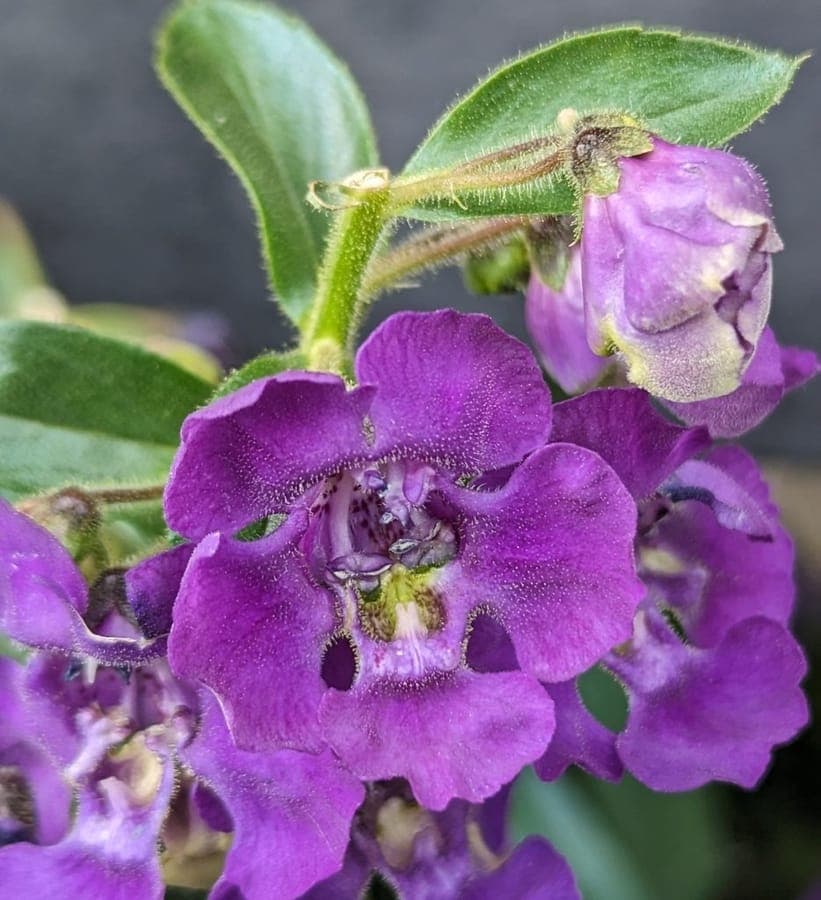
The flowers are carried in upright spikes 15 to 25 cm long at the tips of the stems. Each flower is 1.5 to 2 cm across and two-lipped, with a rounded lower lip and a small pouch in the throat. The photo shows a purple flower up close: broad, velvety lips, a dark-speckled throat and, above it, a hairy leaf and a bud still to open. Colours range from deep purple and lavender to pink, white and bicolours.
In its native range angelonia has a special relationship with its pollinators: the pouch in the flower produces oil, which is collected by specialist bees. In our gardens, bumblebees and other bees visit the flowers.
Flowering starts in June and, in warm weather, carries on without a break until the first frost. Spent flowers usually drop on their own. Angelonia also makes a lovely cut flower: the spikes stay fresh in a vase for about a week.
Ideal location
Give angelonia the warmest, sunniest spot you have. Full sun is essential: at least six hours of direct sun a day, and more is better. A south-facing border, a paved patio that holds the heat or a container against a sunny wall is ideal. In partial shade it grows weak and flowers poorly.
The plant loves warmth, and you will notice that in a cool summer. When nights drop below 10 °C it more or less stands still, and if it goes out in a cold, wet spring it hardly grows at all. So do not plant out too early. Its sturdy stems cope reasonably well with wind, and rain damages the flowers less than it does with many other summer bedding plants.
Use angelonia in groups in a bed, as mid-height planting in a border, or as the upright centrepiece of a large pot. Space plants 25 to 30 cm apart.
Compost and soil
In containers, use a good, open multipurpose compost for flowering plants. In open ground angelonia wants free-draining, moderately fertile soil. Sandy soil and light loam are ideal. On heavy clay, work some compost and coarse grit into the top layer to avoid waterlogged roots. Slightly acidic to neutral soil suits it best.
A drainage hole and a layer of crocks in containers are important. Angelonia tolerates a short dry spell better than standing water.
Free preview
Want to see Summer snapdragon (Angelonia angustifolia): complete guide in your garden? Make a free preview of your design.
Watering and feeding
Once well established in the ground, angelonia is fairly drought tolerant. Water regularly for the first few weeks after planting, then only during longer dry spells. When you do water, give a good soak rather than a little every day.
In containers the compost naturally dries out faster. Water when the top 2 to 3 cm feel dry; on hot days that may be daily. Do not leave water standing in the saucer.
From June to the end of August, give a liquid feed for flowering plants every fortnight. In open ground, a granular fertiliser at planting time is enough. Too much nitrogen leads to long stems that flop over.
Pruning and pinching
Angelonia needs little pruning. Pinch out young plants once after planting so they branch better. Snip off faded spikes just above a pair of leaves to encourage new flowering side shoots. If the plant becomes too tall or a little bare in midsummer, cut it back by a third. Two or three weeks later it will be flowering again.
Angelonia rarely suffers from disease. In a cold, wet spell grey mould or root rot can appear, and aphids and red spider mite sometimes turn up in hot, dry weather. A warm, airy position prevents most problems.
Maintenance calendar
March-April: Sow indoors at 20 to 25 °C if you want to raise your own plants. The seed is fine and needs light to germinate. Grow the seedlings on somewhere warm and bright.
Late May-June: Only plant angelonia outside once nights stay above 10 °C, usually from late May or early June. Pinch out the young plants once.
July-August: Full flower. Snip off faded spikes, water during dry spells and feed every fortnight. Cut a few spikes for the vase as well.
September: Flowering continues. Stop feeding.
October: The first frost brings the season to an end. Clear the plants away, or bring them indoors if you want to overwinter them.
November-February: Overwinter somewhere bright and fairly warm, or start again with new plants next spring.
Winter hardiness and overwintering
Angelonia angustifolia is not hardy at all. The plant starts to suffer from around 5 °C, and it will not survive frost. In the UK and the Low Countries it is therefore grown as an annual.
Overwintering is possible, but tricky and rarely worth the effort. Before the first cold night, bring the plant indoors to a bright spot at 10 to 15 °C, cut it back by half and water sparingly. In a warm, dim living room it soon attracts aphids and becomes weak. Most gardeners buy new plants each spring or raise their own from seed.
Angelonia is not known to be toxic to people or pets. There are no reports of poisoning, but as with any ornamental plant it is best to stop children and animals from eating it.
Companion plants
With its upright spikes, angelonia brings vertical lines to a bed or pot. It combines beautifully with other heat-loving plants. Mealy sage (Salvia farinacea) has the same shape and the same needs; purple angelonia and blue salvia together create a cool, calm picture. For a cheerful contrast, add zinnias (Zinnia elegans) in orange or yellow.
In a border, Verbena bonariensis makes an airy, tall partner behind angelonia. Euphorbia hypericifolia, with its cloud of tiny white flowers, fills out pots and troughs around angelonia nicely. An ornamental grass such as Pennisetum villosum adds movement and softness.
Avoid partners that need shade and plenty of moisture, such as busy Lizzies or shade-loving begonias, as their needs do not match those of angelonia.
Final thoughts
Angelonia is the summer flower for hot spots where other plants give up. Full sun, free-draining soil, not planting out too early and snipping off the odd faded spike are all it asks. In return you get slender flower spikes from June to October that you can even bring indoors for a vase.
The planting calendar on gardenworld.app shows when to sow angelonia and when the nights are warm enough to plant it out. This year, choose the sunniest spot in your garden or on your patio for a group of angelonia and enjoy its purple spikes all summer long.
Frequently asked questions about Summer snapdragon
Is Summer snapdragon winter hardy?
Angelonia angustifolia is not hardy at all. The plant starts to suffer from around 5 °C, and it will not survive frost.
When and how do you prune Summer snapdragon?
Angelonia needs little pruning. Pinch out young plants once after planting so they branch better.
How much water does Summer snapdragon need?
Once well established in the ground, angelonia is fairly drought tolerant. Water regularly for the first few weeks after planting, then only during longer dry spells.
Where does Summer snapdragon grow best?
Give angelonia the warmest, sunniest spot you have. Full sun is essential: at least six hours of direct sun a day, and more is better.

See it in your garden
See Summer snapdragon in your garden
One photo of your garden and a few questions. You see the result in about a minute.
Try it with a photoIdentify this plant in your own garden. Identify a plant
Similar plants
Mealy sage (Salvia farinacea): complete guide
Salvia farinacea
Discover the beautiful mealy sage (Salvia farinacea). Elegant plant with purple-blue flowers. Perfect for sunny borders, cut flowers and long-blooming displays in temperate gardens.
Zinnia elegans: complete guide
Zinnia elegans Jacq.
Discover elegant zinnia - a blooming classic in every color. Cultivation, maintenance and advice for extended summer flowering.
Argentine vervain: complete guide
Verbena bonariensis
Discover how to grow Verbena bonariensis: ideal conditions, pruning tips, hardiness and plant partners. Perfect for wildlife gardens in USDA zones 7-11.
