
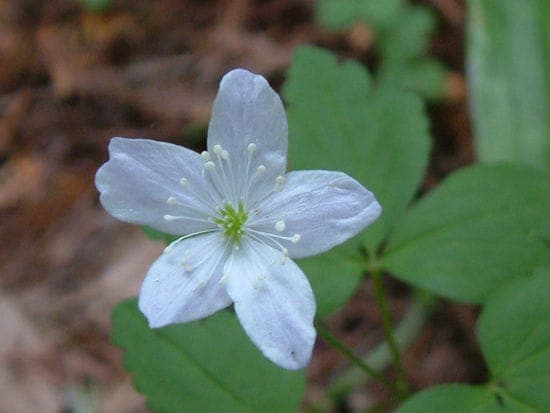
Wikimedia Commons / Public domain, via Wikimedia Commons
Wood anemone: complete guide
Anemone quinquefolia
Want to see Wood anemone: complete guide in your garden?
1 minute, no credit card
Overview
The wood anemone (Anemone quinquefolia) is a delicate spring-flowering plant from the Ranunculaceae family. This North American woodland plant is highly suitable for shaded spots where other flowers struggle. It is known for its white flowers and elegant foliage.
Originally from eastern North America, this plant grows on forest floors and along woodland streams. It forms beautiful woodland carpets beneath trees. For those wanting to create a true woodland garden, this plant is an authentic choice.
Appearance and bloom cycle
The wood anemone grows low, usually not more than 15-25 cm tall. The leaves are elegantly five-divided (hence the botanical name quinquefolia), giving fine, lacy texture. In spring, slender white flowers appear on delicate stems.
The flowers are white to pale pink, approximately 2 cm in diameter, with 6-8 petals surrounding a central mass of stamens. It blooms in April-May depending on location. The bloom period is relatively short, only a few weeks, so plant in groups for effect.
Explore gardenworld.app for woodland garden designs.
Ideal location
The wood anemone grew beneath trees and prefers full to partial shade. Minimum 2-3 hours of indirect light is sufficient. In full sunlight the plant struggles; foliage can scorch.
Best results occur under deciduous trees where winter and spring sun penetrates but summer shade prevails. Avoid warm, dry spots. Along paths in woodland settings or beneath shrubs is ideal.
Soil requirements
The wood anemone thrives best in humus-rich, well-draining soil. Add plenty of compost or leaf mulch at planting. The plant loves slightly acidic to neutral pH (pH 6.0-7.0).
It adapts well to forest conditions. Good drainage is essential; compacted, wet soil leads to poor growth. Rich woodland soil is ideal.
Free design
Want to see Wood anemone: complete guide in your garden? Make a free design now.
Watering
Provide regular moisture during the growing period (January to June). Water well after planting and during the first growing period. Once established and after foliage dies back (June), little water is needed.
In natural conditions it receives water from rainfall. In gardens, water if rainfall is less than 2.5 cm per week. Summer drought can be problematic; mulch helps retain moisture.
Pruning
No pruning needed. Leave dead foliage in place. This slowly converts to humus and adds nutrients to soil. Spent flowers can be removed for tidiness.
The plant goes dormant after flowering on its own. No intervention needed.
Maintenance calendar
March-April: Flowering. Water regularly.
May-June: Foliage gradually dies back. Continue watering.
July-October: Rest period underground. No visible activity.
November-February: Dormancy. Cold required for next spring.
Winter hardiness
The wood anemone is very hardy to USDA zone 3 (-40°C). All temperate winters are not a problem. The plant survives without protection.
Indeed cold and any snow help the plant; it requires cold for good spring emergence. No mulching needed.
Companion plants
The wood anemone combines beautifully with other spring woodland plants like bloodroot (Sanguinaria canadensis), trillium, and wild strawberry. With dark-leaved hostas or hellebores it creates contrast.
Plant in groups for natural effect. The growing foliage of other plants can hide the yellowing leaves of anemone.
Closing
The wood anemone offers elegant white flowers at exactly the right time of spring for woodland settings. For those loving shade gardens, this plant is a must. On gardenworld.app discover how woodland flora can enrich your garden.
Want to see Wood anemone: complete guide in your garden? Make a free design now.
Upload a photo, pick a style, and get a photorealistic design with plant list in under a minute.
No credit card required


Similar plants
Drummond's anemone: complete guide
Anemone drummondii
Discover Drummond's anemone (Anemone drummondii): a silvery-grey mountain plant for cool rock gardens and alpine troughs.
Korean clematis: complete guide
Clematis serratifolia
Clematis serratifolia is a hardy climber with fragrant yellow bell flowers in August-September. Pruning group 3, location and care tips.
Aquilegia brevistyla: complete guide
Aquilegia brevistyla
Discover Aquilegia brevistyla, the elegant North American columbine. Growing tips, shade tolerance, and design ideas for woodland and shadowed gardens.