
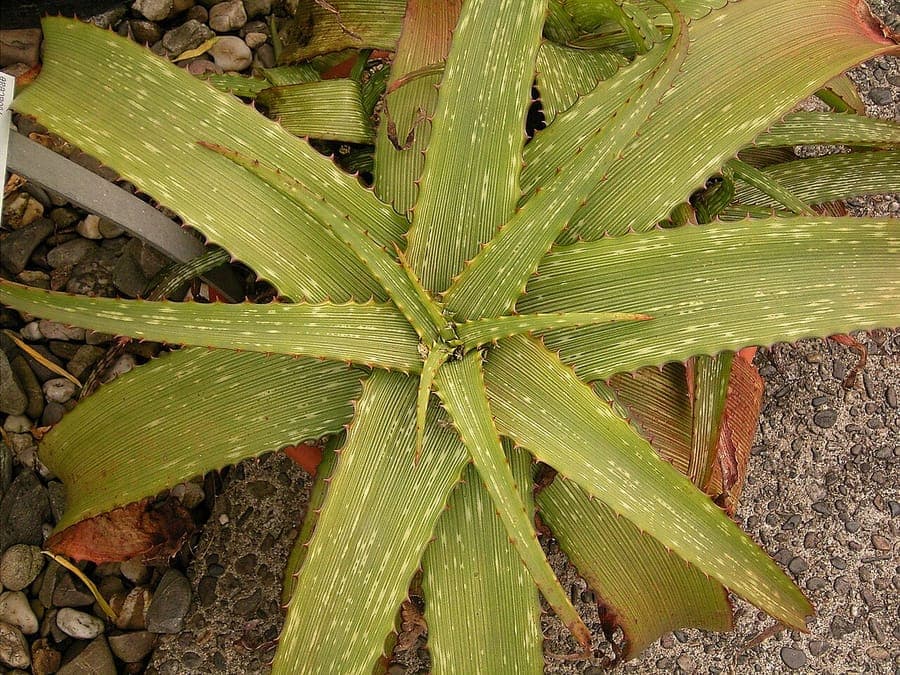
Frank Vincentz / CC BY-SA 3.0, via Wikimedia Commons
Kanniedood Aloe (Aloe grandidentata): complete guide
Aloe grandidentata
Want to see Kanniedood Aloe (Aloe grandidentata): complete guide in your garden?
1 minute, no credit card
Overview
Aloe grandidentata, commonly known as Kanniedood Aloe or Grande Tooth Aloe, is a fascinating succulent from the Asphodelaceae family. Native to South Africa, it thrives in dry savanna landscapes and rocky terrain. The Kanniedood Aloe is highly popular as an ornamental succulent due to its distinctive leaf edges and decorative appearance.
The plant is extremely drought-tolerant and can survive long periods without water. This makes it ideal for xeric gardens, water-conservation gardens, and container cultivation. The plant is also very low-maintenance, making it suitable for beginners.
Appearance and Bloom
Kanniedood Aloe forms rosettes of thick, succulent leaves that are greenish to blue-green. The leaves have characteristic large teeth along the edges, giving it a distinctive American appearance. The plant typically grows 30-50 centimeters tall and 40-60 centimeters wide.
Flowers appear in spring and early summer in yellow to yellow-orange colors, grouped in flower spikes atop tall stems. These flower spikes can be very spectacular and attract many insects. After flowering, the plant can go a long time without blooming again.
Ideal Location
Kanniedood Aloe needs a very sunny location. The plant requires at least 6-8 hours of direct sunlight daily for optimal growth and blooming. In very hot climates, some afternoon shade is welcome.
Use Kanniedood Aloe in dry borders, on rocky slopes, in xeriscape gardens, or in pots on patios and balconies. The plant combines well with other South African succulents and drought-tolerant plants.
Soil
Kanniedood Aloe requires very well-draining soil. Sandy, gravelly, or gritty soils are ideal. Add extra sand or perlite to garden soil if it's too heavy and clayey. In containers, use special cactus or succulent soil with extra sand for additional drainage.
Soil pH can be neutral to slightly alkaline. Poor soils are not a problem for this plant - it even grows better in less fertile conditions.
Watering
Kanniedood Aloe is extremely drought-tolerant and requires minimal water. Water only when soil is completely dry, usually once every two weeks during growing season. In winter, when the plant is dormant, water can be drastically reduced.
Overwatering is a much bigger problem than underwatering for this plant. Ensure water doesn't collect in the rosette, which can cause heart rot. Heavy rains in the garden may be sufficient without supplemental watering.
Free design
Want to see Kanniedood Aloe (Aloe grandidentata): complete guide in your garden? Make a free design now.
Pruning
Kanniedood Aloe requires virtually no pruning. Remove only dead or rotting leaves at the base of the rosette. Flower stalks can be removed if you don't want to collect seeds, but this is optional.
If the plant becomes too large, young offsets can be removed and potted separately for propagation.
Maintenance Calendar
In spring (March-April), flowers begin to appear. This is a fascinating period. In May-June, flowers fade and seeds begin to set. Water the plant minimally during this period.
In July-August the plant grows. In September-October some leaves may turn slightly yellow, which is normal. From November to February the plant is dormant with minimal water needs.
Winter Hardiness
Kanniedood Aloe is moderately winter hardy and can tolerate down to approximately -5°C, though this depends on frost duration. In very cold climates (below -10°C), it's better to keep the plant in a pot and move to a sheltered or frost-free location.
In temperate climates without harsh frost, the plant can stay outdoors. In regions with night frosts, provide some protection.
Companion Plants
Kanniedood Aloe works well with other South African succulents and drought-tolerant plants like Haworthia, Gasteria, and other aloe species. Other succulents like sedums and echeveria also combine well. Fine-stemmed grasses like Festuca can provide nice contrast.
Avoid wet soils and moisture-loving plants in the immediate vicinity.
Final Thoughts
Kanniedood Aloe is an excellent choice for xeric gardens and for beginners with succulents. With its distinctive leaf edges, spectacular blooms, and very low maintenance needs, it's a plant that offers great rewards with minimal effort. The plant is sometimes available at garden centers.
Whether creating a xeriscape garden, planting a balcony succulent garden, or simply looking for an interesting succulent, Kanniedood Aloe is a pleasant choice. Visit gardenworld.app and gardenworld.app for more inspiration and plant combinations.
Want to see Kanniedood Aloe (Aloe grandidentata): complete guide in your garden? Make a free design now.
Upload a photo, pick a style, and get a photorealistic design with plant list in under a minute.
No credit card required


Similar plants
Aloe castanea: complete guide
Aloe castanea
Discover Chestnut aloe, a South African succulent. Growth, nutrition, and garden integration for warm climates and container culture.
Aloe pratensis: complete guide
Aloe pratensis
Learn how to grow Meadow aloe, a South African succulent. Nutrition, propagation, and front yard integration for warm climates or containers.
Pretoria aloe: complete guide
Aloe pretoriensis
Discover Aloe pretoriensis, an elegant South African succulent with striking red blooms. Learn care tips, ideal conditions, and companion planting for this hardy, drought-tolerant plant.