
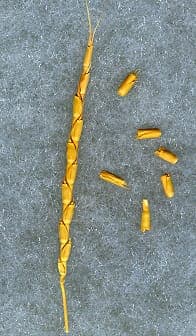
The original uploader was Marknesbitt at English Wikipedia. (January 2006). Later uploaded by Jeannot12 at fr.wikipedia (December 2006) / Public domain, via Wikimedia Commons
Aegilops tauschii: complete guide
Aegilops tauschii
Want to see Aegilops tauschii: complete guide in your garden?
1 minute, no credit card
Overview
Aegilops tauschii, commonly known as Tausch's goat grass or rough-spike hard grass, is a fascinating grass species naturally occurring from Crimea to Eastern Turkey and China. This robust grass belongs to the Poaceae family and has spread across large parts of the world, with introductions in Arizona, California, and New York. With its characteristic growth pattern and adapted survival skills, it offers an interesting choice for gardeners seeking sustainable and versatile plant species.
The plant holds significant scientific value in agricultural and natural studies. As part of the Aegilops genus, this species plays an important role in grass genetics and genomic research. For home gardeners, Aegilops tauschii provides a unique opportunity to integrate a wild grass species that is just as interesting as many domestic grass varieties.
Appearance and bloom
Aegilops tauschii is a remarkable grass species with distinctive morphology. The plant reaches an average height typical of grass shoots, with long, fine leaves growing in bundles. The leaves display a linear form and give the plant an elegant appearance. The foliage of Aegilops tauschii shows a fine texture with a grey-green color.
The flowering structure is particularly interesting: the plant produces spikelets with distinctive, rough spikes or "awns" that manifest in May and June. These spikes are highly characteristic of the Aegilops genus and give the grass a rough, primitive appearance that you immediately recognize in the field. Fruit formation follows after flowering, and seed dispersal occurs through these distinctive spikes.
Ideal location
Aegilops tauschii grows best in locations with full sun exposure. This means the plant needs at least six to eight hours of direct sunlight daily to grow optimally. The sun helps strengthen the plant and increases resistance to diseases and pests.
The plant is highly adaptive to various climate zones and can grow in both temperate and semi-arid climates. This makes it excellent for gardens in countries like the Netherlands, Belgium, and Germany, where the climate is more humid, as well as for warmer regions in Europe. In cold winter periods, the plant may die, but this depends on the specific winter hardiness of your region.
Soil
One of the major advantages of Aegilops tauschii is that it is highly tolerant of various soil types. The plant thrives well on poor, dry soils where many other plant species struggle. This is a great advantage in gardens with less fertile or depleted soil.
The plant prefers well-draining soils but can also survive on heavy, compacted soils. Especially in urban areas where soil is often compacted, Aegilops tauschii proves its worth. It is an excellent species for erosion control and stabilizing slopes. The plant is not fussy about soil pH, although it grows best on neutral to slightly acidic soils.
Free design
Want to see Aegilops tauschii: complete guide in your garden? Make a free design now.
Watering
Once established, Aegilops tauschii is highly drought tolerant. This is one of the biggest advantages of the plant material, especially for gardeners in humid climates where drought is not a realistic problem. During planting, the soil should be kept moist until roots are well established.
During the growing season, the grass requires limited water, depending on rainfall and temperature. In dry periods, you can provide supplemental water, although this is not strictly necessary. The plant has very low water requirements and is excellent for water-scarce gardens and sustainable gardening.
Pruning
Aegilops tauschii is an easy-to-manage plant regarding pruning. In early spring, you can remove dead leaves from the previous season. This is best done in March or April, before new growth begins.
The plant does not grow in a way that requires regular pruning. The grass grows at its own pace and does not form an uncontrollable mass. Let the plant retain its natural form; this gives the best effects in the garden. If the plant becomes too large or grows out of place, you can trim the grass, but this is rarely necessary.
Maintenance calendar
March-April: Remove dead leaves and inspect for diseases May-June: Enjoy the bloom and observe the characteristic spikes July-October: Minimal maintenance needed; water only during extreme drought November-February: Plant rests; no maintenance needed except frost protection in very cold regions
Winter hardiness
Aegilops tauschii is reasonably hardy and can survive in most European gardens. The plant originates from a climate with harsh winters in areas like Crimea and the Caucasus, so it has some cold tolerance. In the Netherlands, Belgium, and France, the plant should be able to overwinter without special protection.
In very severe winters or in the far north, some plants may die. This depends on the exact origin of the seed or plant material. Young plants are more susceptible to frost damage than established specimens, so protect them well in their first year.
Companion plants
Aegilops tauschii combines well with other drought-tolerant plants and grasses. For instance, if you want to create a xeriscaping garden, this grass pairs beautifully with other Poaceae family species or with other sustainable plant species.
The plant also works well as underplanting for shrubs and low trees that need the same sun exposure. Due to the fine texture of the grass, it can provide attractive contrast with broader-leaved plants. In a wildflower garden with local or adapted plant species, Aegilops tauschii fits perfectly.
Closing
Aegilops tauschii is an excellent choice for gardeners wanting something different from typical ornamental grasses. With its robustness, drought tolerance, and distinctive appearance, the grass offers many benefits. Despite its wild origins, it is easy to grow and requires minimal maintenance. For sustainable gardening, erosion control, or simply as botanical interest, this grass deserves your attention. Find more information and plant material from specialized nurseries and garden centers. Discover the possibilities of this special grass on gardenworld.app and create your dream garden.
Want to see Aegilops tauschii: complete guide in your garden? Make a free design now.
Upload a photo, pick a style, and get a photorealistic design with plant list in under a minute.
No credit card required


Similar plants
Sporobolus pungens: complete guide
Sporobolus pungens
Sporobolus pungens is a stoloniferous Mediterranean coastal grass with outstanding salt and drought tolerance, perfect for seaside and dry gardens.
Mediterranean aegilops: complete guide
Aegilops biuncialis
Everything about Aegilops biuncialis, a Mediterranean annual grass with ornamental spikes and outstanding drought tolerance for dry gardens.
Silver bluestem: complete guide
Bothriochloa saccharoides
Full guide to Bothriochloa saccharoides (silver bluestem): site, soil, watering, winter hardiness, pruning, and garden companions.