
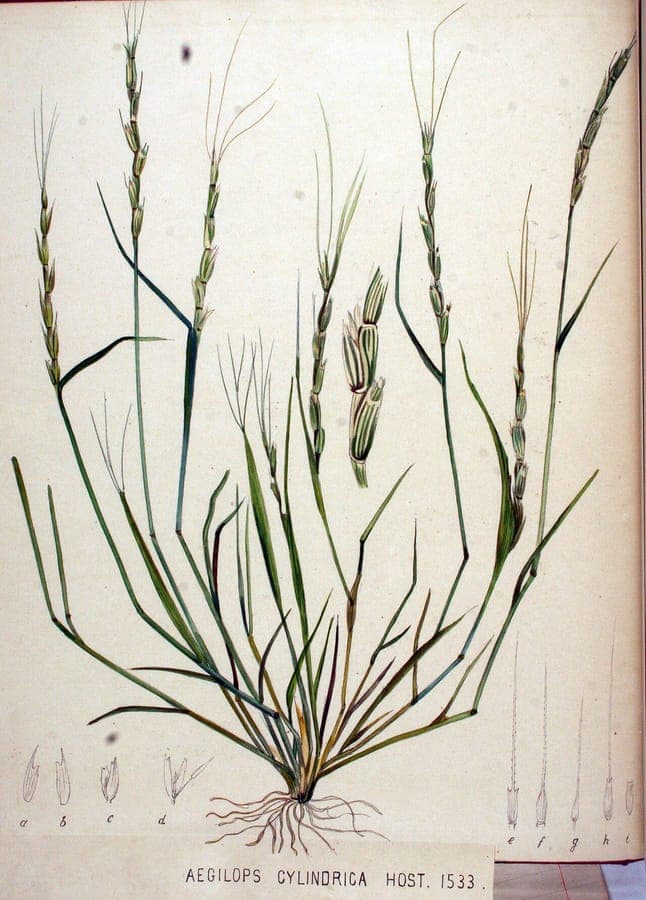
Jan Kops / Public domain, via Wikimedia Commons
Jointed goat grass: complete guide
Aegilops cylindrica
Want to see Jointed goat grass: complete guide in your garden?
1 minute, no credit card
Overview
Aegilops cylindrica, commonly known as jointed goat grass or jointgrass, is a grass species from Poaceae family. Native from East-Central Europe to Central Asia and Pakistan, this plant has become established as invasive outside its native range.
Appearance and characteristics
Jointed goat grass grows as annual or winter-annual reaching 30-60 cm tall. The plant forms loose tufts with narrow leaves. Characteristic inflorescence consists of square spikes with short lateral spikelets. Each spikelet typically contains two florets with long awns.
Ideal location
This species thrives in dry to moderately moist sites. It grows in full sun to partial shade. Robust plant tolerating diverse soils. Particularly problematic in grasslands, crop fields, and abandoned areas.
Soil requirements
Jointed goat grass grows on diverse soils, from acidic to basic. Tolerates poor soils effectively. Sandy, silty, or clay soils all suitable. Well-draining to moderately moist preferred. Compacted soils may limit growth.
Watering
Jointed goat grass tolerates drought well after establishment. Seedlings require moderate moisture for germination. Established plants largely self-sufficient. Moderate rainfall usually sufficient in temperate zones.
Free design
Want to see Jointed goat grass: complete guide in your garden? Make a free design now.
Management
Manual removal effective for small populations. Herbicides can be effective if properly applied. Regular mowing prevents seed production. Prevention better than management. Clean seed certification essential for agriculture.
Maintenance calendar
Spring: Detection and early control. Summer: Prevent seed set. Autumn: Clean agricultural practices. Winter: Minimal action needed.
Ecological significance
Classified as invasive species in North America and elsewhere. Competes with native grassland species. Livestock avoid grazing on plants. Seeds persist several years in soil.
Prevention strategies
Avoidance of invasion is best policy. Quarantine measures in infested areas. Equipment cleaning and sterilization. Farmer education on identification crucial.
Final thoughts
Jointed goat grass is a significant invasive weed in many world regions. Early detection and control essential to prevent spread. Vigilance with seed imports and agricultural practices important.
Information available through agricultural extension services.
Want to see Jointed goat grass: complete guide in your garden? Make a free design now.
Upload a photo, pick a style, and get a photorealistic design with plant list in under a minute.
No credit card required


Similar plants
Sporobolus pungens: complete guide
Sporobolus pungens
Sporobolus pungens is a stoloniferous Mediterranean coastal grass with outstanding salt and drought tolerance, perfect for seaside and dry gardens.
Mediterranean aegilops: complete guide
Aegilops biuncialis
Everything about Aegilops biuncialis, a Mediterranean annual grass with ornamental spikes and outstanding drought tolerance for dry gardens.
Silver bluestem: complete guide
Bothriochloa saccharoides
Full guide to Bothriochloa saccharoides (silver bluestem): site, soil, watering, winter hardiness, pruning, and garden companions.