
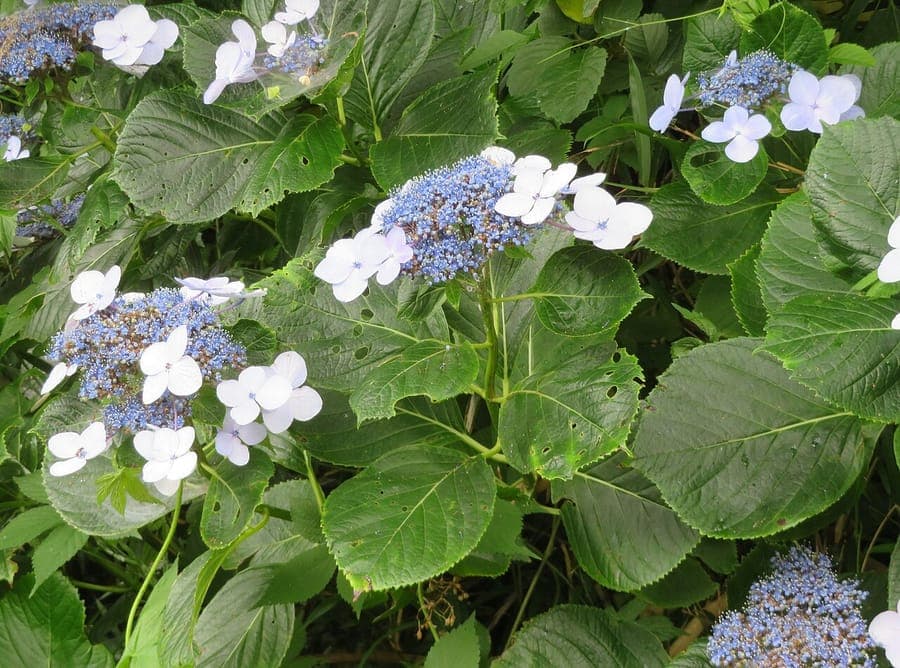
How to prune hortensia serrata: guide for mountain hydrangea
By the GardenWorld editorial team, updated on
Want to see this in your garden?
Full design in HD: €7.99
What is hortensia serrata?
Hortensia serrata, also called mountain hydrangea or Japanese hydrangea, is a more delicate version than the large hydrangeas most gardens grow. This shrub stays compact, reaches only 1-1.5 metres tall, and produces finer flowers in lovely pink and blue tones. It resembles hortensia aspera but serrata is even more fragile and blooms earlier in the season.
This makes serrata ideal for smaller gardens and borders. But here is the catch: the pruning technique is completely different from large panicle hydrangeas. Wrong pruning means almost no flowers next summer, because serrata blooms on old wood from the previous year.
Why serrata is different
Many gardeners prune all hydrangeas the same way: hard pruning in spring. This works for panicle types that bloom on new growth. Serrata makes flowers on old wood. This means spring pruning wipes out all next summer's flowers. So you face a choice: no pruning, or accept fewer flowers.
This is frustrating, but there is a clever middle path: light pruning after bloom.
The right pruning timing: August, not March
The big mistake: pruning serrata in March. Do not do this if you want abundant flowers. Serrata blooms mainly June through September. Once they finish blooming (usually late August, early September) you may prune.
At that point you gently remove spent flowers, weak branches, and damaged wood. You remove no more than 20-30% of the shrub. This is "late-summer pruning" at its gentlest.
In March do nothing. Nothing at all. Serrata's winter preparation is critical. Heavy spring pruning costs you everything.
Step-by-step
Step 1: Assess your shrub in June
Once your hortensia serrata starts blooming (usually June), look at its overall shape. Does it grow evenly? Are there branches reaching too far forward or outward? Remember these observations. You will address them in August.
Step 2: Remove spent flowers in August
Late August, as blooming slows, take your secateurs. Carefully cut the faded flowers about 10-15 cm below where the bloom starts. This lets your shrub put energy into other flowers instead of seed-making. This is called "deadheading" and it encourages secondary bloom.
Step 3: Thin weak, damaged wood
Now that you have removed spent flowers, look at the branch structure. Are there branches that are sick, damaged, or very spindly? Cut these completely away, flush to the main branches or base. Do this carefully and remove no more than two or three weak branches.
Step 4: Shape the silhouette lightly
If your serrata is rougher than you like, you may gently cut branches back to a stronger bud. Never cut more than 5-10 cm back per branch. The idea is shaping, not hard pruning.
Step 5: Leave it until next season
After August pruning do nothing until next summer. Not even in March. Winter frosts may kill some branches - cut these away in May once you see what is truly dead.
Free preview
Create your own garden design
How to spot healthy vs. damaged wood?
Healthy wood: Reddish-brown or green, flexible, no cracks. When you bend it, it feels supple.
Damaged wood: Grey, dry, brittle. Cut this back until you see green tissue (usually 5-10 cm up).
Frost-killed wood: After hard frosts, the tip may be grey-brown. Wait until May, then you see clearly what is truly dead.
Frequently asked questions
Can I prune my serrata in March without losing flowers?
Technically you may gently remove dead wood in March. But hard pruning costs all next flowers. Better to wait until August.
My serrata does not bloom at all. What is wrong?
Two likely causes: (1) you pruned hard last March, and (2) you have too much shade. Serrata wants sun to part-shade, at least 4-5 hours. Full shade gives little bloom.
How old must my serrata be before it blooms well?
Young serrata (years 1-2) grow much more vigorously than they bloom. Expect real flowering only in year 3-4. Until then let them mostly grow.
Can I prune serrata in autumn?
No, better not. Autumn pruning (October, November) damages branches for winter. You risk frost injury.
Does hydrangea blue powder work on serrata?
Yes, serrata responds to hydrangea blueing powder (alum). But apply it carefully - sprinkle at the base in March, not too much. Serrata sometimes colours brighter blue than large hydrangeas because they have finer tissue.
Hortensia serrata vs. other types
vs. Hortensia aspera: Aspera is tougher, tolerates more pruning. Serrata is more careful. Both prune after bloom, not in spring.
vs. Hortensia paniculata: Panicle can be hard-pruned in March without trouble. Serrata cannot. Panicle blooms on new growth (summer), serrata on old wood.
vs. Hortensia macrophylla: Macrophylla (bigleaf hydrangea) is very dependent on old wood. Even more careful than serrata. Never hard-prune.
Seasonal calendar for serrata
March: Check for frost damage. Remove dead wood carefully (only black/grey).
April-May: Growth period. No pruning. Feed and water.
June-July: Bloom starts. Enjoy, no pruning.
August-September: Deadhead spent flowers. Carefully remove weak wood.
October-December: Rest. No pruning.
January-February: Frost period. Only wait out frost damage.
Discover your own garden design
At gardenworld.app you can upload your front yard and see how hydrangeas fit - with realistic growth shapes and seasonal bloom. Plan your planting with confidence.
Read also how to prune young hydrangea first year for starting with young serrata, and how to prune hortensia aspera for related species.
Create your own garden design
Upload a photo, pick a style, and get a photorealistic design with plant list in under a minute.
Full design in HD: €7.99


Related articles
PlantingHortensia snoeien: wanneer, hoe diep en per soort
Hortensia snoeien hangt af van de soort: boerenhortensia licht na de bloei, Annabelle en pluimhortensia in maart hard terug. Tabel per soort en stappenplan.
PlantingHow to prune young hydrangea first year after planting
Young hydrangeas (years 1-2) grow, they do not bloom much yet. Learn what to do and not do in the first season.
PlantingHow to prune old hydrangea for rejuvenation: chaos back to shape
Old, overgrown hydrangeas can be restarted. Learn step-by-step how to do complete rejuvenation without killing the plant.