
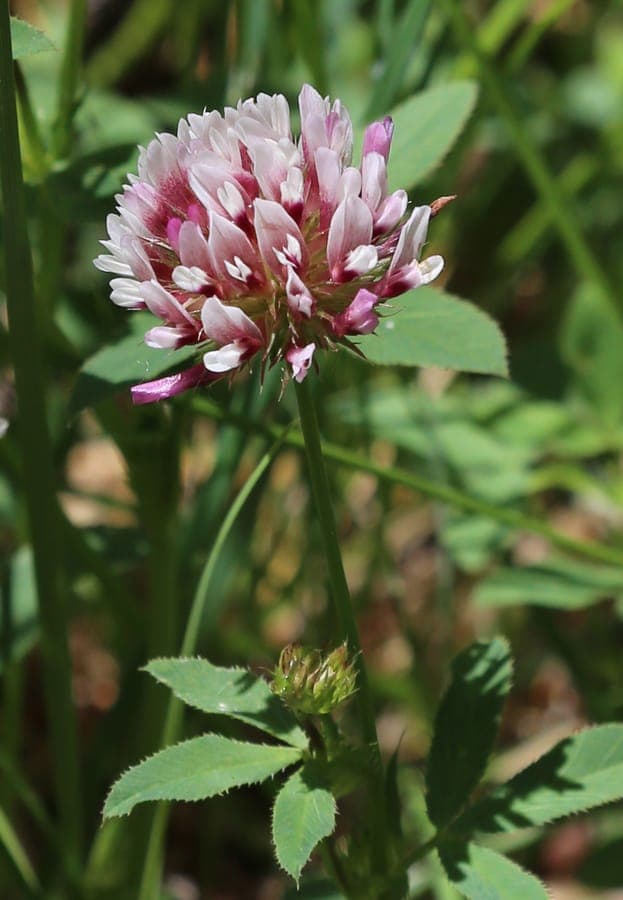
Dcrjsr / CC BY 3.0, via Wikimedia Commons
Longstalk clover: complete guide to Trifolium longipes
Trifolium longipes
¿Quieres ver Longstalk clover: complete guide to Trifolium longipes en tu jardín?
1 minuto, sin tarjeta de crédito
Overview
Trifolium longipes, the longstalk clover or long-stalk clover, is a rhizomatous perennial in the Fabaceae family. It is native across a wide range in western North America, from Arizona and California in the south through Colorado, Idaho, Montana, Nevada, New Mexico, Oregon, Utah, Washington, and Wyoming, extending into northeastern Mexico. In its native habitat it grows in mountain meadows, moist valleys, and open woodland edges.
The species is rated as rapid in growth rate, meaning it establishes quickly and spreads via rhizomes to form dense mats within a single season. Like all clovers, it fixes atmospheric nitrogen, improving soil fertility over time. The purple flowers are highly attractive to bees, bumblebees, and butterflies. Gardenworld.app can help you design a garden where wildlife-friendly plants like this one take centre stage.
Appearance and bloom
Leaves are the classic three-part clover shape with a fine texture. The leaflets are green with a faint pale chevron marking. Plant height is low, 10 to 20 cm for the foliage, but the flower stalks are notably long - the name 'longipes' refers to this long-footed character.
Flowers are purple to violet-pink, arranged in round to oval heads held well above the leaf mat. The black seeds that follow are small but persistent. Bloom time falls in spring and early summer. The long stalks make the flowers highly visible to passing pollinators.
Ideal location
Trifolium longipes grows in full sun to partial shade in the garden. In its native mountain range it is found in open meadows as well as light woodland understorey, so it tolerates more shade than many other clovers. A position with morning sun and afternoon shade suits it particularly well in hot climates.
Suitable uses include groundcover, lawn enrichment, naturalised areas, and as filler in informal borders. Its rapid growth makes it useful for quickly covering bare ground.
Soil
The preferred pH range is 5.6 to 6.8, making this a plant for slightly acid to neutral soils. It prefers soils that retain some moisture but drain reasonably well. Light loam with some organic matter is ideal. Too rich or too heavy a soil leads to excessive leafy growth at the expense of flowers. As a nitrogen-fixer, the plant improves lean soils over time.
Watering
In its mountain habitat, Trifolium longipes benefits from snowmelt and regular rainfall. In garden conditions, water during dry spells in summer, especially on sandy soils. Loamy or humus-rich soils retain enough moisture that watering is rarely needed except during extended droughts. Water deeply once a week when no rain falls for more than two weeks.
Good drainage is still important: the roots dislike standing water. Avoid planting in low spots that collect water after heavy rain.
Pruning
Little pruning is needed. In lawn use, maintain a mowing height of at least 7 cm. In borders, cut back old growth in autumn after the plant dies back. The rhizomes ensure reliable re-sprouting in spring, even after a fairly hard cut. A light shear after the main bloom in summer can encourage a second flush of flowers.
Diseño gratis
¿Quieres ver Longstalk clover: complete guide to Trifolium longipes en tu jardín? Crea un diseño gratis ahora.
Maintenance calendar
- February/March: Remove dead material from the previous season. First new shoots emerge.
- April: Rapid vegetative growth. Apply light fertiliser on poor soils.
- May/June: Bloom period. Leave undisturbed for pollinators.
- July: Light trim after main bloom possible. Keep watering during drought.
- August: Heat rest. Plant may look stressed but recovers in autumn.
- September/October: Fresh growth as temperatures cool. Contain spread if needed.
- November to January: Dormant period. Rhizomes survive cold without protection.
Winter hardiness
Trifolium longipes is well cold-hardy, corresponding to USDA zones 4 to 7. As a plant of the western American mountains it is adapted to hard winters. The rhizomes survive temperatures well below -20C in the soil. Above-ground parts die back in cold winters but return reliably in spring. In mild winters the plant can remain semi-evergreen.
Companion plants
Trifolium longipes pairs well with other low alpine and meadow plants. In a naturalistic border, combine with Geum triflorum, Viola species, and low sedges. In a wildflower meadow mix, it works alongside Geranium, Lupinus, and Ranunculus. For a pollinator-focused planting, combine with Achillea millefolium and Knautia arvensis whose blooming overlaps and draws a broad range of insects.
Propagation
Longstalk clover spreads naturally by seed and creeping rootstocks, and both methods translate well to garden use. Gather ripe seed heads in August, rub them out over a tray and store the seed dry until spring. Sow in March into pots of moist, humus-rich compost; an overnight soak in tepid water speeds germination noticeably. Established clumps divide cleanly in early spring: slice through the mat with a sharp spade, keeping at least three crowns and a generous ball of earth per division, then replant 25 cm apart and water steadily for the first fortnight. By midsummer the divisions knit back into a continuous carpet, and flowering resumes the following year at full strength.
Common problems and solutions
This mountain clover is remarkably trouble-free, but two issues deserve attention. It dislikes prolonged summer drought; on sandy ground without supplemental water the foliage yellows and bloom stalls, so mulch generously with compost to lock in moisture. Powdery mildew can appear in stagnant, airless corners; choose an open position and remove affected stems promptly. Slugs nibble young spring shoots but lose interest once plants mature. Rabbits and deer, unfortunately, relish clover of every kind; where they roam, a low ring of netting around new plantings for the first season is a sensible precaution. On gardenworld.app you can test how a clover understorey looks beneath your existing borders before committing. Check new plantings weekly through their first year; catching browsing damage or drought stress early makes the difference between a slow start and a mat that closes over within two seasons.
Closing thoughts
Trifolium longipes is a versatile, fast-establishing perennial clover that delivers both decorative and ecological value. The purple flowers stand out, maintenance demands are low, and the nitrogen fixation is a genuine bonus for soil health. Visit gardenworld.app to find out how plants like longstalk clover can anchor a naturalistic, wildlife-friendly garden design.
¿Quieres ver Longstalk clover: complete guide to Trifolium longipes en tu jardín? Crea un diseño gratis ahora.
Sube una foto, elige un estilo y obtén un diseño fotorrealista con lista de plantas en menos de un minuto.
Más de 10.000 jardines diseñados
Sin tarjeta de crédito


Plantas similares
Caucasian clover: complete guide to Trifolium ambiguum
Trifolium ambiguum
Everything about Trifolium ambiguum, caucasian or kura clover. Growth habit, location, soil, maintenance and use as groundcover or pasture plant.
Large-head clover: complete guide to Trifolium macrocephalum
Trifolium macrocephalum
Everything about Trifolium macrocephalum, the large-head clover from the Pacific Northwest. Location, soil, watering, pruning and companion plants.