
Solanum tomentosum: complete guide
Solanum tomentosum
¿Quieres ver Solanum tomentosum: complete guide en tu jardín?
1 minuto, sin tarjeta de crédito
Overview
Solanum tomentosum is a striking, felt-leaved nightshade in the family Solanaceae, native to southern Africa: the Cape Provinces, the Free State, KwaZulu-Natal, Lesotho, and the northern provinces of South Africa. None other than Carl Linnaeus himself described the species in 1753 in his famous Species Plantarum. In Afrikaans the plant is known as gifappeltjie, a name that leaves no room for doubt: the fruit is poisonous. In German the plant is called filziger nachtschatten (felted nightshade), for the dense, felt-like hairs covering its foliage, while English-language sources call it wild aubergine.
The species name tomentosum comes from the Latin tomentum (felt or down) and describes the dense, greyish-white hairs covering the entire plant. Because of its wide range, from the coastal plains of the Cape to the high plateaus of Lesotho, the species has been described repeatedly under different names over the centuries; botanists now recognize more than ten synonyms, from Solanum pulverulentum to Solanum tomentosum var. scabriusculum, a sign of just how much natural variation this species shows across its range. On gardenworld.app we discuss Solanum tomentosum among our unusual, thorny ornamentals for boundary planting.
The plant grows as a compact, thorny shrub 50 to 150 centimeters tall, with stems and leaf veins armed with sharp prickles, a trait that protects it from browsing wildlife in its native highveld habitat.
Within the enormous genus Solanum, which counts thousands of species worldwide including potato, tomato, and eggplant, Solanum tomentosum represents the group of armed, felt-leaved shrubs found across the southern half of Africa. For fans of unusual, thorny structural plants with a story behind them, this species is a surprisingly tough addition to the usual lineup of garden nightshades.
Appearance and bloom
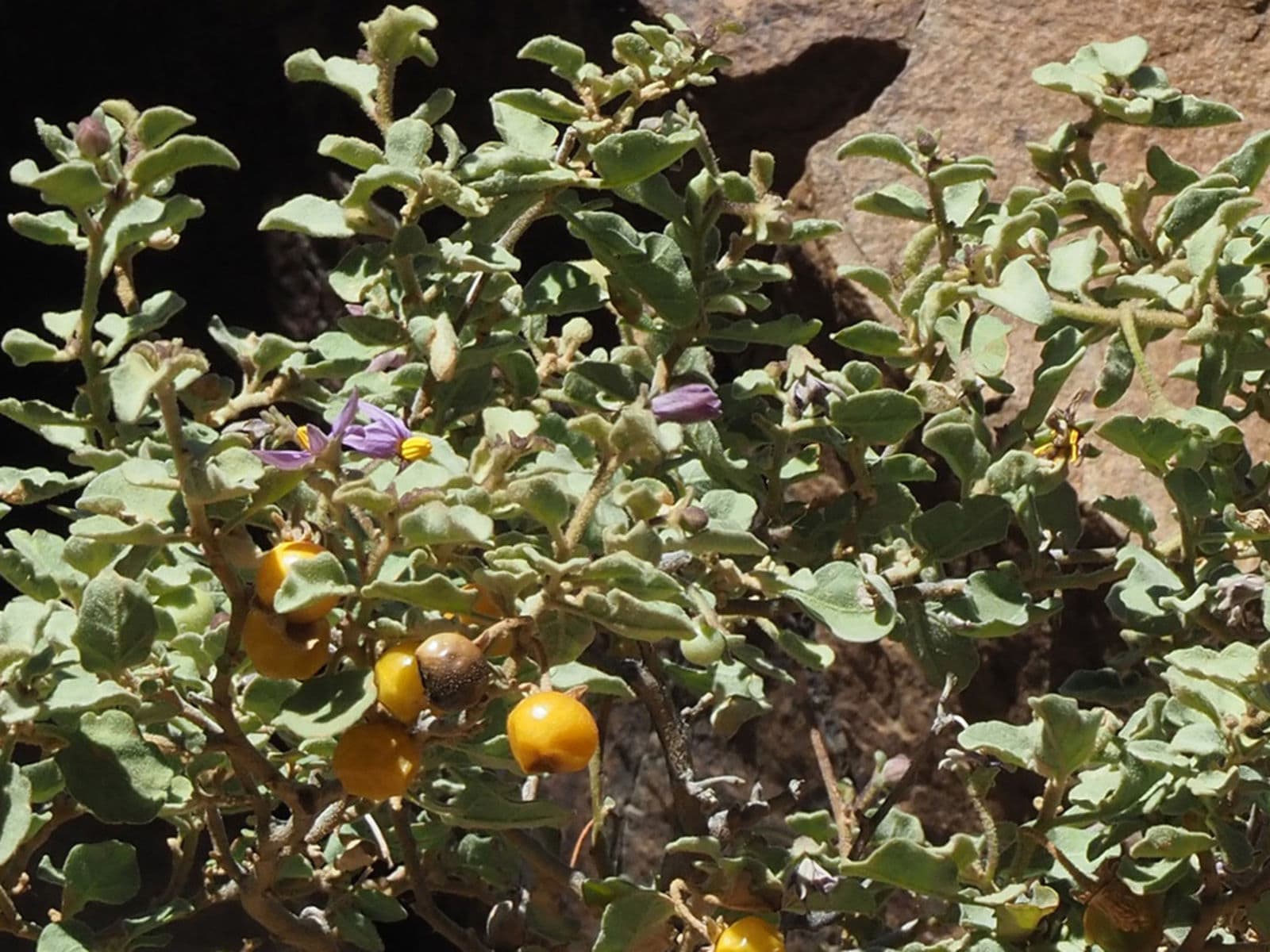
The most striking feature of Solanum tomentosum is the dense, greyish-white felt covering nearly the entire leaf and stem, comparable to the hairs on familiar garden plants such as Stachys byzantina (lamb's ear). This felt reflects intense sunlight and reduces moisture loss, an adaptation to the dry, sunny highveld where the plant originates. Leaves are oval to elongated with a gently lobed margin.
Flowers appear in small clusters and show the classic star shape of the nightshade family: five purple to violet petals surrounding a striking cone of yellow stamens, much like the flowers of potato. In northern Europe, given a spot in full sun, the plant blooms from June through September.
After flowering, round yellow berries about 2 centimeters across develop. As the Afrikaans name gifappeltjie already reveals, these berries are poisonous if ingested and must be kept well away from children, pets, and livestock.
Ideal location
Solanum tomentosum needs a spot in full sun, since in its native habitat on the South African highveld it grows on open, exposed grassland with no shade from trees. At least six to eight hours of direct sunlight a day is needed for a compact habit and abundant bloom.
Choose a spot away from paths and play areas, since the sharp prickles on stems and leaf veins can cause painful scratches on contact. A border toward the back of the garden or among other thorny ornamentals is a safe and practical choice.
Diseño gratis
¿Quieres ver Solanum tomentosum: complete guide en tu jardín? Crea un diseño gratis ahora.
Soil
The soil must drain well; the highveld of Lesotho and the Free State has predominantly sandy to loamy soil with a neutral to mildly alkaline pH between 6.5 and 7.5. Heavy, waterlogged clay quickly leads to root rot, especially in wet northern European winters.
When planting in heavy soil, work in grit or sand to improve drainage. Lean to moderately fertile soil is sufficient; overfeeding produces soft growth that withstands wind and cold far less well.
Watering
During the first growing season after planting, keep the soil lightly moist so the plant establishes properly. After that, Solanum tomentosum is markedly drought tolerant, in keeping with the hot, dry summers of its South African highveld habitat, and rarely needs supplemental water except during prolonged heat.
Avoid consistently overwatering: the roots of this highveld plant are not adapted to prolonged wet soil and quickly respond with root rot.
Pruning
Prune Solanum tomentosum in early spring, in March, cutting back to a compact form of about 40 centimeters to encourage fresh, healthy growth. Wear thick gloves while pruning because of the sharp prickles on stems and leaf veins.
After winter, remove any frozen or dead branches entirely. A light summer trim after flowering keeps the shrub compact and encourages a second flush of bloom in autumn.
Maintenance calendar
March: prune to a compact shape and check for winter damage. April through May: new growth, water moderately. June through September: main bloom and fruit set, minimal feeding. October: berries ripen to yellow, remove them if children or pets have access to the garden. November through February: winter rest; protect the root crown during hard frost with a layer of dry leaves or straw.
Winter hardiness
Solanum tomentosum is notably more winter hardy than many of its tropical Andean relatives, thanks to its origin on the high, cold grasslands of Lesotho and the Free State, where night frost and occasionally even snow occur in winter. In a sheltered, well-drained spot, the plant survives temperatures down to roughly -8 degrees Celsius, corresponding to USDA zone 8b to 9a.
In regions with harsher winters, a thick layer of mulch around the root crown is advisable, or grow the plant in a large pot that you move temporarily against a sheltered wall during extreme frost.
Companion plants
Solanum tomentosum pairs well with other South African highveld plants already well established in northern European gardens: red hot poker (Kniphofia uvaria), Agapanthus, Crocosmia, and the graceful grass-like Dierama pulcherrimum. Together they form a sunny, texture-rich border with a distinctly southern character.
For sourcing: garden centers typically stock the more familiar South African garden plants such as Kniphofia and Agapanthus; for Solanum tomentosum itself, your best bet is a specialist grower of rare Solanaceae or a seed supplier focused on South African flora.
Closing
Solanum tomentosum is a fascinating, thorny nightshade with dense felted foliage and surprising winter hardiness for a South African species. Given a sunny, well-drained spot away from paths, this highveld plant makes a unique addition to a sunny, texture-rich border. Always be mindful of the poisonous yellow berries in gardens with children or pets. Browse gardenworld.app for more unusual South African ornamentals to complete your sunny border.
¿Quieres ver Solanum tomentosum: complete guide en tu jardín? Crea un diseño gratis ahora.
Sube una foto, elige un estilo y obtén un diseño fotorrealista con lista de plantas en menos de un minuto.
Más de 10.000 jardines diseñados
Sin tarjeta de crédito


Plantas similares
Solanum dolichosepalum: complete guide
Solanum dolichosepalum
Discover Solanum dolichosepalum, an Andean nightshade with striking long sepals. Growing tips, hardiness, and companion planting for your patio.
Solanum ripense: complete guide
Solanum ripense
Discover Solanum ripense, a moisture-loving Andean nightshade for pond edges and conservatories. Growing tips, hardiness, and companions.
Solanum interius: complete guide to this plains nightshade
Solanum interius
Grow plains nightshade, a drought-tolerant North American wildflower with purple blooms and remarkable adaptability to dry prairie soils.