
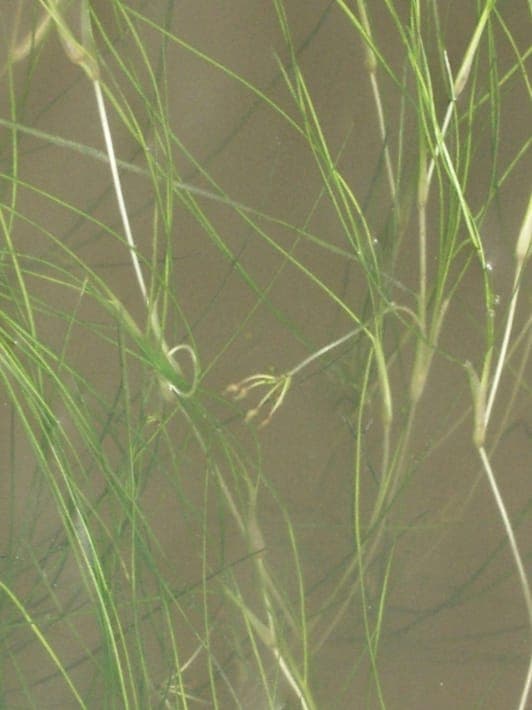
Ruppia2000 / CC BY-SA 3.0, via Wikimedia Commons
Beaked tasselweed: complete guide
Ruppia maritima
¿Quieres ver Beaked tasselweed: complete guide en tu jardín?
1 minuto, sin tarjeta de crédito
Overview
Beaked tasselweed (Ruppia maritima), also known as widgeongrass in English-speaking regions, is a submerged aquatic plant with worldwide distribution in salt, brackish and even freshwater environments. This plant plays an essential role in coastal ponds and estuaries, providing food and shelter for numerous aquatic organisms and waterbirds.
Beaked tasselweed holds enormous ecological value, especially in coastal regions where it stabilizes food chains and maintains healthy water habitats. For garden designers interested in ecological water design, beaked tasselweed represents an important reference species. At gardenworld.app you can integrate this ecologically important water plant into water gardens combining habitat recreation with sustainability.
Appearance and growth
Beaked tasselweed grows submerged with thin, thread-like stems and linear leaves reaching 2-8 centimetres in length. The plant forms open, dispersed underwater mats without forming dense stands. The root system anchors in sediment on the bottom.
Flowering remains inconspicuous and occurs underwater. Characteristic for the plant are the long-stalked fruit peduncles developing after flowering - not spiral-shaped like related Ruppia cirrhosa, but straighter and longer. These fruit stalks extend 5-10 centimetres in length and prove striking underwater.
Ideal location
Beaked tasselweed grows in salt to brackish water, preferring salinities between 10-30 per cent. The plant tolerates highly variable salinity well. In estuaries it thrives with alternating salt and fresh water. In pure freshwater the plant grows much more weakly.
The plant thrives in full sun to half-shade. Water turbulence and wave action favour growth and oxygen circulation. In stagnant water problems develop more readily.
Diseño gratis
¿Quieres ver Beaked tasselweed: complete guide en tu jardín? Crea un diseño gratis ahora.
Water and habitat
The plant grows in diverse substrates: sand, clay, silt and mud. For garden habitats use sand or aquarium gravel. Temperatures between 0-25°C prove acceptable - making this a remarkably adaptable species. In winter much foliage dies back in cold regions, but the plant recovers in spring.
Water quality must be good with adequate oxygen. pH between 7.5-8.5 proves ideal for saltwater environments.
Ecological role
Beaked tasselweed provides food for numerous aquatic animals, particularly waterbirds such as ducks, geese and swans. The plant also provides shelter for fish and invertebrate larvae. In estuaries the plant represents an ecological keystone species.
For garden designers this means beaked tasselweed is a plant with high ecological value that substantially enriches water habitats.
Culture in garden ponds
For garden designers wishing to create aquatic plantings suitable for beaked tasselweed, saltwater conditions prove essential. This requires special salt water (purchased or created with salt) and regular water quality monitoring. This suits water garden specialists best.
Conclusion
Beaked tasselweed represents an ecologically valuable water plant for coastal areas, estuaries and saltwater conditions. For specialized water garden designers this plant offers opportunities for innovative water habitats combining ecology with aesthetics.
¿Quieres ver Beaked tasselweed: complete guide en tu jardín? Crea un diseño gratis ahora.
Sube una foto, elige un estilo y obtén un diseño fotorrealista con lista de plantas en menos de un minuto.
Más de 10.000 jardines diseñados
Sin tarjeta de crédito


Plantas similares
Spiral tasselweed: complete guide
Ruppia cirrhosa
Everything about Spiral tasselweed (Ruppia cirrhosa): cultivation in aquatic systems, water quality and aquatic plants. Expert tips for this unique water plant.
Eelgrass: complete guide
Zostera marina
Discover the importance of seagrass ecosystems. Eelgrass ecology, conservation and restoration insights.
Floating-leaf Pondweed: complete guide for water gardens
Potamogeton natans L.
Floating-leaf Pondweed is a floating-leaf plant with submerged and floating leaf forms. Discover how this plant improves water quality and biodiversity.