
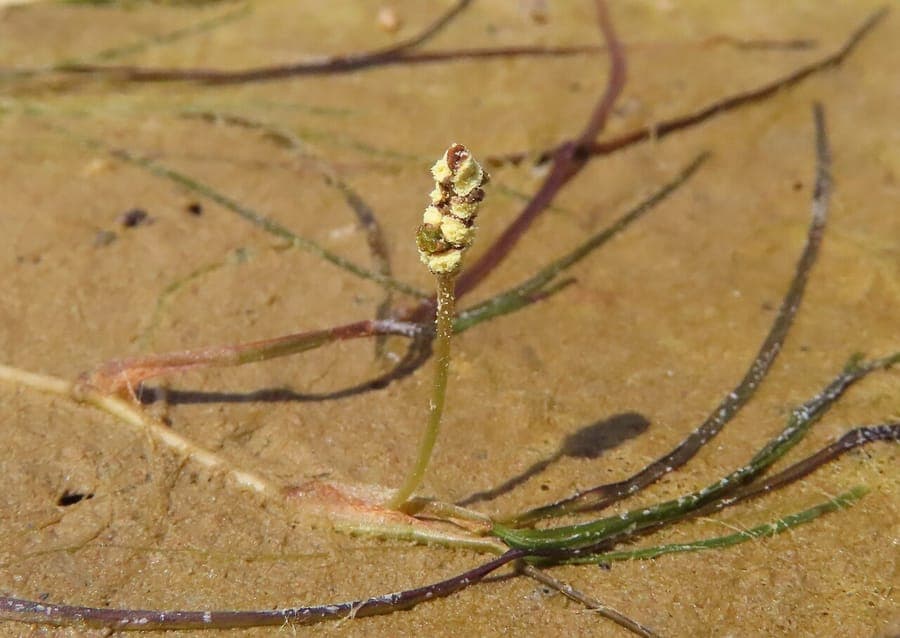
E Wusk / CC BY-SA 4.0, via Wikimedia Commons
Spiral tasselweed: complete guide
Ruppia cirrhosa
¿Quieres ver Spiral tasselweed: complete guide en tu jardín?
1 minuto, sin tarjeta de crédito
Overview
Spiral tasselweed (Ruppia cirrhosa) is a fascinating submerged aquatic plant occurring naturally in brackish and saline environments across Europe, Asia, North Africa and North America. The plant derives its name from the characteristic spiral-shaped fruit stalks that develop after flowering - 'cirrhosa' meaning 'curled' or 'spiral' in Latin.
This plant plays a crucial ecological role as a food and shelter provider for aquatic fauna. For garden designers with water features, spiral tasselweed offers a valuable connection between water and ecology. At gardenworld.app you can integrate this unique aquatic plant into water garden designs emphasizing both functionality and beauty.
Appearance and growth
Spiral tasselweed grows submerged with thin, thread-like stems and extremely fine, linear leaves reaching 2-5 centimetres in length. The plant forms no dense mass but rather grows as an open, dispersed underwater vegetation. Leaves group around nodes along the stem.
Flowering occurs underwater and remains invisible to human observation. After flowering, the characteristic spiral-shaped fruit stalks develop - the 'cirrus' or spiral structures - where fruits mature. These spirals extend to 15 centimetres in length and constitute the plant's distinctive feature.
Ideal location
Spiral tasselweed thrives in brackish to saline environments with salinity between 5-30 per cent. In freshwater the plant grows much weakly or not at all. In garden ponds this plant suits estuarine ponds or tidal water features rather than conventional freshwater ponds.
The plant prefers full sun and water with moderate to good water circulation. In stagnant water algae problems develop rapidly. Water depths from 30-200 centimetres prove suitable.
Diseño gratis
¿Quieres ver Spiral tasselweed: complete guide en tu jardín? Crea un diseño gratis ahora.
Water and substrate
The plant grows in sandy to muddy substrates. For aquatic plant containers use sand or aquarium gravel. Water quality proves crucial: brackish to saline water with pH 7.5-8.5 proves ideal. Temperatures between 5-25°C prove acceptable.
The plant tolerates periodic desiccation better than many aquatic plants - in natural habitats water surfaces regularly disappear.
Role in ecosystems
Spiral tasselweed forms an important component of aquatic food chains. The plant serves as food and shelter provider for numerous aquatic organisms. For garden water ecosystems this means the plant contributes to ecological stability and biodiversity.
Culture in garden ponds
For garden designers wishing to create aquatic plantings suitable for spiral tasselweed, special artificial brackish water conditions prove necessary. This proves complex and best suits serious aquatic plant enthusiasts. In temperate gardens this remains primarily for experimental water quality projects.
Maintenance
The plant requires minimal maintenance in appropriate conditions. Periodic water changes help control algal growth. Water quality monitoring proves essential.
Conclusion
Spiral tasselweed represents a unique aquatic plant offering ecological and aesthetic value to brackish and saline habitats. For specialized garden designers this plant offers opportunities for innovative water landscapes combining ecology with design.
¿Quieres ver Spiral tasselweed: complete guide en tu jardín? Crea un diseño gratis ahora.
Sube una foto, elige un estilo y obtén un diseño fotorrealista con lista de plantas en menos de un minuto.
Más de 10.000 jardines diseñados
Sin tarjeta de crédito


Plantas similares
Beaked tasselweed: complete guide
Ruppia maritima
Everything about Beaked tasselweed (Ruppia maritima): cultivation in aquatic habitats, water quality and native water flora. Expert tips for this aquatic plant.
Eelgrass: complete guide
Zostera marina
Discover the importance of seagrass ecosystems. Eelgrass ecology, conservation and restoration insights.
Floating-leaf Pondweed: complete guide for water gardens
Potamogeton natans L.
Floating-leaf Pondweed is a floating-leaf plant with submerged and floating leaf forms. Discover how this plant improves water quality and biodiversity.