
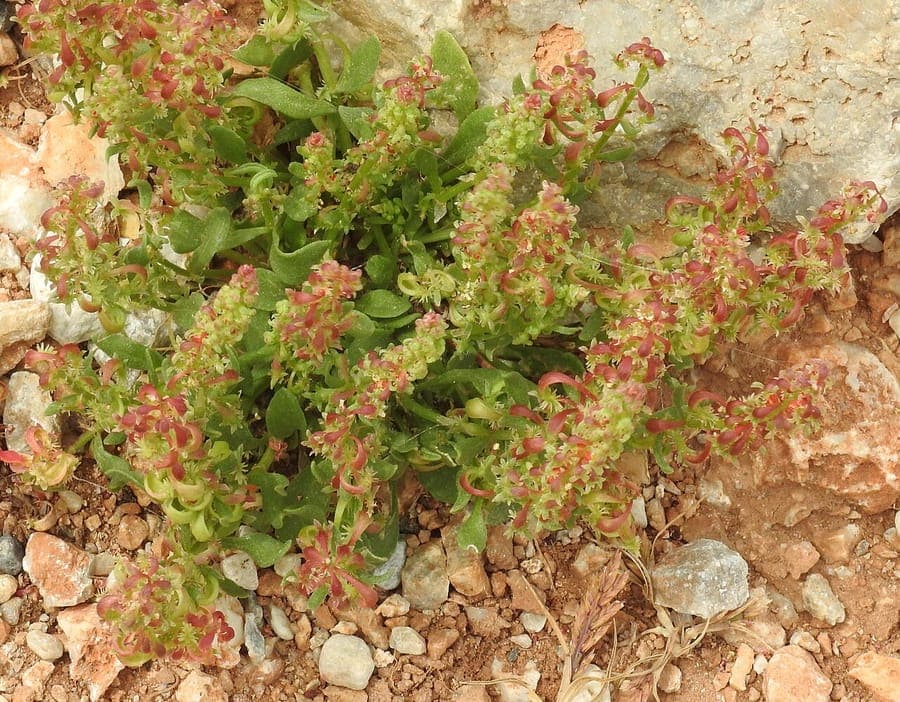
Robert Flogaus-Faust / CC BY 4.0, via Wikimedia Commons
Ruby dock: complete guide
Rumex bucephalophorus
¿Quieres ver Ruby dock: complete guide en tu jardín?
1 minuto, sin tarjeta de crédito
Ruby dock is a fascinating annual to biennial plant native to the Mediterranean region. The plant is particularly characterized by striking, winged seeds that resemble small bull's horns. While not a traditional food plant, it is interesting for lovers of Mediterranean flora. With its preference for warm, dry conditions, it is a perfect addition to xeriscapes. Ruby dock grows in compact, branching forms to approximately 30 to 50 cm tall. The leaves are relatively small and narrow, with green to reddish tints. The plant remains largely inconspicuous until fruiting. The flowers are small and inconspicuous, but the fruiting is spectacular. The characteristic fruits have three broadly winged segments. These structures turn red to orange-red when ripe. This Mediterranean plant thrives exclusively in full sun receiving at least six to eight hours of direct sunlight daily. Shade tolerance is very limited. The plant appreciates warm, sheltered spots. Protection from cold winds is important in temperate climates. Ruby dock grows best on light, well-draining soils. Poor, sandy or gravelly soils are actually ideal. A pH between 6.5 and 8.0 is preferred. Do not plant in heavy, clay or wet soils. Once established, Ruby dock is very drought-tolerant. Regular watering is not necessary. The plant is actually more susceptible to fungal diseases if watered too frequently. In pots, keep soil moist but not wet. In wet winters, good drainage is essential. Pruning is actually not necessary for Ruby dock. Because it is an annual or short-lived biennial, it grows naturally in its desired shape. You can remove spent flower clusters to prevent self-seeding if you wish. May-July: sow seeds directly outdoors in prepared sandy soil. August-September: monitor growth. September-October: enjoy the spectacular fruiting. November: let seeds fall naturally or remove plants. Ruby dock has only limited winter hardiness. The plant is native to the Mediterranean. In regions with freezing winters, it usually does not survive outdoors. In temperate climates, it can occur as an annual in warm seasons. Ruby dock fits well in Mediterranean planting schemes with other drought-tolerant species. Combine with lavender, rosemary and other Mediterranean herbs. Gray-leaved plants complement well. This creates attractive texture and color combinations. Ruby dock is an unusual, botanically interesting choice for warm, dry gardens. Its spectacular fruiting adds structure without much maintenance. For seeds, we refer you to specialized seed suppliers. Discover more about Mediterranean gardening on gardenworld.app.
¿Quieres ver Ruby dock: complete guide en tu jardín? Crea un diseño gratis ahora.
Sube una foto, elige un estilo y obtén un diseño fotorrealista con lista de plantas en menos de un minuto.
Más de 10.000 jardines diseñados
Sin tarjeta de crédito


Plantas similares
Russian dock: complete guide
Rumex confertus
Discover Russian dock, a robust plant from Eastern Europe. Read our guide for cultivation in temperate climates and diverse soils.
Toothed dock: complete guide
Rumex dentatus
Discover toothed dock, a Mediterranean and Asian food plant with characteristic toothed leaves. Growing guide for warm gardens.
Garden sorrel: complete guide
Rumex acetosa
Garden sorrel (Rumex acetosa) is a nutritious culinary herb with tangy leaves. Learn to grow, harvest and use it in cooking.