
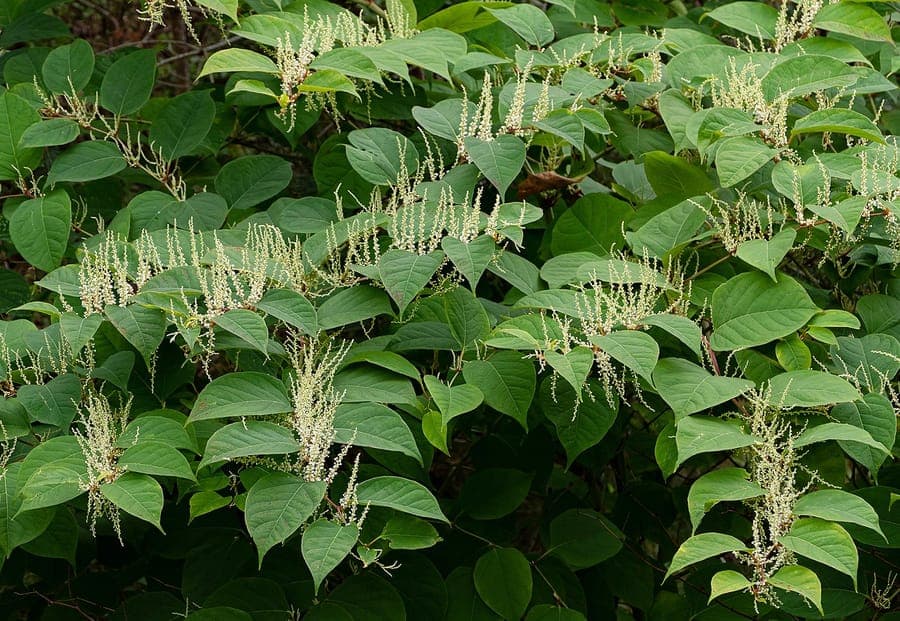
W.carter / CC0, via Wikimedia Commons
Japanese knotweed: complete guide
Reynoutria japonica
¿Quieres ver Japanese knotweed: complete guide en tu jardín?
1 minuto, sin tarjeta de crédito
Overview
Japanese knotweed (Reynoutria japonica) is a rapid-growing herbaceous perennial native to the Far East, including Japan, China and Korea. This plant is notorious for its remarkable growth rate and ability to overwhelm surrounding vegetation. In many European countries, Japanese knotweed appears on invasive species lists due to its aggressive expansion patterns.
This article provides essential understanding for managing this powerful plant and guidance for situations where control proves critical.
Appearance & Bloom
Japanese knotweed grows as a robust, cane-like plant with upright stems ranging from red to green. The plant rapidly achieves heights of 1.5 to 2 metres, sometimes exceeding this in optimal conditions. Leaves are broad and heart-shaped, approximately 7 to 14 centimetres long, creating dense canopy coverage.
Flowers appear from August through October as small, white to pale green blooms in drooping panicles. Though less showy, these flowers attract pollinators. Following flowering, winged seeds form that disperse readily via wind and water.
The plant dies back completely in winter but emerges vigorously each spring from underground rhizomes.
Spread & Invasiveness
Japanese knotweed spreads via three mechanisms: seed dispersal, vegetative reproduction from fragments, and critically, via underground rhizomes extending tens of metres in any direction. A single small rhizome fragment can establish an entirely new colony.
In many European countries, deliberately planting Japanese knotweed is now legally prohibited. Removal requires sustained effort and often herbicide application.
Diseño gratis
¿Quieres ver Japanese knotweed: complete guide en tu jardín? Crea un diseño gratis ahora.
Ideal Location
Japanese knotweed thrives in full sun to partial shade. Should you cultivate this plant, contain it rigorously within enclosed spaces where expansion proves impossible, such as large containers or areas surrounded by impenetrable barriers.
Soil & Water
Japanese knotweed grows on virtually all soil types and proves extremely water-adaptive, making its management exceptionally challenging.
Management & Control
If Japanese knotweed already inhabits your garden:
- Cut regularly - minimum weekly during growing season
- Reinforce barriers - excavate at least 60-90 centimetres deep to contain rhizomes
- Monitor surrounding areas for new growth
- Consider professional removal for large infestations
Herbicide treatment often proves necessary for complete elimination.
Winter
While the plant disappears completely in winter, rhizomes survive frost easily, creating false confidence in control.
Why This Article
We alert garden designers to this species and provide essential management knowledge. Japanese knotweed can serve specific purposes like screening or windbreaks, but demands serious precautions.
Conclusion
Japanese knotweed is inappropriate for most residential gardens. If you possess this plant, professional removal merits consideration. For future projects, alternative vigorous growers offering fewer complications prove preferable.
Discover more responsible plant choices on gardenworld.app.
¿Quieres ver Japanese knotweed: complete guide en tu jardín? Crea un diseño gratis ahora.
Sube una foto, elige un estilo y obtén un diseño fotorrealista con lista de plantas en menos de un minuto.
Más de 10.000 jardines diseñados
Sin tarjeta de crédito


Plantas similares
Giant knotweed: complete guide
Reynoutria sachalinensis
Understand giant knotweed (Reynoutria sachalinensis) - its massive size, invasive nature, and aggressive management requirements.
European buckthorn: complete guide
Rhamnus cathartica
Discover European buckthorn (Rhamnus cathartica), a hardy native shrub for hedgerows, screening and wildlife support. Growing, care and benefits.