
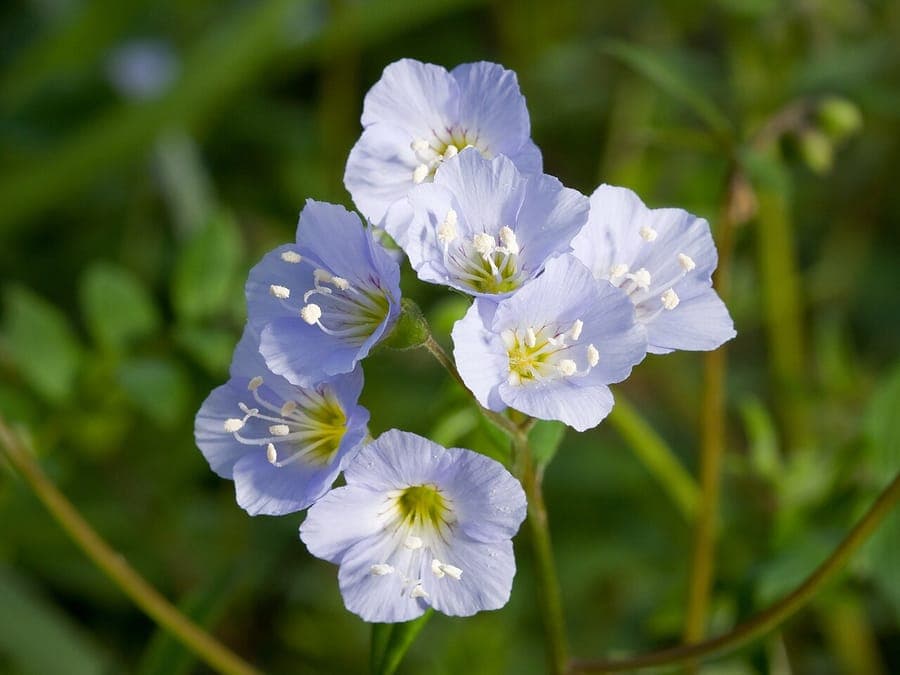
Ryan Kaldari / Public domain, via Wikimedia Commons
Polemonium reptans: complete guide
Polemonium reptans
¿Quieres ver Polemonium reptans: complete guide en tu jardín?
1 minuto, sin tarjeta de crédito
Overview
Polemonium reptans, commonly known as creeping Jacob's-ladder or Greek valerian, is an attractive perennial from North America. This elegant ground cover grows spread across the ground and provides beautiful blue flowers from April to May. The plant is ideal for shady corners of your garden where other plants struggle to grow.
Appearance and bloom
Creeping Jacob's-ladder grows to 25-35 centimeters tall and spreads out as a groundcover. The leaves are neatly divided along the central stem, creating a ladder-like structure (hence the name Jacob's-ladder). The flowers are light blue, pink or white and have a yellow center. They appear in April-May and attract bees and butterflies.
Ideal location
The plant thrives best in partial shade to full shade. It tolerates sun but blooms less in very warm, dry environments. A location under deciduous trees or on the north side of a wall is ideal. Temperatures of 5-20 degrees Celsius are optimal.
Soil
The soil should be noticeably moist and humus-rich. A pH of 6.0 to 7.0 is ideal. Adding plenty of organic matter improves growth. The plant values good drainage to prevent root rot, but does not like dry soil.
Watering
Water regularly, especially during dry periods. Ensure the soil remains consistently moist, but not waterlogged. In winter, watering can be reduced. Mulch helps maintain moisture and cools the roots.
Diseño gratis
¿Quieres ver Polemonium reptans: complete guide en tu jardín? Crea un diseño gratis ahora.
Pruning
Pruning is not necessary, but removing withered flowers and old leaves keeps the plant neat. After flowering, the plant can be trimmed back to stimulate fuller growth patterns. Remove dead leaves in autumn.
Maintenance calendar
Plant in spring or autumn. Provide regular watering and mulch. During the growing season, provide moderate feeding. Check for slugs and Botrytis in damp environments. Replace every 3-4 years for better growth.
Winter hardiness
Creeping Jacob's-ladder is completely winter hardy and tolerates temperatures down to -25 degrees Celsius. The plant remains semi-evergreen and looks attractive even in winter. Winter protection is not necessary.
Companion plants
The plant combines well with other shade-loving perennials such as hellebore, lungwort, astilbe and hosta. They also form beautiful combinations with spring-blooming flowers such as crocus and tulip. Together they create interesting ground coverage.
Closing
Creeping Jacob's-ladder is a carefree, easy-to-grow perennial that adds beauty and interest to shaded garden corners for years to come. With simple care, this plant will return year after year and gradually expand. An essential plant for any shade lover.
¿Quieres ver Polemonium reptans: complete guide en tu jardín? Crea un diseño gratis ahora.
Sube una foto, elige un estilo y obtén un diseño fotorrealista con lista de plantas en menos de un minuto.
Sin tarjeta de crédito


Plantas similares
Phlox alyssifolia: complete guide to Alyssum-leaf Phlox
Phlox alyssifolia
Alyssum-leaf phlox is a compact alpine pink bloomer from North America. Discover care, location and all growing requirements.
Phlox richardsonii: complete guide to Richardson's Phlox
Phlox richardsonii
Richardson's phlox is an arctic bloomer exceptionally robust. Learn cultivation in extreme conditions and complete care guide.
Polemonium foliosissimum: complete guide
Polemonium foliosissimum
Polemonium foliosissimum is a vigorous Rocky Mountain perennial with blue-purple summer flowers that attract pollinators and thrive in borders.