
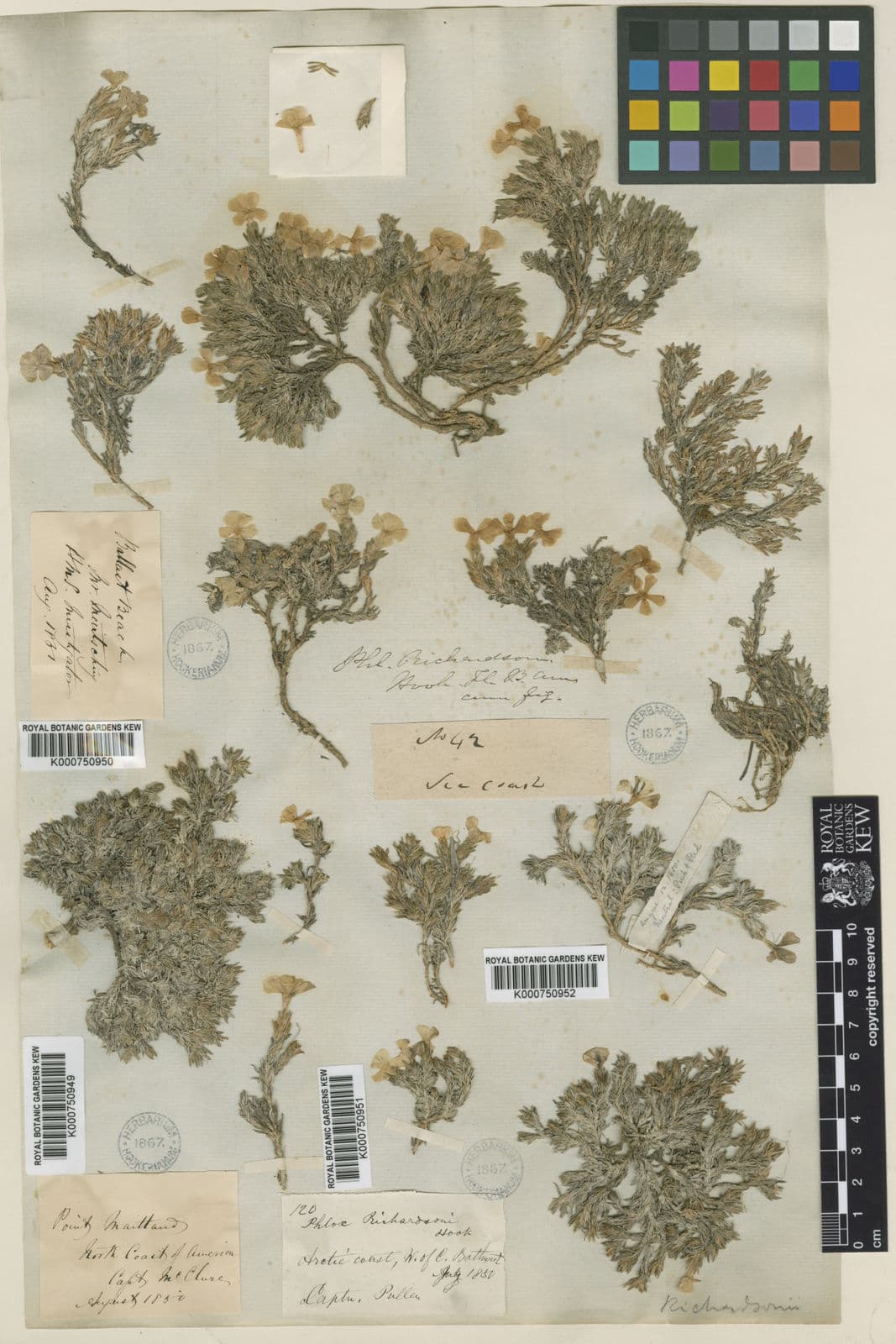
Phlox richardsonii: complete guide to Richardson's Phlox
Phlox richardsonii
¿Quieres ver Phlox richardsonii: complete guide to Richardson's Phlox en tu jardín?
1 minuto, sin tarjeta de crédito
Overview
Phlox richardsonii, known as Richardson's Phlox, is a fascinating flowering plant native to subarctic and arctic regions of North America. This plant naturally grows in Alaska, Yukon, Northwest Territories, and Nunavut, plus further to Russian Magadan. This is one of the most extreme alpine plants you can grow in a garden.
This small but extremely resilient plant is built to survive extreme cold and short growing seasons. It's a perfect choice for gardeners in colder regions or those wanting to experiment with extreme alpine gardening. Richardson's Phlox is a true survival plant.
Appearance & Bloom
Phlox richardsonii grows as an extremely compact cushion - often just 5 to 15 centimeters tall. It's a cushion-plant with dense, small foliage. Growth is extremely dense and compact due to extreme environmental conditions from which it comes.
Flowers appear in June and July - very late in the growing season due to short arctic summer. Flowers are small but extremely numerous and gleam from pink to purple. Each tiny flower is about 0.5 to 1 centimeter across. The blooming period is short but intense, creating a spectacle in the garden.
Ideal Location
Richardson's Phlox performs best in locations receiving full sun exposure - but in arctic summers this means almost 24-hour daylight. In temperate climates the plant needs at least six to eight hours direct sunlight daily.
The plant prefers well-ventilated locations where wind can blow freely. This also helps prevent moisture problems. In very cold regions, snow cover in winter can actually be beneficial.
Soil
Richardson's Phlox has the same preference for very well-draining, rocky soil as its relatives. This is essential in temperate climates. In arctic areas the plant sometimes grows in tundra-like soils, but in gardens you must ensure optimal drainage.
The plant prefers moderately poor sand and gravel. A neutral to slightly acidic pH range (6.0 to 7.5) is suitable. Very permeable soil is the key.
Watering
Once established, Richardson's Phlox is extremely drought-tolerant. This is necessary given its arctic origin. During first growing season water regularly - once weekly if no rain. Once the plant becomes well-rooted, water can be very limited.
In arctic summers with abundant rainfall, the plant may need no extra water at all. In temperate climates, cautious watering only in extreme drought is needed. Never water excessively.
Pruning
Pruning is virtually unnecessary for this extremely compact cushion-plant. The plant maintains its compact form naturally due to its slow growth pattern. If dead portions appear, you can carefully remove them.
The plant is practically maintenance-free regarding pruning.
Maintenance Calendar
Spring (March-May): Check in March for winter damage. In temperate climates you can carefully remove damaged portions.
Summer (June-August): This is the blooming period. The plant needs minimal maintenance. Water only in very dry conditions.
Fall (September-October): Gradually reduce watering.
Winter (November-February): Minimal watering needed. Protect against water accumulation in winter.
Winter Hardiness
Richardson's Phlox is extremely winter hardy - much more than adequate for any European climate. This plant can withstand temperatures of -40 degrees Celsius. Winter is actually not a problem - wet conditions in winter are a far greater threat.
The plant is built for arctic winters and will thrive in any European climate.
Diseño gratis
¿Quieres ver Phlox richardsonii: complete guide to Richardson's Phlox en tu jardín? Crea un diseño gratis ahora.
Companion Plants
Richardson's Phlox works beautifully with other extreme arctic and alpine plants. Combine with other cushion-plants and extremely compact mountain flora. Saxifraga, Draba, and other extreme alpine plants are good companions.
The plant attracts researchers of extreme alpine gardens.
Propagation
Richardson's Phlox is trickier to propagate than common garden phloxes, but it is achievable via seed or division. Collect seeds in August, right after the brief arctic blooming period, once seed capsules turn brown. The seeds need a long cold stratification - store them for at least ten to twelve weeks in the refrigerator (2-5 degrees Celsius) before sowing indoors in March at 12-15 degrees, a lower temperature than most garden plants require.
Division is the most reliable method for temperate gardens. Divide the cushion-forming plant very carefully in early spring (April) since the root mass is small and delicate. Plant directly, spaced 4-6 inches apart, into very well-draining, rocky soil, and keep the plant shaded from harsh sun for the first few weeks.
Cuttings are difficult given this species' extremely slow growth, but can be taken in July from non-flowering shoots. Place them in a mix of perlite and fine gravel. Rooting can take several months - patience is essential here. Gardeners preferring an easier-to-find, less demanding relative can try Phlox subulata 'Candy Stripe', a striped groundcover cultivar available at virtually any garden center.
Pests and Diseases
Thanks to its arctic origin, Richardson's Phlox is surprisingly free of typical garden pests. In temperate climates, powdery mildew can occasionally appear during humid, warm summers - a condition the plant never encounters in its natural habitat. Ensure excellent air circulation and avoid excessive shade to limit this risk.
Slugs may nibble young shoots in early spring, particularly in damp gardens. Crushed shell grit around the plant offers good protection. Spider mites can become an issue during unusually hot, dry summer spells.
Root rot from wet winter soil is by far the greatest threat - far more dangerous than frost itself. Provide a raised bed or extra gravel in the planting hole to prevent water accumulation. Specialized alpine nurseries can advise on suitable drainage materials for this demanding alpine species.
Combining in the Garden
Because Richardson's Phlox rarely encounters conditions resembling its native tundra in temperate gardens, it pays to combine the plant with other extremely hardy cushion plants that appreciate the same sharp drainage. Consider Draba, Silene acaulis, and compact Saxifraga species, all of which thrive in a raised bed with plenty of gravel. Position the plant preferably on the south or southwest side of the rock garden, where soil warms fastest in spring after winter.
Since the blooming period is short, the plant pairs best with early-flowering bulbs like crocuses or Iris reticulata, which have already finished blooming by the time Richardson's Phlox peaks in June-July. This keeps the rock garden visually interesting throughout spring and early summer.
Conclusion
Richardson's Phlox is an absolutely interesting plant for those loving extreme alpine gardening. With its arctic origin and extremely compact form, this plant brings a unique dimension to the garden. Provide full sun, very well-draining soil, and minimal water, and you'll have a happy arctic plant lasting many years.
The plant is harder to find than normal alpine phloxes, but available at specialized alpine nurseries. Visit gardenworld.app for ideas about extreme alpine and arctic gardens. You'll also find designs on gardenworld.app where this arctic jewel fits perfectly.
¿Quieres ver Phlox richardsonii: complete guide to Richardson's Phlox en tu jardín? Crea un diseño gratis ahora.
Sube una foto, elige un estilo y obtén un diseño fotorrealista con lista de plantas en menos de un minuto.
Más de 10.000 jardines diseñados
Sin tarjeta de crédito


Plantas similares
Phlox alyssifolia: complete guide to Alyssum-leaf Phlox
Phlox alyssifolia
Alyssum-leaf phlox is a compact alpine pink bloomer from North America. Discover care, location and all growing requirements.
Polemonium foliosissimum: complete guide
Polemonium foliosissimum
Polemonium foliosissimum is a vigorous Rocky Mountain perennial with blue-purple summer flowers that attract pollinators and thrive in borders.
Skunkweed: complete guide
Navarretia squarrosa
Everything about Navarretia squarrosa, California stinkweed - a pungent annual wildflower from the Pacific coast with small purple blooms.