
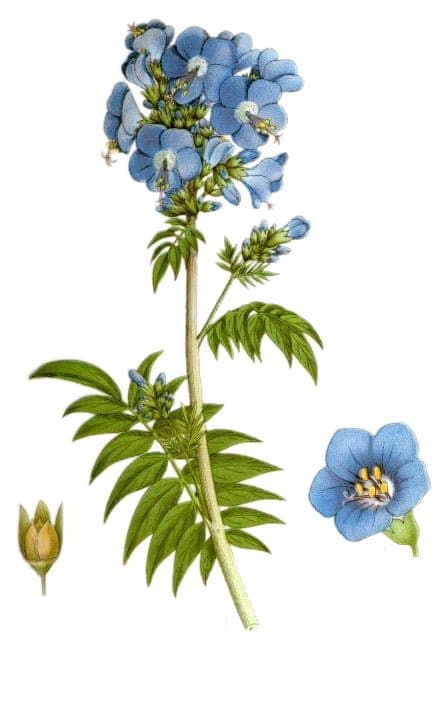
Carl Axel Magnus Lindman / Public domain, via Wikimedia Commons
Jacob's Ladder: complete guide
Polemonium caeruleum
¿Quieres ver Jacob's Ladder: complete guide en tu jardín?
1 minuto, sin tarjeta de crédito
Overview
Jacob's Ladder (Polemonium caeruleum) is a classic garden plant from the Polemoniaceae family, native to Europe through Japan and the Himalayas. This versatile perennial is celebrated for its beautifully structured blue flowers blooming from May to August. It grows as a herbaceous plant, typically reaching 40-60 cm in height, with continuous flowering patterns making it a reliable choice for gardeners of all levels.
Appearance and bloom
The name Jacob's Ladder references the characteristic feathered foliage that resembles ladder rungs. Leaves are deep green, lanceolate, and arranged in opposite pairs along the stems. The flowers are the true showstopper - five-petaled stars in an enchanting sky blue with yellow stamens. Each flower opens delicately and continues blooming for months with proper care. The flowering period runs from May through August, with possible rebloom in autumn if deadheaded regularly.
Ideal location
Jacob's Ladder performs best in full sun to partial shade. While the plant tolerates shade well, it blooms more abundantly in sunlight. Plant where it receives at least 4-6 hours of direct sunlight daily. In very hot climates, afternoon shade provides protection against leaf scorch.
Soil
The plant is not fussy about soil composition but grows best in well-draining, nutrient-rich soil. A pH between 6.5 and 7.0 is ideal. Add compost or peat moss to heavy clay soils to improve drainage. Poor drainage leads to root rot, especially in winter months.
Watering
Keep soil consistently moist but never waterlogged. Water regularly during growing periods, especially in dry spells. Once established, the plant is fairly drought-tolerant. Summer may require daily watering, while winter needs significantly less. Water in early morning to prevent fungal issues.
Diseño gratis
¿Quieres ver Jacob's Ladder: complete guide en tu jardín? Crea un diseño gratis ahora.
Pruning
Regularly remove spent flowers to encourage more blooming. Cut back dead or damaged stems in spring. After summer flowering, you can cut the entire plant back to 10-15 cm above ground to achieve compact growth and more autumn bloomers. Spring pruning prevents leggy growth habit.
Maintenance calendar
Spring (March-April): Prune and remove dead material. Apply organic fertilizer dose. Summer (June-August): Regular watering, deadheading tasks. Autumn (September-October): Second pruning round, winter preparation. Winter: Minimal care, water only during dry spells.
Winter hardiness
Jacob's Ladder is hardy to at least minus 15 degrees Celsius (USDA zone 4), thanks to its origin in cold European regions. In temperate climates, the plant easily survives winter. Mulch around the plant in autumn for extra insulation in very cold areas. The plant dies back to ground level in winter and regrows from the base in spring.
Companion plants
Excellent companion plants include Nepeta (catmint), Geranium (cranesbill), and Aquilegia (columbine). Combine with white or pink flowering shrubs for color contrast. Low-growing groundcovers beneath Jacob's Ladder help suppress weeds and enhance appearance.
Closing
Jacob's Ladder brings elegance and color through May to August blooms to any garden. With minimal care needs and hardy nature, it's ideal for both beginner and experienced gardeners. Available at quality garden centers. Visit gardenworld.app for more garden inspiration. Years of reliable blooms and easy maintenance make Jacob's Ladder a must-have for every plant garden.
For more information about designing your garden, visit gardenworld.app today!
¿Quieres ver Jacob's Ladder: complete guide en tu jardín? Crea un diseño gratis ahora.
Sube una foto, elige un estilo y obtén un diseño fotorrealista con lista de plantas en menos de un minuto.
Más de 10.000 jardines diseñados
Sin tarjeta de crédito


Plantas similares
Phlox alyssifolia: complete guide to Alyssum-leaf Phlox
Phlox alyssifolia
Alyssum-leaf phlox is a compact alpine pink bloomer from North America. Discover care, location and all growing requirements.
Phlox richardsonii: complete guide to Richardson's Phlox
Phlox richardsonii
Richardson's phlox is an arctic bloomer exceptionally robust. Learn cultivation in extreme conditions and complete care guide.
Polemonium foliosissimum: complete guide
Polemonium foliosissimum
Polemonium foliosissimum is a vigorous Rocky Mountain perennial with blue-purple summer flowers that attract pollinators and thrive in borders.