
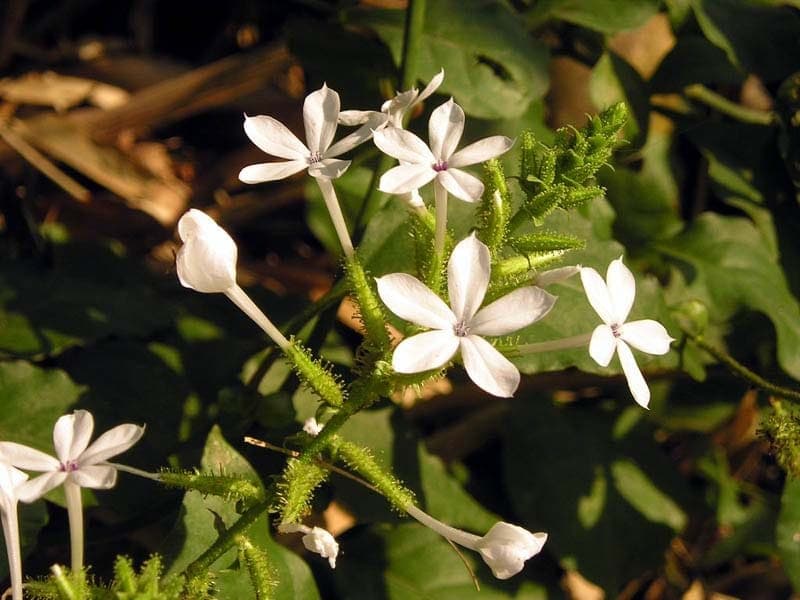
Bernard Loison / CC BY-SA 2.5, via Wikimedia Commons
Ceylon Leadwort: complete guide
Plumbago zeylanica
¿Quieres ver Ceylon Leadwort: complete guide en tu jardín?
1 minuto, sin tarjeta de crédito
Overview
Ceylon Leadwort (Plumbago zeylanica), also known as Doctorbush or Wild Leadwort, is a tropical to subtropical shrub from the Plumbaginaceae family, native to tropical Asia, Africa, and Americas. This versatile plant is renowned for its elegant, white flowers that unfold from May to October, as well as its medicinal applications in traditional Asian medicine.
In Europe, this plant is typically cultivated in containers within heated conservatories or as a seasonal plant on terraces and verandas during warm months. With its abundant flowering, ease of cultivation, and compact footprint, it is highly suitable for greenhouses and tropical gardens.
Via gardenworld.app, discover how to optimally manage this tropical plant in protected environments.
Appearance and bloom
Ceylon Leadwort grows into an upright shrub of 1.5 to 2.5 meters in height, depending on nutrition and climate. The branches are thin, leafy, with lanceolate, dark-green leaves of 5-8 cm length.
The flowers are the spectacle: small to medium-sized, five-petaled, pure white to very pale blue, grouped in cyme-like clusters of 10-20 flowers. They possess a silky appearance, a subtle fine fragrance, and appear continuously from May to October under optimal conditions.
After flowering, small inconspicuous seed capsules develop. The entire plant contains alkaloid compounds (especially in root bark), making it traditionally medicinal.
Ideal location
Provide Ceylon Leadwort with full sun, at least six hours of direct sun daily. In partial shade, flowering is much less abundant.
Indoors: Position before the largest, warmest window in the house (preference: south or west-facing). Supplementary artificial light may help in winter months.
Outdoors (warm season): Terrace or veranda where temperature never drops below 15 degrees Celsius. Wind protection is preferable but not essential.
Soil
Ceylon Leadwort grows on diverse soils, with preference for well-draining, slightly acidic to neutral soil. For container cultivation:
- 50% potting soil
- 25% perlite or lava
- 25% peat moss substitute (coconut or cotton pulp)
The plant enjoys feeding. Add a slow-release fertilizer to potting soil or apply liquid feeding every two weeks.
Diseño gratis
¿Quieres ver Ceylon Leadwort: complete guide en tu jardín? Crea un diseño gratis ahora.
Watering
Keep soil continuously evenly moist, especially during growth and flowering periods. The plant is less drought-tolerant than some other tropical species.
Summer: water 2-3 times weekly, depending on evaporation Winter: reduce watering significantly, but ensure soil does not dry completely
High humidity (50-60%) promotes flowering and offers protection against spider mites. Spray regularly or place on a tray with moist gravel.
Pruning
Ceylon Leadwort responds well to pruning. This promotes more compact growth and richer flowering:
- In spring: cut back to 30-50 cm height
- During growing season: pinch tips to encourage branching
- After flowering: optionally remove overwintered, bare branches
Wind-pruned fragments can be propagated in rooting medium (success 60-80%).
Maintenance calendar
January-March: Minimal growth, careful pruning and watering April-May: Growth accelerates, pruning completed, increase water June-September: Peak flowering, optimal feeding, high humidity October-November: Flowering diminishes, reduce water December: Preparation for winter dormancy
Winter hardiness
Ceylon Leadwort is not winter-hardy outdoors in temperate climates. This is a tropical plant for heated conservatories or seasonal use on protected terraces.
Temperatures below 10-12 degrees Celsius cause growth suppression; below 5 degrees, leaf drop and possible stem death. Ideal growth temperature: 20-28 degrees Celsius.
Companion plants
Ceylon Leadwort harmonizes beautifully in conservatory with:
- Mandevilla (Dipladenia) for red flower contrast
- Jasminum sambac for fragrant white flowers
- Ipomoea for blue morning glory effects
- Hibiscus rosa-sinensis for tropical color
- Ficus benjamina as green background
In plant collections: Combine with complementary tropical plants for collection effect.
Closing remarks
Ceylon Leadwort brings authentic tropical white blooms to your protected indoor environment. For those with warm conservatories and seeking long-lasting, elegant flowering, this plant is a classic choice.
Available through specialty tropical plant nurseries. For growth guidance and conservatory management, consult gardenworld.app.
¿Quieres ver Ceylon Leadwort: complete guide en tu jardín? Crea un diseño gratis ahora.
Sube una foto, elige un estilo y obtén un diseño fotorrealista con lista de plantas en menos de un minuto.
Más de 10.000 jardines diseñados
Sin tarjeta de crédito


Plantas similares
Plumbago: complete guide
Plumbago auriculata
Discover everything about Plumbago auriculata: care instructions, growth habits, appearance, and how to successfully grow this stunning climbing plant in your garden.
Himalayan clematis: complete guide
Clematis montana
Everything you need to know about Clematis montana: fast-growing climber with spring flowers, perfect for walls, fences, and arbors. Care, pruning, and planting tips.
Ipomoea tricolor: complete guide
Ipomoea tricolor
Master Heavenly Blue morning-glory: sunlight requirements, soil prep, watering schedule, and disease management for reliable sky-blue blooms.