
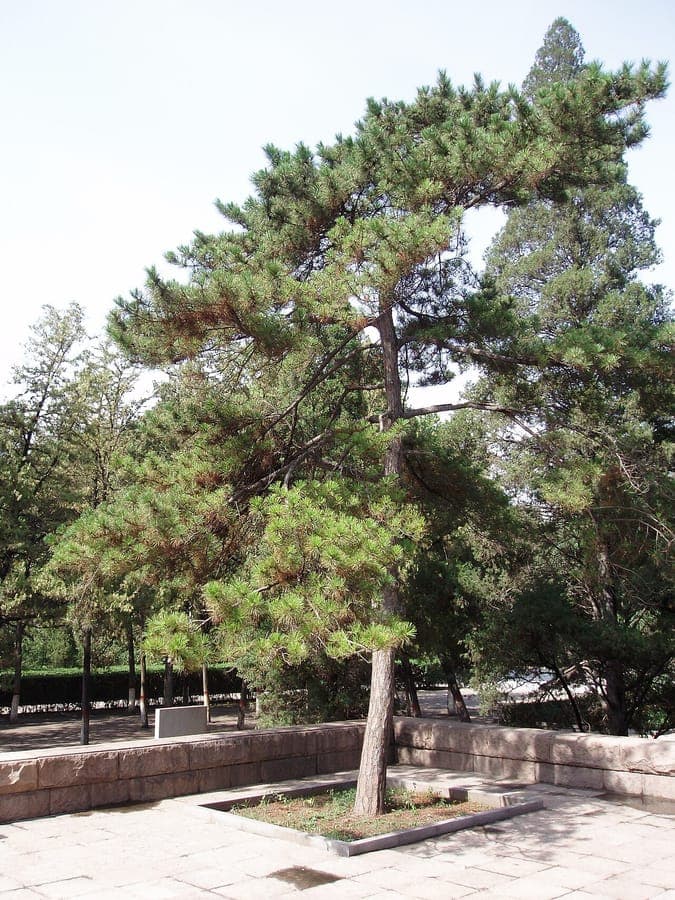
Taken by Fanghong / CC BY-SA 3.0, via Wikimedia Commons
Chinese Pine: Complete Guide
Pinus tabuliformis
¿Quieres ver Chinese Pine: Complete Guide en tu jardín?
1 minuto, sin tarjeta de crédito
Overview
The Chinese Pine or Table-form Pine (Pinus tabuliformis), native to China and Korea, is a unique and ornamental coniferous tree with a characteristic flat, table-like crown form. This medium-sized tree reaches mature heights of 20-25 meters and forms a broad, horizontally-structured silhouette that clearly distinguishes itself from vertical conifers. The tree is known for its adaptability to Asian climates with strong seasonal variations and dry summers. With its regular, table-like form, Chinese Pine is an excellent choice for those seeking an unexpected, architectural shape.
Appearance and Bloom
The needles of Chinese Pine are green and measure 8-15 centimeters, growing in pairs (fascicles of two). They are relatively stiff and give the tree a fairly coarse texture. The tree is particularly striking because of its flat, horizontally-growing branches that spread in wide layers, making the silhouette resemble an inverted table or parasol. The brownish bark forms deep grooves. In spring, yellowish male flowers appear. The cones are 6-10 centimeters long and ripen to grayish-brown.
Ideal Location
Chinese Pine thrives best in a location with full sun. Six to seven hours of direct daylight is desirable for maintaining its beautiful, regular crown form. The tree tolerates fairly dry summers and can withstand moderate wind. Plant it in a position where its unique table-like silhouette is clearly visible, for instance as a central accent in a Japanese or minimalist garden. The tree is also suitable for container cultivation in milder climates. Avoid very windy exposures that may disturb the characteristic flat crown.
Soil
Chinese Pine prefers sandy to loamy, well-draining soils with pH around 6.0-7.0. It accepts both slightly acidic and neutral conditions. Heavy clay soils must be improved with coarse sand and organic material. This is a tree for well-draining soils; waterlogging poses a risk. Once established, soil fertility is less important and the tree thrives on lean soils. Ensure good water drainage especially in winter.
Watering
Chinese Pine is drought-tolerant once established, especially because it originates from mountainous regions with seasonal droughts. During the first growing season, water regularly to keep soil moist. Thereafter, provide supplementary water only during very dry periods. This tree tolerates dry summers well. In very hot, dry regions water weekly in July-August. Winter generally requires no supplementation unless exceptionally dry. Ensure good drainage conditions especially.
Diseño gratis
¿Quieres ver Chinese Pine: Complete Guide en tu jardín? Crea un diseño gratis ahora.
Pruning
Chinese Pine forms its characteristic flat, table-like crown form largely on its own, especially if the tree stands in full sun. Minimal pruning is needed. Remove only dead or damaged branches in late winter. If you wish to further accent the typical flat crown form, carefully cut back vertically growing branches toward lateral branches. This requires some patience and insight. Most trees look best without aggressive pruning.
Maintenance Calendar
January-February: Check frost damage on young trees. Remove dead wood. No fertilizer.
March-April: Observe form. Young trees water regularly. Bark and twig check.
May-July: Normal watering. Careful disease monitoring. No pruning unless necessary.
August-September: Prepare for fall. Reduce watering.
October-November: Fall inspection. Remove old foliage around base.
December: Winter protection for young specimens where needed. Check form.
Winter Hardiness
Chinese Pine is moderately hardy and tolerates temperatures down to approximately -12 to -15 degrees Celsius. Young trees may suffer frost damage in severe winters, especially in open locations. In cold climates best protected with frost cloth or screen. Wet winter soils pose greater risk than cold itself. Once established (four to five years), winter hardiness improves. In milder climates or protected locations this tree grows without problems.
Companion Plants
Chinese Pine works beautifully in Asian-inspired gardens. Combine with other oriental trees and bamboo. Low growers such as Acer palmatum (Japanese Maple) form elegant contrast. Underplanting with Carex (sedges) and small groundcovers supports the distinguished character. For modern gardens it can also stand alone as an accent. Avoid compact plantings; let its unique form remain free.
Closing Thoughts
Chinese Pine offers an unexpected, architectural form that clearly distinguishes itself from common conifers. With its table-like silhouette, it is a statement plant for minimalist and Asian-inspired gardens. Plant it in full sun, ensure good drainage, and admire its unique form development. For retailers: check with specialized tree nurseries; this species is not universally stocked. More about exotic conifers on gardenworld.app.
Practical References
Gardenworld.app helps with design of Asian-inspired gardens. Chinese Pine is a long-term source of structure and character.
¿Quieres ver Chinese Pine: Complete Guide en tu jardín? Crea un diseño gratis ahora.
Sube una foto, elige un estilo y obtén un diseño fotorrealista con lista de plantas en menos de un minuto.
Más de 10.000 jardines diseñados
Sin tarjeta de crédito


Plantas similares
Montezuma Pine: Complete Guide
Pinus montezumae
Discover the spectacular Montezuma Pine (Pinus montezumae), a dramatic Mexican conifer with exceptionally long needles and rough bark. Perfect privacy tree and structural focal point for large gardens.
Red Pine: Complete Guide
Pinus resinosa
Discover the Red Pine (Pinus resinosa), an elegant North American conifer with striking reddish young bark. Perfect form for mixed needle forest landscapes.
Loblolly pine: complete guide
Pinus taeda L.
The Loblolly pine (Pinus taeda) is a fast-growing American conifer with warm golden-green foliage. Discover cultivation, care, and landscape applications of this impressive tree.