
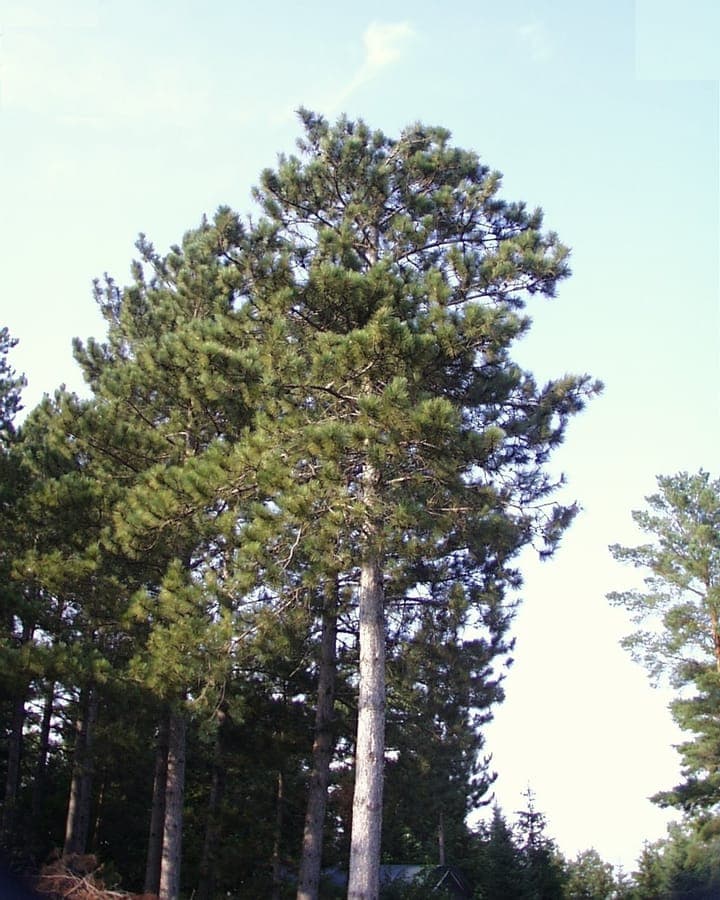
Wikimedia Commons / Public domain, via Wikimedia Commons
Red Pine: Complete Guide
Pinus resinosa
¿Quieres ver Red Pine: Complete Guide en tu jardín?
1 minuto, sin tarjeta de crédito
Overview
The Red Pine or Canadian Red Pine (Pinus resinosa) is an elegant yet robust coniferous tree native to Canada and the northeastern parts of North America. This majestic conifer is known for its characteristic bright red young bark that contrasts beautifully against dark green needles. The mature tree reaches heights up to 25 meters with a regular, conical crown form. The Red Pine is widely used in forest landscapes and large gardens because it prefers well-draining acidic soils and is not susceptible to many common needle tree diseases.
Appearance and Bloom
The evenly distributed, long needles of Red Pine are dark green and measure 10-16 centimeters. They grow in pairs (fascicles of two) and give the tree a very regular, fine texture. The most striking feature, however, is the young, brilliant red bark that stands out brightly in light. As the tree ages, this red bark darkens to grayish-brown. The cylindrical, brown cones reach 5-8 centimeters in length. In early spring, inconspicuous reddish male flowers appear.
Ideal Location
Red Pine thrives best in a location with full sun. Minimum five to six hours of direct daylight is necessary. The tree prefers locations with well-draining soil and somewhat drier conditions. Because it is native to northern forest regions, it tolerates cold winters excellently. Position it where its characteristic red young bark is clearly visible, for instance against a dark background of deciduous trees. It can also be used as a windbreak, though not in the harshest wind situations.
Soil
Red Pine prefers acidic, well-draining soils with pH between 4.5-6.5. Sandy loams with organic matter are ideal. It does not perform well in heavy clay soils or waterlogging conditions. Add sand and compost for improvement at planting time. This is a tree for "poor" soils, like many conifers - it does not demand much fertility but requires good drainage. Once established it can manage with lean soil.
Watering
Red Pine is reasonably drought-tolerant once established but grows faster and looks better with regularly moist yet well-draining soil during the growing season. During the first year after planting, water regularly so soil does not dry out. After that, in normal years provide moisture only during prolonged dry periods. In sandy soils during hot summers water weekly. Ensure good drainage in winter; waterlogged soil poses the greatest risk.
Diseño gratis
¿Quieres ver Red Pine: Complete Guide en tu jardín? Crea un diseño gratis ahora.
Pruning
Red Pine naturally forms an attractive, regular conical shape and requires very little pruning. Remove only dead or damaged wood in late winter or early spring. This tree does not tolerate heavy pruning well; it recovers poorly. The long needles and regular form are essential to its beauty. Prune very carefully and only where truly necessary. A mature tree hardly ever needs pruning.
Maintenance Calendar
January-February: Frost check on young trees. Remove dead branches. No fertilizer needed.
March-April: Observe growth. Young trees water regularly. Bark inspection.
May-July: Normal watering regimen. Monitor diseases. No pruning.
August-September: Prepare for fall. Reduce watering.
October-November: Fall check. Possible leaf removal around trunk.
December: Winter protection for young specimens where needed.
Winter Hardiness
Red Pine is very hardy and performs better in cold climates than warm. The tree tolerates temperatures down to -30 degrees Celsius without problems. Its natural habitat (boreal forests of Canada and northern USA) indicates its preference for cold periods. In mild winter climates it may have adaptation difficulties. This is a tree for northern and alpine gardens. Once established, winter protection is not needed.
Companion Plants
Red Pine forms beautifully in mixed coniferous forest landscapes. Combine with other conifers such as Picea (spruce), Larix (larch), or Pinus sylvestris (Scots pine). The red bark contrasts nicely with dark deciduous tree silhouettes. Groundcovers such as Hedera helix (ivy) or mosses support the natural forest feel. For large gardens this is an excellent structural plant.
Closing Thoughts
Red Pine delivers elegance and naturalness to large gardens and forest landscapes. With its characteristic red young bark and regular form, it is an excellent choice for those who appreciate native North American conifers. Plant it in acidic, well-draining soil and let it grow. For retailers: OBI and Hornbach stock this species. More design tips on gardenworld.app.
Practical References
Gardenworld.app helps with selection of suitable trees for your climate zone. Red Pine is a long-term investment in garden beauty.
¿Quieres ver Red Pine: Complete Guide en tu jardín? Crea un diseño gratis ahora.
Sube una foto, elige un estilo y obtén un diseño fotorrealista con lista de plantas en menos de un minuto.
Más de 10.000 jardines diseñados
Sin tarjeta de crédito


Plantas similares
Montezuma Pine: Complete Guide
Pinus montezumae
Discover the spectacular Montezuma Pine (Pinus montezumae), a dramatic Mexican conifer with exceptionally long needles and rough bark. Perfect privacy tree and structural focal point for large gardens.
Table Mountain Pine: Complete Guide
Pinus pungens
Discover the Table Mountain Pine (Pinus pungens), a robust American conifer with short needles and distinctive sharp cones. Ideal for coastal-hardy and frost-resistant landscapes.
Loblolly pine: complete guide
Pinus taeda L.
The Loblolly pine (Pinus taeda) is a fast-growing American conifer with warm golden-green foliage. Discover cultivation, care, and landscape applications of this impressive tree.