
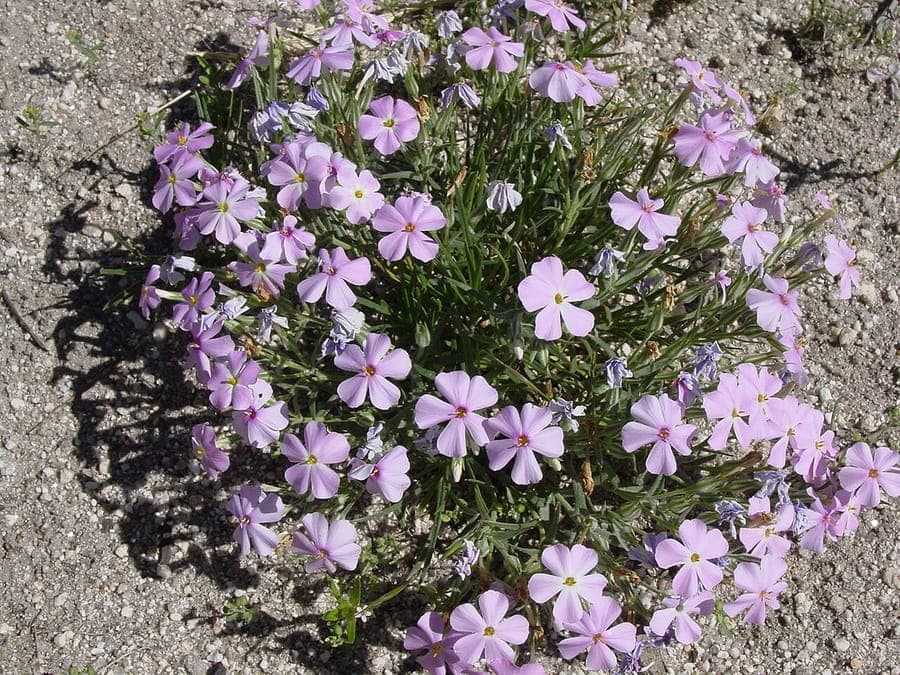
Wallace Keck / Public domain, via Wikimedia Commons
Longleaf phlox: complete guide
Phlox longifolia
¿Quieres ver Longleaf phlox: complete guide en tu jardín?
1 minuto, sin tarjeta de crédito
Overview
Phlox longifolia, named for its distinctively long, narrow leaves, is a North American dryland perennial ranging from western Canada to the western and west-central United States. This Polemoniaceae member naturally inhabits open, dry, grassy slopes of plateau mountains. In gardens, it forms dense, upright clumps 30-50 cm tall with characteristically elongated foliage and purple to pink flowers in May-June. Drought-tolerant and exceptionally cold-hardy, it excels in dry borders and xeriscaping schemes.
Appearance and bloom time
Longleaf phlox grows as upright, well-branched clumps about 30-50 cm tall with concentrated leaf mass. The defining feature is the long, fine, narrow foliage extending from base to apex of stems. These elongated leaves impart the plant's distinctive character. Stems are multiple and form dense, upright bundles. Flowers emerge in May-June as medium-sized blooms roughly 1-1.5 cm across in shades of pink, purple, or occasionally white. Flowering is moderate to good. Fragrance is subtle and sweet.
Ideal location
Longleaf phlox thrives in full sun, well-ventilated positions with minimum 6-8 hours of direct daily light. Half-shade is tolerated but flowering diminishes. The plant prefers open, mountain-like conditions. Sheltered spots are less favorable. Avoid humid, warm corners. Alpine-like, windy environments deliver best performance.
Soil
Longleaf phlox prefers well-draining, sandy to gravelly soil, pH 6.5 to 7.5. Heavy clay requires significant amendment: add sand, gravel, or perlite for improved drainage. In pots: use universal growing medium plus perlite blend. Organic matter in moderate quantities is appropriate. Avoid constantly moist, waterlogged conditions. Drought tolerance increases with plant age.
Diseño gratis
¿Quieres ver Longleaf phlox: complete guide en tu jardín? Crea un diseño gratis ahora.
Watering
Established longleaf phlox tolerate considerable drought; young specimens require more regular watering. During the first growing season, water when the top 2-3 cm feels dry. After establishment (1-2 years), water only during prolonged droughts. Summer rainfall usually suffices. Preference leans toward the drier side; avoid waterlogging. Water at soil level, not overhead.
Pruning
Following bloom (July), spent flower stems may be cut back to young foliage. Long, weak stems can be shortened to 10-15 cm to restore compactness. In spring, remove dead foliage. This is a delicate plant; excessive pruning damages it. Maintain natural growth patterns by intervening minimally.
Maintenance calendar
April: Spring cleanup - remove dead foliage. May-June: Peak bloom. Water young plants regularly. July: Bloom concludes. Remove spent flower material. August-October: Autumn progresses slowly. Water sparsely. November-March: Winter dormancy.
Winter hardiness
Longleaf phlox is winter-hardy to USDA zones 4-5. This renders it suitable for northern Netherlands. Established plants survive severe winters without protection. Young plants benefit from light leaf-mold mulch coverage in the first winter.
Companion plants
Longleaf phlox pairs beautifully with other dry-garden residents. Fine grasses, Salvias, Artemisias, Sedums, small Geraniums. For flower contrast: yellow Alyssum saxatile, orange Helianthemum, blue Veronica, pink Dianthus. In dry borders grouped with Coreopsis, Gaillardia, and Achillea for self-sustaining landscapes.
Conclusion
Longleaf phlox offers a rare combination: distinctive elongated foliage, reliable drought-tolerance, cold-hardiness, and medium-sized pink flowers. Perfect for dry, sunny gardens where conventional phlox falter. Once established, it thrives for years with minimal attention. This is genuine xeriscaping foundation material.
¿Quieres ver Longleaf phlox: complete guide en tu jardín? Crea un diseño gratis ahora.
Sube una foto, elige un estilo y obtén un diseño fotorrealista con lista de plantas en menos de un minuto.
Más de 10.000 jardines diseñados
Sin tarjeta de crédito


Plantas similares
Phlox alyssifolia: complete guide to Alyssum-leaf Phlox
Phlox alyssifolia
Alyssum-leaf phlox is a compact alpine pink bloomer from North America. Discover care, location and all growing requirements.
Phlox richardsonii: complete guide to Richardson's Phlox
Phlox richardsonii
Richardson's phlox is an arctic bloomer exceptionally robust. Learn cultivation in extreme conditions and complete care guide.
Polemonium foliosissimum: complete guide
Polemonium foliosissimum
Polemonium foliosissimum is a vigorous Rocky Mountain perennial with blue-purple summer flowers that attract pollinators and thrive in borders.