
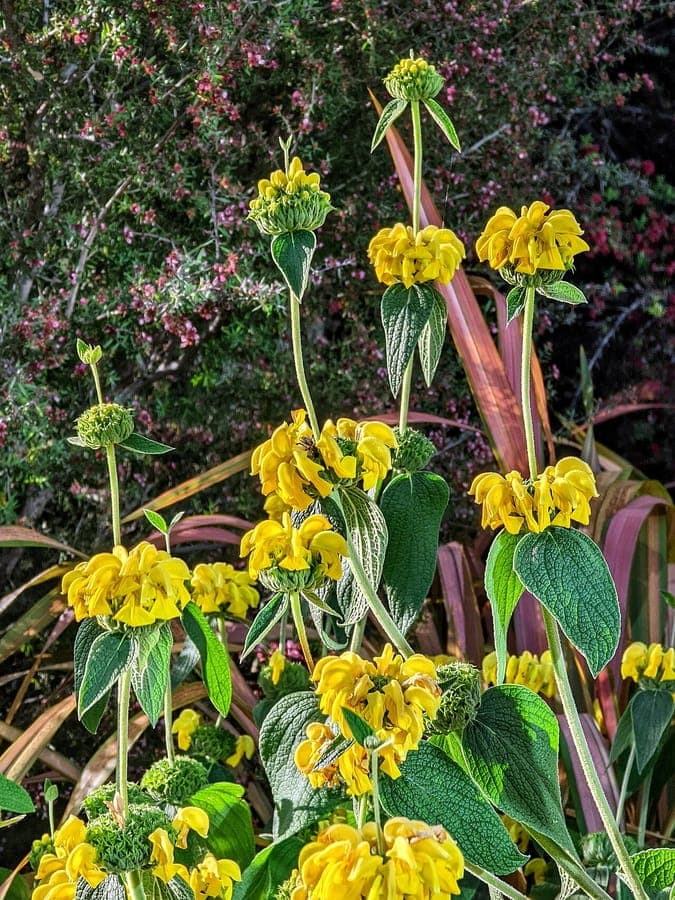
Dicklyon / CC BY-SA 4.0, via Wikimedia Commons
Phlomis russeliana: complete guide
Phlomis russeliana
¿Quieres ver Phlomis russeliana: complete guide en tu jardín?
1 minuto, sin tarjeta de crédito
Overview
Turkish sage (Phlomis russeliana) is a robust, semi-evergreen shrub originating from northern Turkey. This plant belongs to the Lamiaceae family and is known for its exceptional frost hardiness and resilience. With its imposing height of up to 1 metre and wide growth form, Phlomis russeliana creates an impressive structural plant in modern and naturalistic gardens.
The plant bears large, grey-green leaves and yellow flowers that form in characteristic spiky whorls. This gives the plant unique, highly decorative qualities that remain present even after flowering thanks to the interesting seed capsule structures. The plant is extremely drought-tolerant and grows almost anywhere you want to plant it, as long as it drains well.
Appearance and Bloom
Phlomis russeliana develops into a full, bushy shrub with a natural, irregular growth form. The leaves are large, oblong-heart-shaped and densely covered with grey tomentose hairs, making them appear grey-green. The leaves can reach 10-15 centimetres long and maintain their colour throughout most of the year.
Flowers appear from August to September in striking yellow clusters on upright stems. The inflorescence consists of multiple whorls of approximately 2 centimetre wide, two-lipped flowers. After flowering, useful seed capsules form that are highly decorative and provide bird seed.
The plant typically reaches a height of 80-120 centimetres and a width of 60-90 centimetres, depending on growing conditions.
Ideal Location
Phlomis russeliana grows optimally in full sun, although it also thrives reasonably well in lightly shaded locations. Ensure at least 5-6 hours of direct sunlight daily. The plant is much less frost-sensitive than its relative Phlomis fruticosa and functions well in more northerly climates.
Plant the shrub where there is good air circulation to prevent fungal infections. Avoid waterlogged spots and areas where water stagnates, especially in winter.
Soil Preparation
Turkish sage requires well-draining, preferably poor to moderately fertile soil. The plant tolerates chalky, neutral and even slightly acidic soils. Heavy clay soils should be amended with sand (30-40%) and gravel.
Avoid excessively rich soils, as this promotes excessive nitrogen growth at the expense of flowering. Moderately fertile to poor soils produce the most attractive, compact plants with rich flowering.
Diseño gratis
¿Quieres ver Phlomis russeliana: complete guide en tu jardín? Crea un diseño gratis ahora.
Watering
After planting, water regularly for the first three weeks. Once established, Phlomis russeliana is extremely drought-tolerant and can thrive with minimal rainfall.
Water when the top 3-4 centimetres of soil feel dry. Under normal growing conditions, rainwater is sufficient, and extra water can even be detrimental to the plant. Especially in winter, avoid excessive watering, which can cause root rot.
Pruning and Maintenance
Prune in spring (March-April) for the best shape. Remove all damaged or dead branches. The plant responds well to pruning and can be cut back up to 30% of its height if it becomes too large.
Deadheading (removing spent flowers) extends the flowering period, although many gardeners leave the seed heads for their ornamental value and bird food.
Maintenance Calendar
March-April: Spring inspection, remove dead wood, no heavy pruning. April-May: Growing season begins, water as needed. August-September: Flowering period, enjoy the yellow blooms. October-November: Prepare for winter, stop nitrogen. December-February: Winter dormancy, minimal water.
Winter Hardiness
Phlomis russeliana is considerably hardier than Phlomis fruticosa and tolerates temperatures down to -15 to -18 degrees Celsius. In most European gardens no winter protection is needed. The plant is suitable for gardens in climate zones 6-10.
Once established, the plant is robust and requires no special winter support, even in fairly cold winters.
Companion Plants
Turkish sage works well with other drought-loving Mediterranean plants and hardy shrubs. Combine it with lavender, santolina, grey-leaved artemisia and rosemary for Mediterranean theme gardens.
Structural plants such as ornamental grasses (Miscanthus, Festuca glauca) create attractive texture contrasts. Add groupings such as geranium sanguineum and other hardy geraniums.
For bird appeal, plant alongside flowering shrubs that offer bird seed (such as other Phlomis species) and fruits (Ilex verticillata).
Conclusion
Phlomis russeliana is an excellent choice for gardeners seeking a robust, low-maintenance and winter-hardy shrub. This Turkish original offers years of structure, interesting architecture and yellow flowers. The plant is available at many specialized garden centres. Combine it in your front yard with complementary plants and enjoy a Mediterranean ambiance year-round. Discover more design ideas at gardenworld.app and make your dream garden a reality with our professional garden designs.
¿Quieres ver Phlomis russeliana: complete guide en tu jardín? Crea un diseño gratis ahora.
Sube una foto, elige un estilo y obtén un diseño fotorrealista con lista de plantas en menos de un minuto.
Más de 10.000 jardines diseñados
Sin tarjeta de crédito


Plantas similares
Phlomis fruticosa: complete guide
Phlomis fruticosa
Learn all about Jerusalem sage (Phlomis fruticosa): cultivation, care, flowers, maintenance and winter hardiness. Practical tips for your garden.
Phlox paniculata: complete guide
Phlox paniculata
Everything about garden phlox (Phlox paniculata): growth, fragrance, beautiful flowers, pruning and propagation. Classic summer bloomer for borders.
Phlox drummondii: complete guide
Phlox drummondii
Learn all about Drummond's phlox (Phlox drummondii): seeds, growth, colourful flowers, care and propagation. Perfect for full sun locations.