
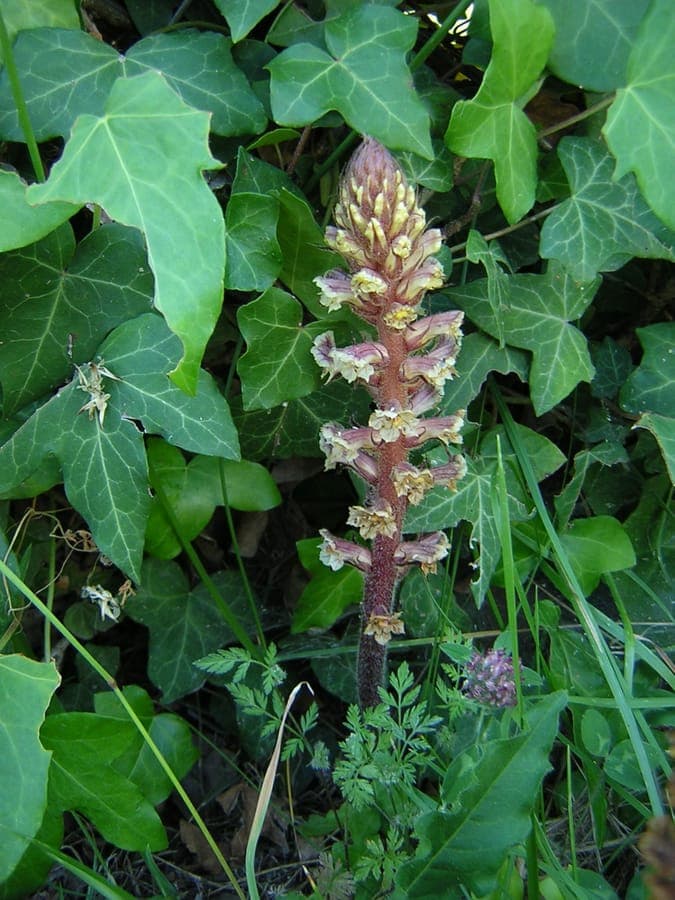
No machine-readable author provided. Aroche assumed (based on copyright claims). / CC BY 2.5, via Wikimedia Commons
Orobanche hederae: complete guide
Orobanche hederae
¿Quieres ver Orobanche hederae: complete guide en tu jardín?
1 minuto, sin tarjeta de crédito
Overview
Orobanche hederae, commonly called ivy broomrape, is a distinctive parasitic plant from the Orobanchaceae family. This species ranges from Macaronesia and western Europe through the Mediterranean region to northern Iran. It is one of the few Orobanche species that specifically parasitizes ivy (Hedera species).
The plant demonstrates fascinating adaptation to its host, ivy. This climbing plant provides a stable platform for the parasite, resulting in interesting growth patterns. The species is especially common in southern Europe where ivy is widely distributed.
Appearance and Bloom
Ivy broomrape typically grows 20 to 40 centimeters in height, making it shorter than many other Orobanche species. The plant completely lacks green foliage since photosynthesis is unnecessary. Instead, it displays yellowish to brownish scale-like structures.
The flowers are fairly small but attractive, with purple to reddish coloration. They appear from May through October, depending on region and climatic conditions. The flowers have a tubular form with a prominent upper lip.
The blooming period is notably long compared to many other Orobanche species. This provides insects with extended opportunities for pollination and results in good seed production.
Ideal Location
Ivy broomrape thrives best where ivy grows abundantly. This includes walls, rock faces, trees, and other vertical surfaces where ivy establishes. The plant prefers moderate shade to half sun.
In natural habitats, this plant occurs primarily in Mediterranean regions with mild winters. Coastal cliff faces and woodlands with abundant ivy are most likely locations.
The species is particularly abundant in western Europe, emphasizing maritime regions such as France, Spain, Portugal, and Belgium. Its occurrence indicates favorable climatic conditions.
Soil
The soil requirements of ivy broomrape are determined by ivy's preferences. This host plant can grow on highly variable soils, from very stony to reasonably nutrient-rich.
As with most Orobanche species, well-draining soils are important. Waterlogging can cause fungal problems. However, ivy can grow on much wetter sites than many other host plants.
Calcareous soils are not strictly necessary, though ivy thrives on both acid and alkaline soils.
Diseño gratis
¿Quieres ver Orobanche hederae: complete guide en tu jardín? Crea un diseño gratis ahora.
Watering
Ivy broomrape requires little direct water since it obtains nutrition and moisture through ivy. However, healthy ivy requires regular water, especially during dry periods and in the establishment phase.
In temperate climates, natural rainfall usually provides sufficient water. In drier Mediterranean climates, supplementary watering may be beneficial.
Excessive watering should be avoided as it can promote algae and moss growth on ivy and cause diseases.
Pruning
Pruning is not directly applicable to ivy broomrape itself. The parasite cannot be pruned independently.
However, pruning of its host, ivy, affects the parasite. Heavy pruning of ivy can compromise broomrape survival. Therefore, careful pruning is advisable.
Dead flowers can be removed for aesthetic reasons, but this is not necessary for plant health.
Maintenance Calendar
Spring (March-May): Ivy broomrape begins growth as ivy starts sprouting. First flowers can appear as early as May.
Summer (June-August): This is the primary blooming period with peak activity. July and August show peak flowering.
Autumn (September-October): Blooming can continue through October. Seed capsules begin ripening.
Winter (November-February): The plant rests underground. In harsh winters, many plants may die, though many Mediterranean populations survive.
Winter Hardiness
Ivy broomrape is moderately winter-hardy. In temperate western European climates, it can survive to -10°C. In harsher continental climates, severe winters can kill many plants.
Winter hardiness depends heavily on ivy's health. Healthy ivy can tolerate temperatures to -20°C, which aids broomrape survival.
Companion Plants
The essential companion for ivy broomrape is ivy (Hedera species). This is the only plant on which this parasite can grow.
In natural habitats, ivy broomrape grows alongside shade-loving plants such as ferns, ivy varieties, and mosses. This creates interesting shaded plant communities.
Closing Thoughts
Orobanche hederae demonstrates how specialized parasitic plants can become. The close relationship with ivy is an example of co-evolution between parasite and host.
More information about this and other fascinating parasitic plants can be found on gardenworld.app. Explore ivy species and their role in ecosystems. gardenworld.app provides comprehensive guides for understanding plant relationships.
Ask experts at specialized plant retailers for information about native parasitic plants and their roles in gardens. These specialists understand the special relationships between parasites and hosts.
¿Quieres ver Orobanche hederae: complete guide en tu jardín? Crea un diseño gratis ahora.
Sube una foto, elige un estilo y obtén un diseño fotorrealista con lista de plantas en menos de un minuto.
Más de 10.000 jardines diseñados
Sin tarjeta de crédito


Plantas similares
Orobanche caryophyllacea: complete guide
Orobanche caryophyllacea
Bedstraw broomrape discovery: ecology, appearance, bloom and location. Everything about this parasitic plant with practical cultivation information and insights.
Orobanche elatior: complete guide
Orobanche elatior
Tall broomrape discovery: characteristics, bloom, ecology and cultivation. Complete information about this fascinating parasitic plant with care tips.
Orobanche minor: complete guide
Orobanche minor
Clover broomrape discovery: ecology, appearance, bloom and care. Complete guide for this widely distributed parasitic plant.