
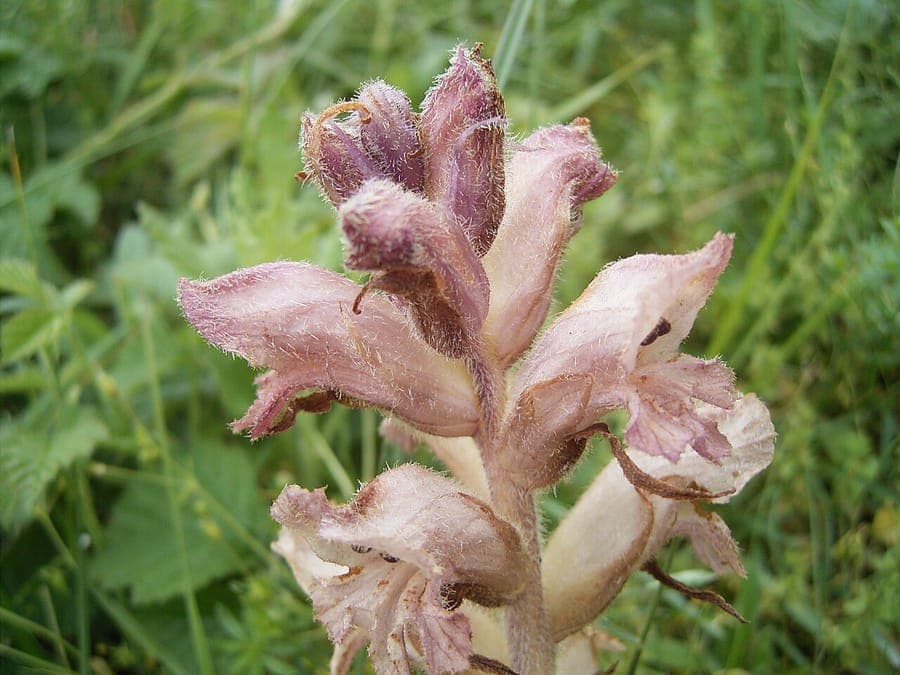
self / CC BY-SA 3.0, via Wikimedia Commons
Orobanche caryophyllacea: complete guide
Orobanche caryophyllacea
¿Quieres ver Orobanche caryophyllacea: complete guide en tu jardín?
1 minuto, sin tarjeta de crédito
Overview
Orobanche caryophyllacea, commonly called bedstraw broomrape, is a fascinating parasitic plant belonging to the Orobanchaceae family. This remarkable species employs a unique biological strategy whereby it lives entirely as a parasite on its host plants for nutrition. Found from Europe through Xinjiang and Pakistan to Northwest Africa, this plant particularly favors sticky cleavers (Galium species) as its host. The parasitic lifestyle makes this an intellectually engaging subject for botanists and garden ecologists alike.
This plant demonstrates how intricate natural relationships can be. Rather than conducting photosynthesis, Orobanche caryophyllacea absorbs nutrients directly from its host plant's roots. This singular adaptation makes it a valuable research subject for biologists and plant enthusiasts.
Appearance and Bloom
Bedstraw broomrape displays a characteristic appearance with an unusual form and coloration. The plant typically grows between 30 to 60 centimeters in height, though some specimens may be shorter. The flower head is compact and densely populated with blooms displaying striking yellow to purple tones.
The flowers appear from May through July and are quite beautiful, with tubular shapes that attract insects. Each individual flower contains vital reproductive structures. The plant lacks green leaves entirely since these are unnecessary for its parasitic nutrition strategy. Instead, we observe scale-like, pale structures that perform the functional role of leaves.
The root system is uniquely adapted: rather than conventional roots, this parasite develops haustoria that attach to host plant roots. This specialized system allows the plant to absorb nutrients and water directly from its host.
Ideal Location
Orobanche caryophyllacea thrives best where its host plants occur naturally. This typically means dry to moderately moist soils with abundant cleavers populations. The plant prefers partial shade to full sun depending on the region.
In Europe, this species occurs on nutrient-poor and calcareous soils. Locations on hillsides or slopes are often ideal as they ensure proper drainage. Grasslands, dry meadows, and natural habitats are where this plant most commonly occurs.
The plant spreads readily in areas with regular disturbance such as grazed meadows. Natural habitats along woodland edges and in dry valleys are also suitable.
Soil
The soil requirements of bedstraw broomrape are particular because it doesn't absorb nutrients directly through conventional roots. Its host plants, however, prefer neutral to alkaline soils. A pH of 7 to 8 is ideal.
The soil must be well-draining, without excess moisture that could promote fungal diseases. Nutrient-rich soils are not necessary since the parasite obtains nutrition through its host. However, humus-poor soils are not optimal for host plant growth.
In garden settings, bedstraw broomrape grows best where its host plants flourish. These prefer calcareous, dry soils without artificial fertilizers.
Diseño gratis
¿Quieres ver Orobanche caryophyllacea: complete guide en tu jardín? Crea un diseño gratis ahora.
Watering
Bedstraw broomrape requires little direct water since it obtains water and nutrients through its host plant. However, supplementary watering during dry periods can benefit the host plants.
In temperate climates, natural rainfall is usually sufficient. In dry summers, occasional watering helps, particularly for young plants.
Overwatering should be avoided as it can promote fungal diseases and harm the host plant's viability.
Pruning
Pruning is not applicable to Orobanche caryophyllacea in the traditional sense. It's not a shrub or herb you would regularly trim. Dead flower stems can be removed after blooming for a tidier appearance.
The plant completes its life cycle within the growing season. In autumn, all above-ground parts die back and only the underground system overwinters.
In temperate climates, removing volunteer plants may be helpful to prevent unwanted spread, though this species rarely becomes aggressive in gardens.
Maintenance Calendar
Spring (March-May): Bedstraw broomrape emerges from dormancy as its host plant begins growth. Initial seedlings appear from mid-March through May.
Summer (June-August): Blooming reaches its peak in July. After flowering, seed capsules form. Seed pods mature by late August.
Autumn (September-October): Seed dispersal occurs. Above-ground parts die back as the plant prepares for winter dormancy.
Winter (November-February): The plant rests dormant. The underground system can overwinter under appropriate conditions.
Winter Hardiness
Orobanche caryophyllacea is winter-hardy in temperate European climates. The plant survives freezing as long as the soil doesn't become waterlogged. Temperatures down to -15°C are tolerated.
In more extreme cold regions, supplemental protection may be beneficial, though many populations naturally die back in severe winters.
Companion Plants
The primary companion for bedstraw broomrape is naturally its host plant, cleavers (Galium species). Without this plant, the parasite cannot survive.
In natural habitats, bedstraw broomrape grows alongside other lime-loving herbs such as oregano, thyme, and lavender. These plants create the appropriate ecological environment.
Closing Thoughts
Orobanche caryophyllacea is an exceptional plant that demonstrates how intricate natural relationships can be. This parasitic species has perfectly adapted to living as a dependent on its host plant. For gardeners and nature enthusiasts, this plant offers a fascinating study subject.
On gardenworld.app you can find details about other Orobanche species and parasitic plants. Explore cleaver species too to understand the complete ecology. gardenworld.app reveals much more about these special plant groups.
For questions, always contact specialized plant retailers, where experts gladly share more information about native flora and parasitic relationships in gardens.
¿Quieres ver Orobanche caryophyllacea: complete guide en tu jardín? Crea un diseño gratis ahora.
Sube una foto, elige un estilo y obtén un diseño fotorrealista con lista de plantas en menos de un minuto.
Más de 10.000 jardines diseñados
Sin tarjeta de crédito


Plantas similares
Orobanche elatior: complete guide
Orobanche elatior
Tall broomrape discovery: characteristics, bloom, ecology and cultivation. Complete information about this fascinating parasitic plant with care tips.
Orobanche minor: complete guide
Orobanche minor
Clover broomrape discovery: ecology, appearance, bloom and care. Complete guide for this widely distributed parasitic plant.
Orobanche hederae: complete guide
Orobanche hederae
Ivy broomrape discovery: characteristics, bloom, ecology and care. Complete guide for this specialized parasitic plant on ivy.