
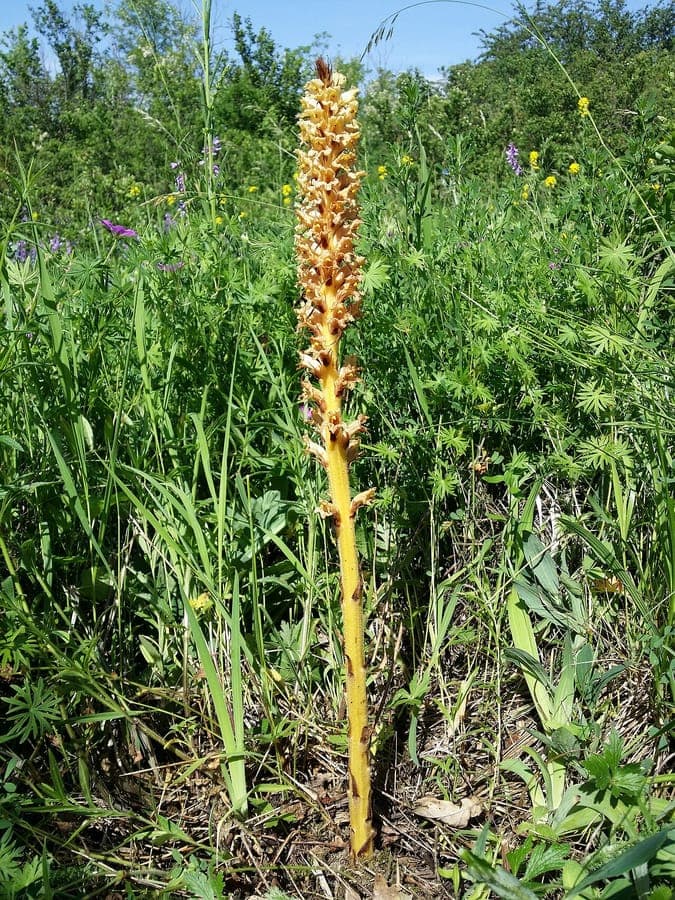
Stefan.lefnaer / CC BY-SA 4.0, via Wikimedia Commons
Orobanche elatior: complete guide
Orobanche elatior
¿Quieres ver Orobanche elatior: complete guide en tu jardín?
1 minuto, sin tarjeta de crédito
Overview
Orobanche elatior, commonly known as tall broomrape or knapweed broomrape, is a remarkable parasitic plant from the Orobanchaceae family. This species ranges from Europe through northwestern and central China to northern Iran. The plant primarily parasitizes knapweeds (Centaurea species), from which its common name derives.
The parasitic lifestyle of tall broomrape is biologically fascinating. Rather than conducting photosynthesis, this plant directly absorbs nutrients from the roots of knapweed species. This makes it a unique study subject for botanists and garden ecologists.
Appearance and Bloom
Tall broomrape grows as a distinctive plant reaching 60 centimeters in height with thick, fleshy-looking stems. The plant completely lacks green foliage because photosynthesis is unnecessary. Instead, it displays scale-like, yellowish structures characteristic of parasitic plants.
The flowers are the most striking feature. They appear from May through August in compact spikes displaying beautiful yellow to purple coloration. The flowers have a tubular shape with two lips that attract insects for pollination.
After pollination, seed capsules form. These capsules contain thousands of tiny seeds dispersed by wind to locate suitable host plants.
Ideal Location
Tall broomrape thrives best where knapweeds occur naturally. These are typically found on dry to moderately moist meadows and grasslands. The plant prefers partial shade to full sun.
In natural habitats, this plant occurs on dry hillsides, nutrient-poor meadows, and along forest edges. It particularly thrives in regions with warm summers and regular spring rainfall.
The presence of tall broomrape indicates healthy, non-degraded ecosystems. The plant grows alongside other wildflowers in well-managed natural areas.
Soil
The soil requirements of tall broomrape are determined largely by its host plant's preferences. Knapweed prefers neutral to slightly alkaline soils with pH 6.5 to 8.
Well-draining soils without waterlogging are essential. Nutrient-rich, heavily amended soils are not ideal; nutrient-poor soils are actually preferable. The plant grows well on stony, calcareous soils.
Humus-rich soils can help support knapweed growth, though these host plants are not particularly demanding regarding soil quality.
Diseño gratis
¿Quieres ver Orobanche elatior: complete guide en tu jardín? Crea un diseño gratis ahora.
Watering
Tall broomrape requires little direct water since it obtains moisture and nutrients through its host plant. However, well-established knapweeds need regular water, especially during dry periods.
Natural rainfall is usually sufficient in temperate climates. During dry summers, supplementary watering helps host plants and thus indirectly benefits the broomrape.
Overwatering should be avoided as it can cause fungal diseases and harm knapweed growth.
Pruning
Pruning is not applicable to tall broomrape in the traditional sense. The plant is not woody and requires no regular trimming.
Dead flower spikes can be removed after blooming for tidier appearance, but this is not strictly necessary. The plant naturally dies back in autumn.
The underground portions overwinter and regrow the following year as the host plant emerges.
Maintenance Calendar
Spring (March-May): The plant begins growth as its host plant emerges. Seedlings can appear by April and grow rapidly.
Summer (June-August): This is the flowering period. July marks peak bloom. After August, seed formation begins.
Autumn (September-October): Seed capsules mature. The plant prepares for winter dormancy.
Winter (November-February): The plant rests underground. In severe winters, many plants may die, but seeds can persist in soil.
Winter Hardiness
Tall broomrape is winter-hardy in temperate European climates. The plant tolerates temperatures down to -10 to -15°C. In colder regions, harsh winters can kill many plants.
Winter hardiness also depends on soil drainage. The plant survives better on well-drained soils than on wet sites.
Companion Plants
The natural and essential companion for tall broomrape is knapweed (Centaurea species). Without this plant, the parasite cannot survive.
In natural habitats, tall broomrape grows with other wildflowers such as marjoram, thyme, lavender, and other yellow-flowered species. This plant community creates interesting bloom sequences throughout the season.
Closing Thoughts
Orobanche elatior is a fascinating plant demonstrating the importance of parasitic relationships in ecosystems. Its elegant flowers and unique lifestyle make it a valuable study subject.
More information about this and other parasitic plants can be found on gardenworld.app. Explore knapweed species to fully understand the ecological relationship. gardenworld.app offers comprehensive guides for understanding natural relationships in gardens.
For questions about this plant, contact specialized plant retailers where experts have knowledge of native flora and ecological relationships.
¿Quieres ver Orobanche elatior: complete guide en tu jardín? Crea un diseño gratis ahora.
Sube una foto, elige un estilo y obtén un diseño fotorrealista con lista de plantas en menos de un minuto.
Más de 10.000 jardines diseñados
Sin tarjeta de crédito


Plantas similares
Orobanche caryophyllacea: complete guide
Orobanche caryophyllacea
Bedstraw broomrape discovery: ecology, appearance, bloom and location. Everything about this parasitic plant with practical cultivation information and insights.
Orobanche minor: complete guide
Orobanche minor
Clover broomrape discovery: ecology, appearance, bloom and care. Complete guide for this widely distributed parasitic plant.
Orobanche hederae: complete guide
Orobanche hederae
Ivy broomrape discovery: characteristics, bloom, ecology and care. Complete guide for this specialized parasitic plant on ivy.