
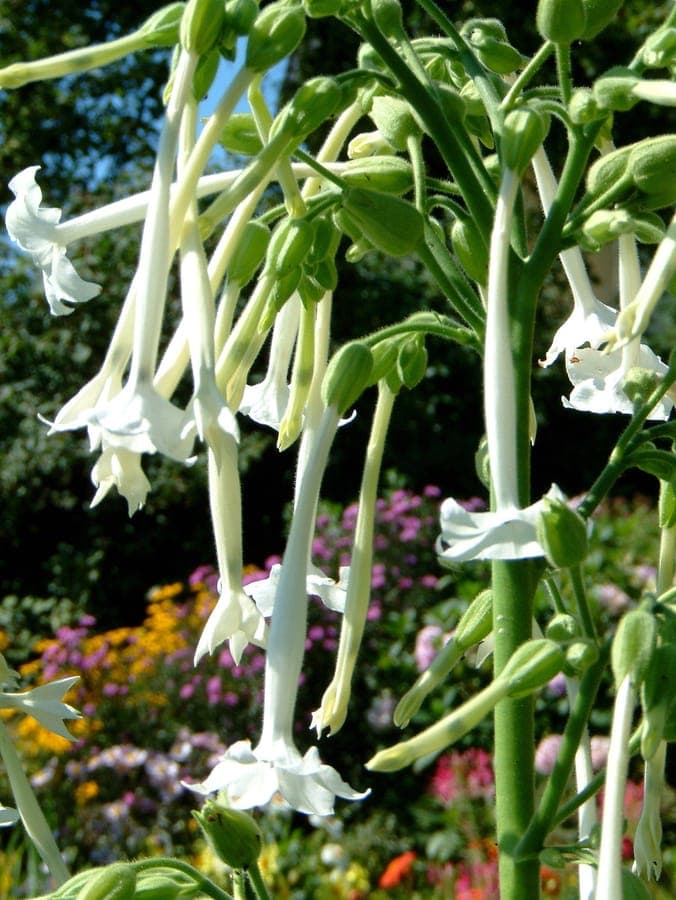
Hedwig Storch / CC BY-SA 3.0, via Wikimedia Commons
Nicotiana sylvestris: complete guide
Nicotiana sylvestris
¿Quieres ver Nicotiana sylvestris: complete guide en tu jardín?
1 minuto, sin tarjeta de crédito
Overview
Nicotiana sylvestris, better known as woodland tobacco, ornamental tobacco or flowering tobacco, is an impressive South American plant from the nightshade family (Solanaceae). This plant is native to the mountain regions of Bolivia and northwestern Argentina. Unlike the commercial tobacco plant (Nicotiana tabacum), this species is purely ornamental and contains no toxic alkaloids in quantities relevant for human consumption.
Nicotiana sylvestris is primarily valued for its elegant growth, impressive height and spectacular white fragrant flowers. The plant is becoming an increasingly popular choice for modern gardens, especially among lovers of vertical accents and scented plants.
Appearance and bloom
Nicotiana sylvestris reaches an impressive height of 100 to 150 cm, with some specimens reaching 180 cm under ideal conditions. The plant grows upright with a single strong main stem and a few side branches towards the top.
The leaves are large, elongated to lance-shaped, approximately 15 to 30 cm long, with a fine hairy texture. They have a dark green colour and are arranged alternately on the stem.
The flowers are the real highlight of this plant. Small, slender, white-cream coloured flowers grow in loose, elegant clusters towards the top of the plant. Each flower is approximately 3 to 5 cm long and funnel- or trumpet-shaped. The flowers emit a subtle, pleasant scent, especially in the evening.
Flowering begins in June and continues until October, as long as night temperatures do not drop below 10 degrees Celsius. The flowers usually open in the afternoon and close in the morning.
After flowering, small seed pods develop containing hundreds of tiny seeds.
Ideal location
Nicotiana sylvestris grows best in sunny to half-shaded spots. At least 4 to 6 hours of direct sunlight daily is needed for good growth, although the plant also grows in partial shade.
In very warm areas, the plant may benefit from protection against the burning midday sun. Place the plant where it receives morning sun and is slightly shaded in the afternoon.
The plant tolerates light wind damage but appreciates protection from strong winds that can break the tall stems.
Soil
Nicotiana sylvestris grows well in almost all fertile soils with good drainage. The plant prefers a moderately moist, humus-rich soil.
A pH between 6.5 and 7.5 is ideal. On very poor soils, the plant grows poorly; it appreciates moderately fertile soil with some organic matter.
The soil must be well-draining; stagnant water causes root rot.
Diseño gratis
¿Quieres ver Nicotiana sylvestris: complete guide en tu jardín? Crea un diseño gratis ahora.
Watering
Nicotiana sylvestris requires regular watering for optimal growth. Keep the soil moderately moist but not waterlogged during the growing season.
Young plants especially need extra moisture attention in their first weeks. Adult plants are slightly more drought-tolerant, but grow best with regular watering.
In very warm periods, daily watering may be necessary. During rainy seasons, additional watering is not needed.
Pruning
Nicotiana sylvestris requires little pruning. The plant naturally grows into an elegant shape. If side branches grow too abundantly, they can be carefully removed for a neater appearance.
Faded flowers can be pinched off, although this is not necessary for continued flowering. It does promote neatness.
Seed pods can be left for decoration or seed collection.
Maintenance calendar
Spring (March-May): Sow seeds under glass in March-April. Prick out seedlings when large enough. Plant out after the last frost (mid-May).
Summer (June-August): Plant grows rapidly and begins to flower. Regular watering and possibly supporting tall plants.
Autumn (September-October): Flowering continues. Seed pods ripen.
Winter (November-February): Annual plant dies back at frost. Save seed for next season.
Winter hardiness
Nicotiana sylvestris is not winter-hardy. This is a true annual plant that dies at frost. In very mild areas (USDA zones 9-10), plants can sometimes self-seed, but this is unreliable.
Resow each year in spring after the last frost date.
Companion plants
Nicotiana sylvestris works as the background of borders and as a solitary accent plant. The plant combines well with many other garden plants, especially lower-flowering species that benefit from it as a background.
Good combinations include:
- Dahlia
- Sunflower (Helianthus)
- Rose (Rosa)
- Lavender (Lavandula)
- Sage (Salvia)
- Late-flowering dahlias
- Aster
Closing thoughts
Nicotiana sylvestris is a special choice for gardeners wanting vertical accents without stiff structures. The elegant growth, impressive flowers and pleasant scent make this plant a valuable addition. The plant is easy to grow from seed and offers years of enjoyment.
Seeds are available from seed merchants. Plant a few specimens in groups of three to five for best effect. For more inspiration and plant selection, visit gardenworld.app.
¿Quieres ver Nicotiana sylvestris: complete guide en tu jardín? Crea un diseño gratis ahora.
Sube una foto, elige un estilo y obtén un diseño fotorrealista con lista de plantas en menos de un minuto.
Más de 10.000 jardines diseñados
Sin tarjeta de crédito


Plantas similares
Solanum dolichosepalum: complete guide
Solanum dolichosepalum
Discover Solanum dolichosepalum, an Andean nightshade with striking long sepals. Growing tips, hardiness, and companion planting for your patio.
Solanum ripense: complete guide
Solanum ripense
Discover Solanum ripense, a moisture-loving Andean nightshade for pond edges and conservatories. Growing tips, hardiness, and companions.
Solanum tomentosum: complete guide
Solanum tomentosum
Discover Solanum tomentosum, a thorny South African nightshade with felted leaves. Growing tips, hardiness, and companion planting ideas.