
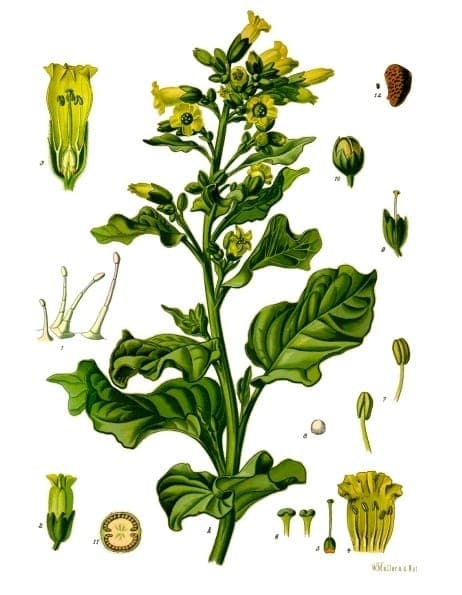
Franz Eugen Köhler, Köhler's Medizinal-Pflanzen / Public domain, via Wikimedia Commons
Nicotiana rustica: complete guide to growing Aztec tobacco
Nicotiana rustica
¿Quieres ver Nicotiana rustica: complete guide to growing Aztec tobacco en tu jardín?
1 minuto, sin tarjeta de crédito
Overview
Nicotiana rustica, known as Aztec tobacco, is a fascinating plant with a rich history. This species originates from Peru and surrounding South American regions and was already cultivated in pre-Columbian times by the Aztecs and other indigenous peoples. Today, this plant is primarily grown because of its historical value and unique ornamental properties. The plant grows as an upright shrub with compact growth to about 120 centimeters in height.
Nicotiana rustica distinguishes itself through its strong fragrance, small greenish-yellow flowers and more compact growth compared to other Nicotiana species. This plant is attractive to gardeners interested in historical plants and ethnobotany. Like all Nicotiana species, this plant contains nicotine and is therefore toxic. The plant can be grown in both open ground and pots and requires much of the same care as other tobacco species.
Appearance and bloom
Nicotiana rustica grows more compactly than many other Nicotiana species, with a strongly branched structure and dense foliage. The leaves are dark green, broad lance-shaped and densely arranged along the stems. The plant takes on a full, woody appearance.
The flowers are small, approximately 1.5 to 2 centimeters long, and greenish-yellow in color with sometimes reddish-brown tints. They appear in loose clusters at the tops of the stems. The flowering period extends from July to September. Although the flowers are not as striking as in other Nicotiana species, they form attractive closures with their dark green leaves. The plant has a characteristic strong, penetrating fragrance.
Ideal location
Nicotiana rustica grows best in a sunny to lightly shaded location. The plant tolerates more shade than many other Nicotiana species and can even grow reasonably well in light half-shade. A southeast to south exposure is ideal. This plant is thermophilic but shows more frost-tolerant properties than some other tobacco species.
Provide adequate air circulation to prevent fungal diseases. The plant can be grown in both open ground and large pots. A protected location against harsh wind is useful, although the plant is more robust than many delicate garden plants. The compact growth makes this plant suitable for smaller gardens.
Soil
Nicotiana rustica is very adaptable to different soil types. The plant grows reasonably well in poor to average soils and does not necessarily require much nutrition. Neutral to very slightly acidic soil (pH 6.0-7.5) is preferred.
Work the soil lightly before planting with organic matter to improve drainage. For pot culture, you can use standard potting soil. This plant is less demanding than many other decorative plants and can even grow in less prepared soil. Good drainage remains important to prevent root rot.
Diseño gratis
¿Quieres ver Nicotiana rustica: complete guide to growing Aztec tobacco en tu jardín? Crea un diseño gratis ahora.
Watering
Nicotiana rustica has moderate water requirements and can tolerate some drought. Water when the top layer of soil feels dry, usually once a week in normal conditions. The plant can occasionally go dry without serious damage.
Avoid waterlogging by ensuring excess water drains well. Water preferably at the base rather than over the leaves. In autumn and winter, when growth slows, less water is given. For potted plants, regular but moderate watering is important.
Pruning
Actually, pruning is not necessary, but removing the tops of young plants stimulates bushier growth. Regularly remove spent flowers to keep the plant neat and encourage more blooming. If the plant becomes too large, you can carefully trim the outer parts.
Remove dead or damaged leaves and stems. At the end of the season, when frost threatens, the plant can be cut back or completely removed. The plant can self-seed, so check if you want to prevent unwanted seedlings.
Maintenance calendar
In spring (May), after frost danger, sow or plant seedlings. Provide regular water and feeding. In summer, monitor for pest insects and deadhead spent flowers. August to September: the plant weakens and produces fewer flowers in heat.
In October, when cooler weather arrives, the plant still produces some flowers. November: after frost, this annual plant dies off. Collect ripe seeds if you want to grow it again next year.
Winter hardiness
This is an annual plant that is not winter-hardy. Nicotiana rustica dies when frost arrives. In Northern Europe, this plant cannot overwinter outdoors. After the first frost danger (November), the plant must be removed.
For seed saving: collect ripe seeds and store them in a cool, dry place until next summer. These seeds can remain viable for several years.
Companion plants
Nicotiana rustica combines well with other annuals and heat-loving plants. Suitable combinations: other Nicotiana species, Brugmansia, Datura, Cestrum, other South American plants. The compact growth makes it suitable for borders and smaller gardens.
The dark green leaves contrast nicely with silvery-leaved plants. Plant this next to red or yellow flowering plants for dramatic contrast effects.
Closing
Nicotiana rustica is a unique plant with historical significance and interesting horticultural properties. For gardeners interested in ethnobotany and historical plants, this is a must-have. With proper care - sun, good drainage and regular watering - you will be able to enjoy this fascinating plant for years.
For more information, visit gardenworld.app. For seeds and plant material, try your local garden center.
Visit gardenworld.app for more plant information and garden advice.
¿Quieres ver Nicotiana rustica: complete guide to growing Aztec tobacco en tu jardín? Crea un diseño gratis ahora.
Sube una foto, elige un estilo y obtén un diseño fotorrealista con lista de plantas en menos de un minuto.
Más de 10.000 jardines diseñados
Sin tarjeta de crédito


Plantas similares
Solanum dolichosepalum: complete guide
Solanum dolichosepalum
Discover Solanum dolichosepalum, an Andean nightshade with striking long sepals. Growing tips, hardiness, and companion planting for your patio.
Solanum ripense: complete guide
Solanum ripense
Discover Solanum ripense, a moisture-loving Andean nightshade for pond edges and conservatories. Growing tips, hardiness, and companions.
Solanum tomentosum: complete guide
Solanum tomentosum
Discover Solanum tomentosum, a thorny South African nightshade with felted leaves. Growing tips, hardiness, and companion planting ideas.