
Wikimedia Commons / CC BY-SA 3.0, via Wikimedia Commons
Eurasian water-milfoil: complete guide
Myriophyllum spicatum
¿Quieres ver Eurasian water-milfoil: complete guide en tu jardín?
1 minuto, sin tarjeta de crédito
Overview
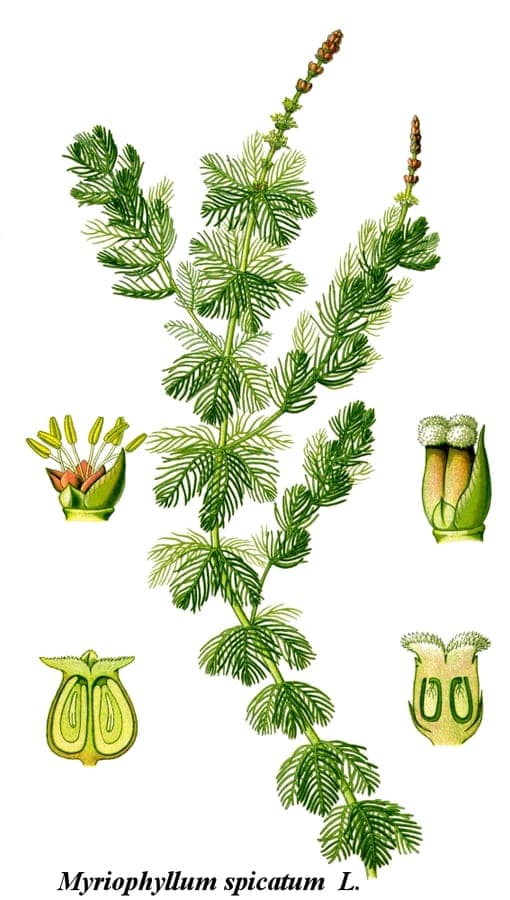
Eurasian water-milfoil (Myriophyllum spicatum), also called spiked water-milfoil, is an aquatic plant of the Haloragaceae family. Native to large parts of Europe, Asia, and North America, it naturally inhabits lakes, ponds, rivers, and canals with moderate to low nutrient levels. Eurasian water-milfoil is one of the most effective natural oxygen producers in aquatic ecosystems, making it highly suitable for garden ponds and ecological water management. The plant prevents algae blooms through fierce nutrient competition and provides food and shelter for aquatic insects and fish. On gardenworld.app, you can design a fully natural, self-regulating aquatic ecosystem with Eurasian water-milfoil as a core component.
Appearance & bloom cycle
Eurasian water-milfoil grows as a slender, heavily branched stem reaching 100 to 200 cm underwater. Leaves are ultra-finely divided into hair-thin lobes, about 1 to 2.5 cm long, arranged in dense whorls around the stem. This dense arrangement gives the plant its characteristic, graceful feather-like form. Color is typically deep to dark green, sometimes with reddish-brown tinges in older, slow-growing sections. Flowers appear inconspicuously as small red to yellow-red spikes above water in July-September, though these rarely appear in heavily shaded conditions. Growth occurs throughout the growing season (April to October) and can be extremely rapid - up to 15 cm per week under optimal conditions.
Ideal location
Eurasian water-milfoil thrives in locations receiving at least 4 to 5 hours of daily direct light (light scale 5 to 7 out of 10). In full sun, it grows fastest and develops intensely green color. Partial shade beneath water lilies or other aquatic plants is also acceptable. It tolerates more shade than many other oxygenators, though growth slows. In deep, shaded lakes, it still grows to considerable depths. A southeast to southwest-facing water location is optimal. In shallow ponds (60-100 cm), direct sunlight is preferable. On gardenworld.app, design a natural pond with Eurasian water-milfoil in deeper zones.
Soil requirements
Eurasian water-milfoil grows best on soft, organic pond bottoms with moderate humus content. In natural lakes and ponds, it establishes on silt, sand, and small stones with organic deposits. For pond cultivation, gravel, sand, or silt mixtures work well. The plant has no specific nutrient demands but grows better in moderately nutrient-rich conditions (typical aquatic ecosystems). Excessive fertilizer stimulates algae blooms instead of plant growth.
Diseño gratis
¿Quieres ver Eurasian water-milfoil: complete guide en tu jardín? Crea un diseño gratis ahora.
Watering
Eurasian water-milfoil is a fully aquatic plant requiring no "watering" - it lives completely underwater. Water quality is important, however. It grows best in neutral to slightly acidic water (pH 6 to 7.5) with moderate nutrient concentration. It also tolerates somewhat harder waters. In ponds: natural water cycling (rain, evaporation) suffices. In large, still water bodies, sediment buildup can smother plants - regular dredging helps. Prefers water between 10 and 25 degrees Celsius.
Pruning
Eurasian water-milfoil grows rapidly and must be cut regularly to prevent pond chokeweed. Cut stems at mid-depth of the pond (approximately 50-100 cm, depending on depth) when they reach the water surface. Cut material can be removed from the pond (composting) or replanted. Pruning is essential May-October, every 2-4 weeks depending on vigor. Failure to prune results in complete pond coverage within one season.
Maintenance calendar
- Jan: Dormant in cold water; minimal inspection
- Feb: Prepare for growing season; check sediment
- Mar: Growth begins as water warms
- Apr: Rapid growth starts; first pruning needed
- May: Peak growth; start 2-weekly pruning
- Jun: Maximum growth; frequent pruning essential
- Jul: Peak growth; flowers possible; weekly pruning
- Aug: Growth sustained; frequent surface coverage checks
- Sep: Growth gradually slows; pruning still needed
- Oct: Growth halts; possible final pruning
- Nov: Dormant; winter preparation
- Dec: Dormancy; minimal care
Winter hardiness
Eurasian water-milfoil is hardy to USDA zone 3 and grows in all Dutch waters. In very harsh winters (below minus 10 degrees C), it may die back, but regenerates from seed or stem fragments the following season. The plant dies above the waterline in winter but remains underwater and can propagate via fragmentation. In temperate climates, growth continues year-round. No winter protection needed.
Companion plants
Eurasian water-milfoil grows well with other aquatic oxygenators: water-weed (Egeria densa), water violet (Hottonia palustris), pondweed (Potamogeton), and other Myriophyllum species. In natural ponds: position in deeper zones (1.5-2.5 m) with other underwater oxygenators. Fish: few fish consume this plant; small insectivores help prevent overgrowth. Caution: Eurasian water-milfoil can become invasive in fast-flowing rivers - use cautiously outside enclosed ponds.
Closing
Eurasian water-milfoil is indispensable for those with natural ponds and aquatic ecosystems. With regular pruning to control growth, it functions as a powerful oxygen producer and nutrient binder. It is underappreciated - many pond owners want it removed, but it deserves recognition for its ecological benefits. Excellent for pond management beginners. Available from nature (careful harvesting from pond edges) or specialized aquatic plant suppliers. Use gardenworld.app to design a complete, self-regulating water garden system with Eurasian water-milfoil as oxygen and nutrient controller.
¿Quieres ver Eurasian water-milfoil: complete guide en tu jardín? Crea un diseño gratis ahora.
Sube una foto, elige un estilo y obtén un diseño fotorrealista con lista de plantas en menos de un minuto.
Más de 10.000 jardines diseñados
Sin tarjeta de crédito


Plantas similares
Siberian water-milfoil: complete guide
Myriophyllum sibiricum
Siberian water-milfoil is an underwater plant with fine, feathery leaves. Perfect for aquariums and ponds with moderate temperatures and good light.
Various-leaf water-milfoil: complete guide
Myriophyllum heterophyllum
Discover various-leaf water-milfoil (Myriophyllum heterophyllum), an elegant aquatic plant from North America with feathery fine foliage, perfect for aquariums and pond gardens with aquatic plant scapes.
Alternate water-milfoil: complete guide
Myriophyllum alterniflorum
Learn how to grow and care for Myriophyllum alterniflorum in your pond or aquarium. Details on depth, light, water quality, and pruning.