
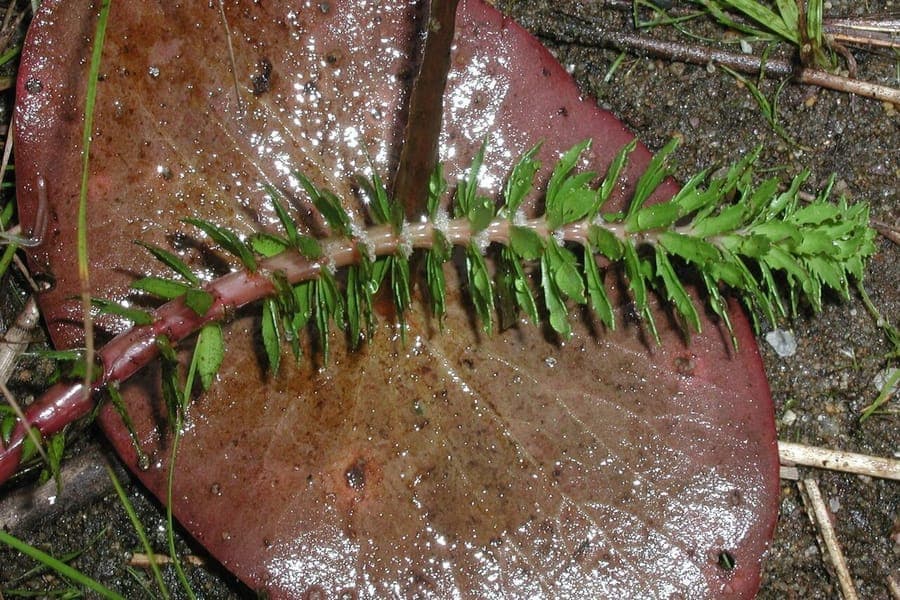
Leslie J. Mehrhoff, University of Connecticut, Bugwood.org / CC BY 3.0, via Wikimedia Commons
Various-leaf water-milfoil: complete guide
Myriophyllum heterophyllum
¿Quieres ver Various-leaf water-milfoil: complete guide en tu jardín?
1 minuto, sin tarjeta de crédito
Overview
Various-leaf water-milfoil (Myriophyllum heterophyllum), also known as broadleaf water-milfoil or twoleaf watermilfoil, is an aquatic plant native to North America, ranging from Canada to Guatemala. This aquatic plant is widely cultivated in aquariums and pond settings due to its delicate, feathery foliage that adds elegant structure to aquatic environments. The plant contributes to oxygen production and helps filter water pollutants.
Appearance and Bloom
Various-leaf water-milfoil grows as underwater vegetation with very fine, feathery leaves arranged in whorls (circles) around the stem. The plant can grow very rapidly under good conditions, reaching several decimeters per week. Above water, small red or purple flowers may appear, although these rarely or never occur in aquariums. Underwater, the plant does not flower.
Ideal Location
Various-leaf water-milfoil grows best under high lighting, at least 8-10 hours per day. In aquariums, it works best with plant lamp lighting. The plant can also grow in more enclosed ponds, but will be less robust without sufficient light. The plant thrives in freshwater to slightly brackish water.
Soil
Various-leaf water-milfoil grows without needing substrate, especially since it grows completely underwater. In aquariums, it can be planted in substrate such as sand or gravel, but root formation is not essential. The plant is very flexible and can also simply be held floating or attached to rocks/wood with fishing line.
Diseño gratis
¿Quieres ver Various-leaf water-milfoil: complete guide en tu jardín? Crea un diseño gratis ahora.
Watering
As an underwater plant, various-leaf water-milfoil doesn't really require watering, as it absorbs nutrients from the water. In aquariums, regular water changes (25-50%) should be made to replenish nutrients and remove waste products. The plant grows rapidly and removes many nutrients from the water.
Pruning
Various-leaf water-milfoil responds well to pruning and should be regularly trimmed to prevent overgrowth. Regular pinching of stem tops encourages more bushy growth. Dead and damaged leaves should be removed immediately to prevent algae growth.
Maintenance Calendar
Weekly: Prune growing tips as needed. Biweekly: Water changes. Monthly: Check for algae growth or diseases. Feeding: Liquid fertilizers (macros and micros) can be given monthly.
Winter Hardiness
Various-leaf water-milfoil can grow in outdoor ponds in temperate climates, though it usually thrives better in aquariums. In very cold winters, it may die in outdoor ponds. The plant tolerates temperatures from approximately 10-24 degrees Celsius, though it grows optimally around 20-22 degrees.
Companion Plants
Various-leaf water-milfoil works well in aquariums and pond settings with other aquatic plants such as Rotala, Ludwigia, Riccardia, and other stem-paired plants. It helps create a balanced aquatic system and is valued by fish and shrimp breeders.
Closing
Various-leaf water-milfoil is a popular and practical choice for aquarium and pond hobbyists. With its rapid growth, elegant appearance, and beneficial properties for water quality, it is a valuable addition to aquatic systems. Available through aquarium specialty stores and online plant nurseries.
¿Quieres ver Various-leaf water-milfoil: complete guide en tu jardín? Crea un diseño gratis ahora.
Sube una foto, elige un estilo y obtén un diseño fotorrealista con lista de plantas en menos de un minuto.
Más de 10.000 jardines diseñados
Sin tarjeta de crédito


Plantas similares
Siberian water-milfoil: complete guide
Myriophyllum sibiricum
Siberian water-milfoil is an underwater plant with fine, feathery leaves. Perfect for aquariums and ponds with moderate temperatures and good light.
Alternate water-milfoil: complete guide
Myriophyllum alterniflorum
Learn how to grow and care for Myriophyllum alterniflorum in your pond or aquarium. Details on depth, light, water quality, and pruning.
Brazilian water-milfoil: complete guide
Myriophyllum aquaticum
Learn how to grow and care for Myriophyllum aquaticum in your aquarium, paludarium, or pond. Details on temperature, light, pruning, and dual-growth.