
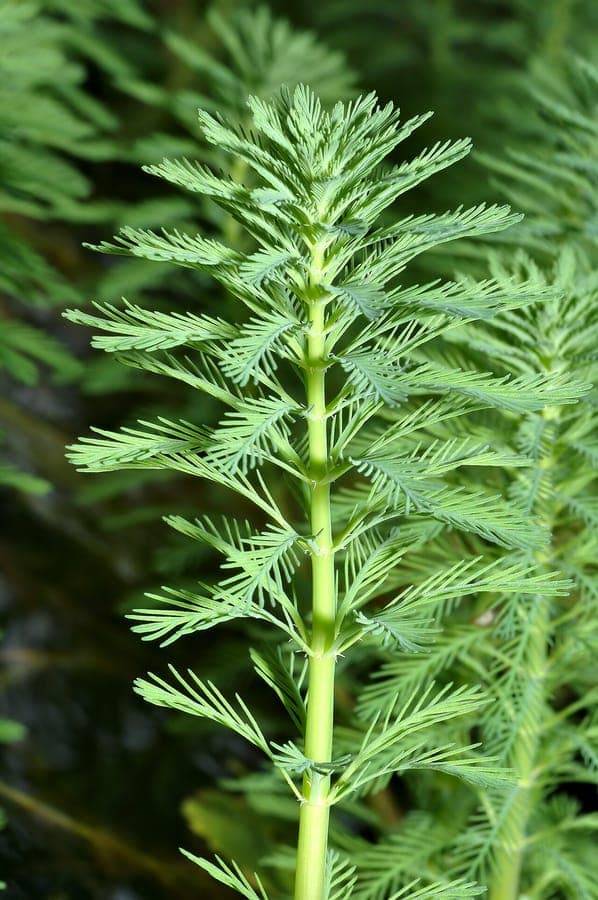
André Karwath aka Aka / CC BY-SA 2.5, via Wikimedia Commons
Brazilian water-milfoil: complete guide
Myriophyllum aquaticum
¿Quieres ver Brazilian water-milfoil: complete guide en tu jardín?
1 minuto, sin tarjeta de crédito
Overview
Brazilian water-milfoil (Myriophyllum aquaticum), also called parrot feather or aquatic feather, is a tropical aquatic plant of the Haloragaceae family. Native to Brazil and surrounding South American regions, it grows in shallow, warm rivers and marshes. Unlike most aquatic plants, Brazilian water-milfoil is amphibious, thriving both submerged and above water, making it extraordinarily versatile. Its delicate, feather-like foliage displays deeper orange-red coloration when grown emersed (above water), earning it favor among aquarists and paludarium enthusiasts worldwide. On gardenworld.app, you can design exotic paludarium systems with Brazilian water-milfoil in semi-aquatic scenarios.
Appearance & bloom cycle
Brazilian water-milfoil grows as a slender, branching plant reaching 30 to 50 cm submerged and up to 100 cm emersed (above water) in optimal conditions. Leaves are ultra-finely divided into hair-thin lobes, 2 to 5 cm long, arranged in opposite pairs. Underwater, leaves are soft and flexible, deep green. Above water, where the plant accesses air, foliage becomes much finer, fresh green to orange-red, with more intense coloration. Growth is rapid, especially emersed, achieving 5-15 cm per week in warm, light-rich conditions. Flowers appear sparingly as minuscule red-yellow buds when the plant grows above water. Emersed growth also serves reproduction via seed.
Ideal location
Brazilian water-milfoil thrives under warm light (6-8/10 light scale), minimum 5 to 6 hours direct daily light. In aquaria with high-quality lighting (LED grow-lights), it grows vigorously. Partial shade (5-6/10) is acceptable but slows growth. Heavy shade (below 4/10) causes thin, weak stems. For paludariums and aquaria, a south-facing position is ideal. Warm conditions are essential: the plant is sensitive to cold below 18 degrees Celsius. Avoid intense midday sun in very hot climates (above 30 degrees C), which can scorch leaves.
Soil requirements
Brazilian water-milfoil thrives submerged without a fixed substrate, floating freely or rooted. For optimal growth, especially for emersed cultivation, use well-draining, nutrient-rich potting soil mixed with sand or perlite (2:1 ratio). In aquaria with gravel or sand substrate, stems root and absorb nutrients directly. The plant tolerates a broad range of nutrients, from nutrient-poor to moderately rich water. In aquaria: add micronutrient fertilizers (iron, potassium) via liquid supplements to intensify color and boost growth.
Watering
As a fully aquatic plant, Brazilian water-milfoil requires no watering, but water temperature is critical. Ideal temperature is 20 to 28 degrees Celsius, preferably 23-26 degrees. Water pH between 5.5 and 7.5 is well-tolerated. In aquaria: perform 25-30% weekly water changes to manage nutrient accumulation. For emersed growth in paludariums, maintain air temperature around 22-26 degrees and humidity 70-80%. Cold conditions halt growth and can cause root rot.
Diseño gratis
¿Quieres ver Brazilian water-milfoil: complete guide en tu jardín? Crea un diseño gratis ahora.
Pruning
Brazilian water-milfoil grows rapidly and requires regular pruning for shape and space management. Cut stems above the third or fourth leaf pair when reaching 40-50 cm. Pruned tops can be planted directly in substrate (submerged) or floated in water. Rooting occurs within 7-10 days. Regularly remove dead underwater leaves. For denser, red-tinged growth, remove lower leaves as stems elongate and maintain strong terminal growth.
Maintenance calendar
- Jan: Minimal growth in aquaria; maintain 20-22 degrees C
- Feb: Prepare for warmer months; adjust heating
- Mar: Growth accelerates; first pruning if temperature rises
- Apr: Strong growth; start 2-weekly pruning
- May: Peak growth above and below water; weekly checks
- Jun: Maximum growth; frequent pruning for shape
- Jul: Peak period; strong light enhances red coloration; flowers possible
- Aug: Growth sustained; supplement nutrients; replant stems
- Sep: Growth gradually slows; reduce pruning frequency
- Oct: Growth decelerates; temperature reduce to 22-24 degrees C
- Nov: Minimal growth; prepare for dormancy
- Dec: Rest period; minimal care
Winter hardiness
Brazilian water-milfoil is not cold-hardy in temperate climates - it dies below 10 degrees Celsius. In moderate climates (Netherlands): suitable only for heated indoor aquaria and paludariums. Below 18 degrees, growth nearly halts; below 10 degrees, plants begin rotting. In warm regions (southern Europe, USDA zones 9-10), it can grow in shallow warm ponds May through October but requires moving indoors for winter.
Companion plants
Brazilian water-milfoil grows well with other warm-water aquarium plants: Ludwigia, dwarf aquatic stems, Rotala, Hemianthus. In paludariums: combine with Alocasia, creeping fig, dwarf ferns. For aquaria: position as mid to background plant with lower-growing Glossostigma in foreground. Fish: Most fish don't consume milfoil; scavenging fish (Corydoras, small plecos) aid detritus removal. In warm ponds: possible with water lilies and Pontederia.
Closing
Brazilian water-milfoil is a fascinating, versatile plant appealing to both aquarium and paludarium enthusiasts through its dual growing modes - submerged and emersed. With warm temperatures (23-26 degrees C), frequent pruning, and adequate lighting, it grows vigorously, forming beautiful orange-red emersed foliage. Ideal for paludarium lovers. Available from specialized aquarium shops and online aquatic plant retailers. Use gardenworld.app to design a complete tropical paludarium with Brazilian water-milfoil as a decorative, functional centerpiece.
¿Quieres ver Brazilian water-milfoil: complete guide en tu jardín? Crea un diseño gratis ahora.
Sube una foto, elige un estilo y obtén un diseño fotorrealista con lista de plantas en menos de un minuto.
Más de 10.000 jardines diseñados
Sin tarjeta de crédito


Plantas similares
Siberian water-milfoil: complete guide
Myriophyllum sibiricum
Siberian water-milfoil is an underwater plant with fine, feathery leaves. Perfect for aquariums and ponds with moderate temperatures and good light.
Various-leaf water-milfoil: complete guide
Myriophyllum heterophyllum
Discover various-leaf water-milfoil (Myriophyllum heterophyllum), an elegant aquatic plant from North America with feathery fine foliage, perfect for aquariums and pond gardens with aquatic plant scapes.
Alternate water-milfoil: complete guide
Myriophyllum alterniflorum
Learn how to grow and care for Myriophyllum alterniflorum in your pond or aquarium. Details on depth, light, water quality, and pruning.