
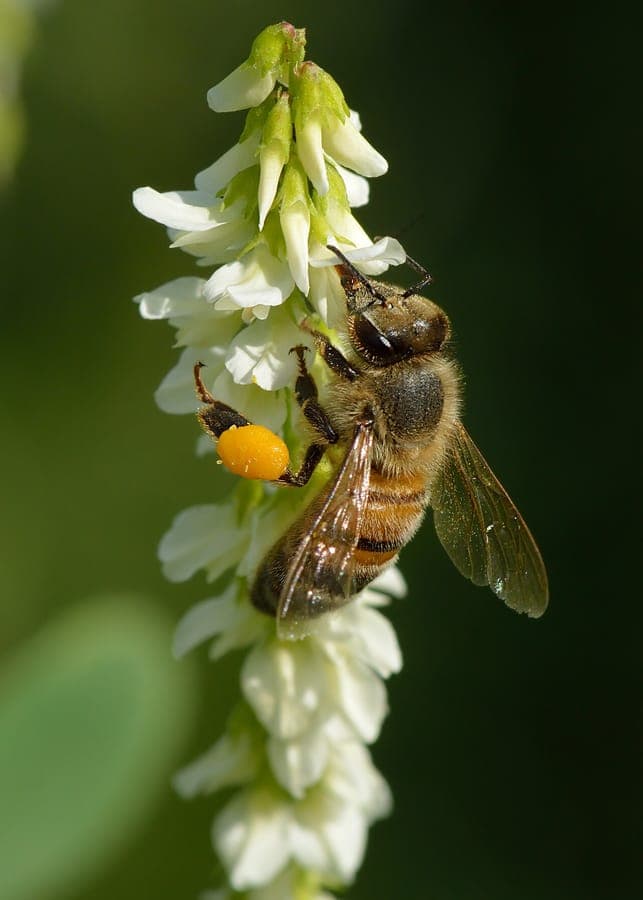
Ivar Leidus / CC BY-SA 4.0, via Wikimedia Commons
White sweet-clover: complete guide
Melilotus albus
¿Quieres ver White sweet-clover: complete guide en tu jardín?
1 minuto, sin tarjeta de crédito
Overview
The white sweet-clover (Melilotus albus) is an elegant biennial plant that is warmly welcomed by gardeners seeking fragrant flowers and beneficial properties. Also known as Bokhara clover or white melilot, this plant originally hails from Europe to China and North Africa. The white sweet-clover is particularly valuable in permaculture and pollinator-friendly gardens, where its pure white flower spikes bloom from May through September, attracting countless bees, butterflies, and beneficial insects. This plant grows excellently in various climates and requires minimal maintenance, making it perfect for beginning gardeners who still want an impactful flowering plant.
The signature characteristic of white sweet-clover is its intense, pleasantly vanilla-scented fragrance that is perceptible from a considerable distance. This typical fragrance derives from coumarin, a natural substance also found in other Melilotus species. When you walk past blooming plants on warm days, you will immediately understand what makes this plant special.
Appearance and Bloom Cycle
White sweet-clover grows as a slender, upright plant that under ideal conditions reaches 100 to 200 cm tall. The plant exhibits an erect growth pattern with minimal branching in the first year, followed by more branching in the second growing season. The stems are green, smooth, and typically glabrous, though they may have slightly hairy sections under certain conditions.
The leaves are compound, consisting of three small, green leaflets, each approximately 5 to 12 mm long with a lightly toothed margin. These trifoliate leaves are highly characteristic of the Melilotus genus and give the plant an airy, delicate appearance. When you touch the leaves, you feel how tender they are despite their apparent sturdiness.
The blooming period for white sweet-clover runs from May through October, with peak time around June and July. The flowers grow in long, slender spikes that can reach 5 cm in length. Individual flowers are minuscule, merely 3 to 4 mm, but together they form a spectacular scented column of snow-white. These flowers are self-sterile, meaning they depend entirely on insects for reproduction.
Ideal Location
White sweet-clover thrives optimally in sunny locations where it receives at least 6 hours of uninterrupted sunlight daily. With more sun comes extended bloom periods, better fragrance development, and a more compact growth pattern. Although the plant tolerates partial shade somewhat (for example, 4-5 hours of sun), this will reduce flower production and cause the plant to grow taller and leggier.
The plant grows very well on warm, sheltered sites and can tolerate wind reasonably well. In very windy situations, application of a windbreak (15-20% shade cloth) can stabilize growth. Avoid locations where water stagnates, such as low valleys or poorly drained zones.
Soil Requirements
The greatest advantage of white sweet-clover is its tolerance for varied soil conditions. The plant grows on acidic (pH 5.5) as well as neutral (pH 7.0) and even slightly alkaline soils (pH 7.5). This pH flexibility makes it an excellent choice for diverse garden situations.
The plant is renowned for accepting poor to moderate soils, especially because it can fix nitrogen thanks to its symbiosis with rhizobium bacteria in its root system. This means you need no rich manure; actually, overly rich soil can lead to reduced blooming and excessive leaf growth. A light compost application of 2-3 cm is sufficient for starting growth.
Drainage is crucial. Although the plant can tolerate dry periods thanks to its deep taproot, waterlogging can cause root rot. In clay soils, improve drainage by working sand (20-25%) and coarse organic material to a depth of 30 cm.
Watering
Once seedlings are established (usually after 3-4 weeks), white sweet-clover is relatively drought-tolerant. The deep taproot system reaches groundwater that shallow-rooted plants cannot access. In normal growing years, in temperate climates like the Netherlands you need scarcely any supplemental water, even after germination.
The first 6-8 weeks are essential. Keep young seedlings consistently moist (like a wrung-out sponge), but not waterlogged. Water deeply once or twice weekly until true leaf pairs appear. This encourages deep taproot development.
During very dry periods (no rain for 2+ weeks), watering can be beneficial. One thorough watering per week is better than daily shallow sprinkling, as this encourages deeper rooting. Once the plant has established (after July), you can usually stop all supplemental watering.
Diseño gratis
¿Quieres ver White sweet-clover: complete guide en tu jardín? Crea un diseño gratis ahora.
Pruning
White sweet-clover requires very little pruning. Actually, this is a plant where non-intervention yields the best results. If you want plants to remain more compact, you can pinch out the top in May (removing the top 5-7 cm) to encourage lateral branching.
For extended flower production, you can remove spent flower spikes before they set seed. This results in 2-3 additional weeks of flower production. Carefully snap or cut off the flower spikes; the plant typically does not break back strongly after removal of large sections.
Second-year plants naturally become sparser and branch more; these require only minimal maintenance besides perhaps removing dead stems in early spring.
Maintenance Calendar
April-May: Sow seed directly or transplant seedlings. Thin to 30-40 cm spacing for full growth. Apply first fertilizer once the plant has 2-3 leaf pairs.
June-July: Monitor for insect damage (rare). Check moisture in dry periods. Pinching tops now can produce many side branches.
August-September: Deadhead spent flowers for longer bloom. Set self-sown seedlings out where gaps develop.
October-November: Let seed dry in place for birds and natural renewal. Remove second-year plants now.
December-March: Little activity. Prepare soil for spring sowing.
Winter Hardiness
White sweet-clover is a true biennial plant: seeds germinate in year 1, flower and set seed in year 2. Biennials can survive winter in zones 2-10 (USDA), meaning they tolerate temperatures to -40°C. In Dutch zones 8a/8b, winter death is virtually non-existent except in very severe winters.
First-year rosettes are extremely cold-hardy and can withstand temperatures to -25°C without damage. If you start seedlings in August, many plants will have substantial rosettes by winter making them very robust.
In very mild winters where temperatures remain above 10°C, first-year plants can exhibit premature bolting, resulting in fall flowering. This is not necessarily problematic, though it diverts energy from rosette building.
Companion Plants
White sweet-clover combines excellently with many other garden plants. Its naturally vertical growth pattern makes it ideal for backgrounds. Combine with lower-growing flowering plants such as the following:
Nasturiums (Tropaeolum majus) form beautiful contrast through orange and red blooms growing at the base. Low-growing Limnanthes douglasii with yellow flowers creates a shimmering foreground. For something taller, choose Ammi visnaga or Daucus carota var. sativus for aeration effects.
Salvia species, especially Salvia nemorosa, group well when grown together on the same drainage. White sweet-clover provides height while Salvia supplies flower colors.
In mixed borders with perennials like Echinops (thistles), the two-year life cycle of Melilotus creates a natural rotation schedule. Plant them anew each year for continuous flowering.
Closing
White sweet-clover deserves a place in every ecologically conscious garden. This biennial plant delivers years of value: beautiful white flowers with fabulous fragrance, nutrition for bees and other insects, and a net gain for soil mineralization thanks to nitrogen fixation. For sourcing quality plants and responsible gardening, I recommend purchasing from reputable garden centers like Intratuin or Gamma. Seeds are widely available from quality seed companies.
The full value of white sweet-clover in permaculture, green manuring, and wildflower landscapes cannot be overstated. If you seek a plant that requires little from your garden while giving much back, white sweet-clover is your answer. Visit gardenworld.app for more plant recommendations for pollinator-friendly gardens and sustainable soil improvement. Gardenworld.app helps you design an ecological garden that benefits both you and nature.
¿Quieres ver White sweet-clover: complete guide en tu jardín? Crea un diseño gratis ahora.
Sube una foto, elige un estilo y obtén un diseño fotorrealista con lista de plantas en menos de un minuto.
Más de 10.000 jardines diseñados
Sin tarjeta de crédito


Plantas similares
Yellow sweetclover: complete guide
Melilotus officinalis
Yellow sweetclover is a biennial with fragrant yellow flower spikes. Traditionally used for medicinal applications. Ideal for bee gardens and wildflower landscapes.
Tall melilot: complete guide
Melilotus altissimus
Explore Melilotus altissimus, the Tall melilot from Europe. A nourishing bee and butterfly plant.
White clover: complete guide
Trifolium repens L.
White clover is an extremely useful ground cover with small white flowers. This guide helps you cultivate, maintain, and use it effectively in your garden.