
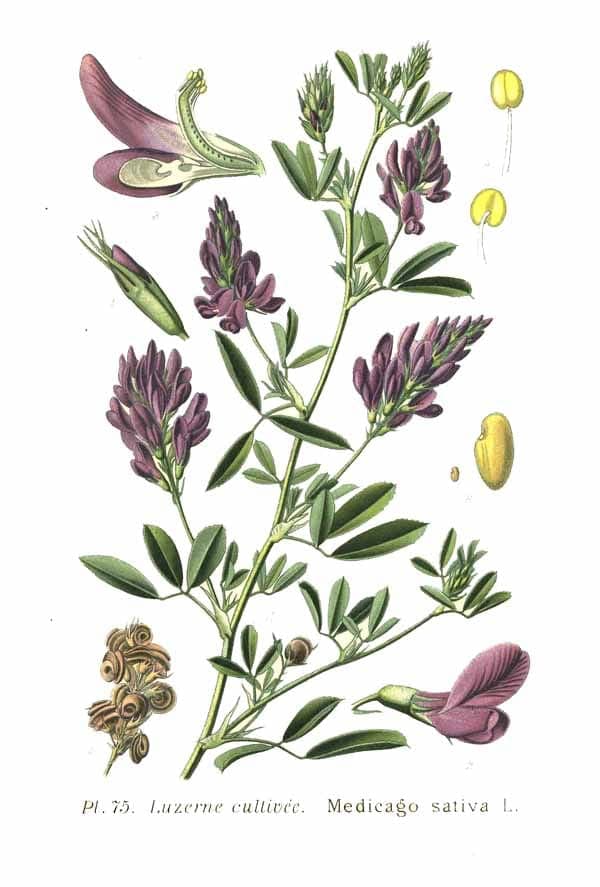
Amédée Masclef / Public domain, via Wikimedia Commons
Alfalfa: complete guide
Medicago sativa
¿Quieres ver Alfalfa: complete guide en tu jardín?
1 minuto, sin tarjeta de crédito
Alfalfa (Medicago sativa L.) is the most renowned legume in the world, scientifically described in 1753. This plant from the Fabaceae family grows naturally from the Mediterranean region through western Siberia and Iran. With purple-blue flowers, deep taproots, and nutritious foliage, alfalfa has been valued for millennia as a forage crop and soil improver.
The plant is also known as 'lucerne' in European English, 'herba medica' in medical traditions, and 'berseem' in Middle Eastern contexts. In various languages, it bears distinct names reflecting its cultural significance. This robust plant reaches 40-80 cm height with strongly developed deep roots capable of penetrating 3-6 meters into soil layers.
The growth period of alfalfa extends from April to November (USDA zones 2-9). Flowering occurs from May to October with purple-blue flowers in loose spikes of 2-4 cm length. Each flower possesses specialized structures where the two lower petals elastically recoil upon pollination. Seed development takes place from August to October with characteristic spiral seed pods.
For optimal growth, select a fully sunny location with at least 7 hours of direct sunlight daily. Alfalfa thrives in well-draining, deeply worked soils. The plant is hardy to USDA zone 2 (-40°C), making it frost-tolerant throughout northern regions. Sow in spring (March-April) or autumn (September-October).
Soil should be well-draining with pH 6.0-7.5. Alfalfa performs poorly in acidic or waterlogged soils. The plant dramatically improves soil quality through nitrogen fixation and deep rooting, reaching soil microbes and nutrients. Plant at spacings of 30-45 cm apart for full yields.
Watering is minimal after complete establishment. Alfalfa has deep roots accessing water far into soil layers. Only during extended drought (longer than 4-5 weeks) provide supplemental water. The plant tolerates moderate flooding less well than some clover species.
Pruning not required, however cutting stimulates regrowth significantly. Alfalfa produces 3-4 harvests per season under optimal conditions. Cut when approximately 10% of flowers begins browning (late bloom stage), usually every 4-5 weeks. This timing minimizes loss of nutritious leaves.
Maintenance calendar: March-April direct sowing; May-August first and second growth; July-August first cut; August-September second cut; September-October third cut if warranted. Full production mode achieved after first complete growing year.
Alfalfa is extremely winter-hardy to USDA zone 2 (-40°C). No special frost protection needed. In very severe winters, some ice-heave may occur, but plants recover in spring. The plant enters winter dormancy in October-November.
As companion plants, alfalfa combines well with timothy, bromegrass, and red clover in pasture mixtures. In pure stand, minimal weed problems due to competitive foliage. For biodiversity, mix with red and white clover, increasing insect flower availability.
Availability: Seed obtainable from all major seed retailers and garden centers throughout North America and Europe. Quality certificates ensure viability and purity. For gardenworld.app users, alfalfa is ideal for forage gardens and estate designs.
Final thoughts: Alfalfa is the premier legume crop worldwide due to its productivity, sustainability, and forage value. The combination of deep roots, regrowth capacity, and nitrogen fixation makes it indispensable for sustainable agriculture. Discover more forage crops on gardenworld.app and build self-sufficient gardens with professionally supported plant selections.
¿Quieres ver Alfalfa: complete guide en tu jardín? Crea un diseño gratis ahora.
Sube una foto, elige un estilo y obtén un diseño fotorrealista con lista de plantas en menos de un minuto.
Más de 10.000 jardines diseñados
Sin tarjeta de crédito


Plantas similares
Hop trefoil: complete guide
Medicago lupulina
Hop trefoil (Medicago lupulina) is a legume valuable for ground cover and fodder. Learn about cultivation, maintenance and benefits.
Little bur-clover: complete guide
Medicago minima
Little bur-clover (Medicago minima) is a compact legume with tiny leaves and seed pods. Ideal for small gardens and container planting.
Bur medic: complete guide
Medicago polymorpha
Bur medic (Medicago polymorpha) is a variable legume with spiny seed pods. Ideal for difficult soils and sustainable ground cover.