
Wikimedia Commons / CC BY-SA 3.0, via Wikimedia Commons
Hop trefoil: complete guide
Medicago lupulina
¿Quieres ver Hop trefoil: complete guide en tu jardín?
1 minuto, sin tarjeta de crédito
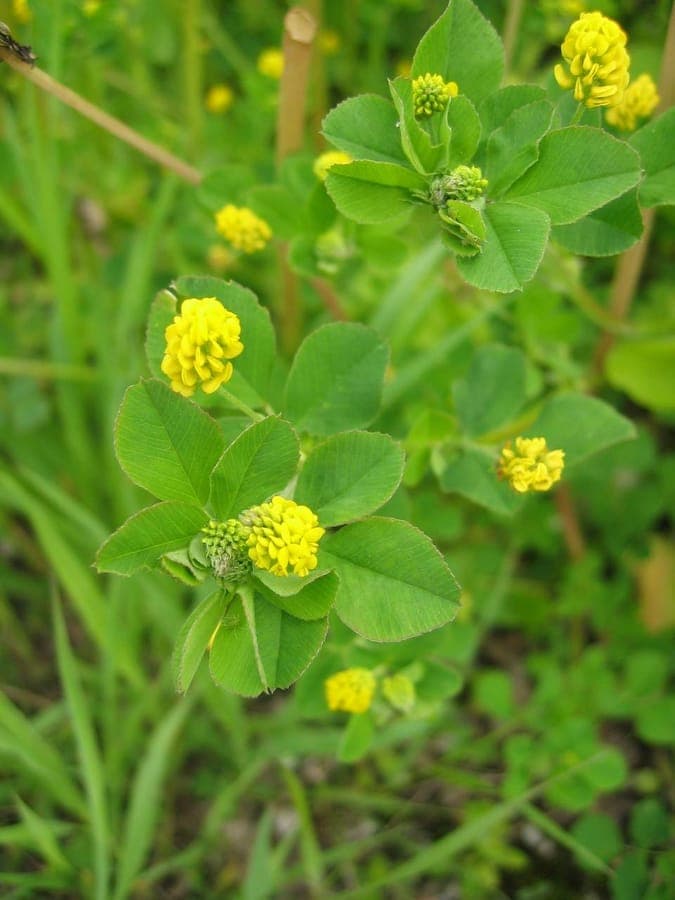
Hop trefoil (Medicago lupulina L.) is a valuable legume species recognized since 1753 in gardens and agricultural fields. This plant from the Fabaceae family grows naturally from Europe through the Caucasus Mountains to North and Central Africa. With golden-yellow flowers and strongly branched growth habit, hop trefoil is an attractive choice for gardeners seeking to improve ground cover and soil quality.
Hop trefoil derives its name from the hop-like seed and flower structures. The plant is also known as 'minette,' 'black medic,' or 'English trefoil.' In English-speaking regions, it appears under various common names including 'nonesuch' and 'yellow trefoil.' The plant reaches heights of 15-50 cm and forms a herbaceous, bushy appearance with fine-textured foliage.
The growth period of hop trefoil extends from March to October in temperate climates (USDA zones 3-10). Flowering occurs from May to August, with yellow flowers presented in compact spikes approximately 1-2 cm in diameter. Each flower features a bilateral structure with five stamens characteristic of Medicago species. Fruit development takes place from August to September, producing dark brown seed pods with typical Medicago characteristics.
For the ideal location, select a sunny spot with at least 6 hours of direct sunlight daily. Hop trefoil thrives in dry to moderately moist conditions. The plant is extremely frost-hardy (hardy to USDA zone 3) and tolerates even extreme temperatures. In gardens throughout temperate regions, hop trefoil easily survives winter, especially when seeds become established in autumn.
The soil should be well-draining with a pH between 5.5 and 7.5. Hop trefoil grows even on poor soils, making it suitable for soil improvement and erosion control. The plant enhances soil quality through nitrogen fixation via symbiosis with Rhizobium bacteria. Plant hop trefoil at spacings of 20-30 cm apart for optimal yields and ground coverage.
Watering is minimal once established. During dry periods (longer than 2-3 weeks without rain), provide supplemental water, especially in the first growing season. The plant is exceptionally drought-tolerant and performs well with less water than traditional grass sods. Mature plants require irrigation only during exceptional droughts.
Pruning is not strictly necessary, however you may cut hop trefoil for fodder production or ground cover management. Cutting in June-July promotes regrowth and stimulates additional flowering. For agricultural use, hop trefoil is typically harvested in two to three cycles per season, with each cutting beginning 8-10 weeks after the previous harvest matures.
Maintenance calendar for hop trefoil: March-April direct sowing into ground; May-August monitor flowering phase; July-September assess seed ripeness; October-November harvest seed for next year if desired. In established plots, regrowth occurs after cutting, sometimes up to three cycles per season.
Hop trefoil is extremely winter-hardy, resistant to temperatures down to -25°C (USDA zone 3). This makes it an ideal choice for northern European and North American gardeners. The plant requires no special winter preparation - allow seeds to fall naturally or cut in October for moderate regrowth the following spring.
As companion plants, combine hop trefoil well with other field crops such as red and white clover, timothy grass, and orchard grass. In garden situations, hop trefoil works excellently alongside wildflowers such as daisy, salad burnet, and buttercup. The combination with these species promotes biodiversity and insect life.
Availability: Hop trefoil seed is obtainable from major garden retailers and online seed companies throughout North America and Europe. For gardenworld.app users, hop trefoil is an excellent choice for natural ground cover and insect-friendly landscape designs.
Final thoughts: Hop trefoil is a robust plant providing benefits for years regarding soil and biodiversity. The combination of yellow flowers, drought tolerance, and nitrogen fixation makes it a valuable addition to gardens and landscapes. Discover more plant varieties on gardenworld.app and design your dream garden with professionally supported plant choices.
¿Quieres ver Hop trefoil: complete guide en tu jardín? Crea un diseño gratis ahora.
Sube una foto, elige un estilo y obtén un diseño fotorrealista con lista de plantas en menos de un minuto.
Más de 10.000 jardines diseñados
Sin tarjeta de crédito


Plantas similares
Little bur-clover: complete guide
Medicago minima
Little bur-clover (Medicago minima) is a compact legume with tiny leaves and seed pods. Ideal for small gardens and container planting.
Bur medic: complete guide
Medicago polymorpha
Bur medic (Medicago polymorpha) is a variable legume with spiny seed pods. Ideal for difficult soils and sustainable ground cover.
Alfalfa: complete guide
Medicago sativa
Alfalfa (Medicago sativa) is the world's premier legume for nutrition and soil enrichment. Learn complete cultivation and management techniques.