
Thilo Machotta (Benutzer: thiloma) / CC BY-SA 2.0 de, via Wikimedia Commons
Purple magnolia: complete guide
Magnolia liliiflora
¿Quieres ver Purple magnolia: complete guide en tu jardín?
1 minuto, sin tarjeta de crédito
Overview
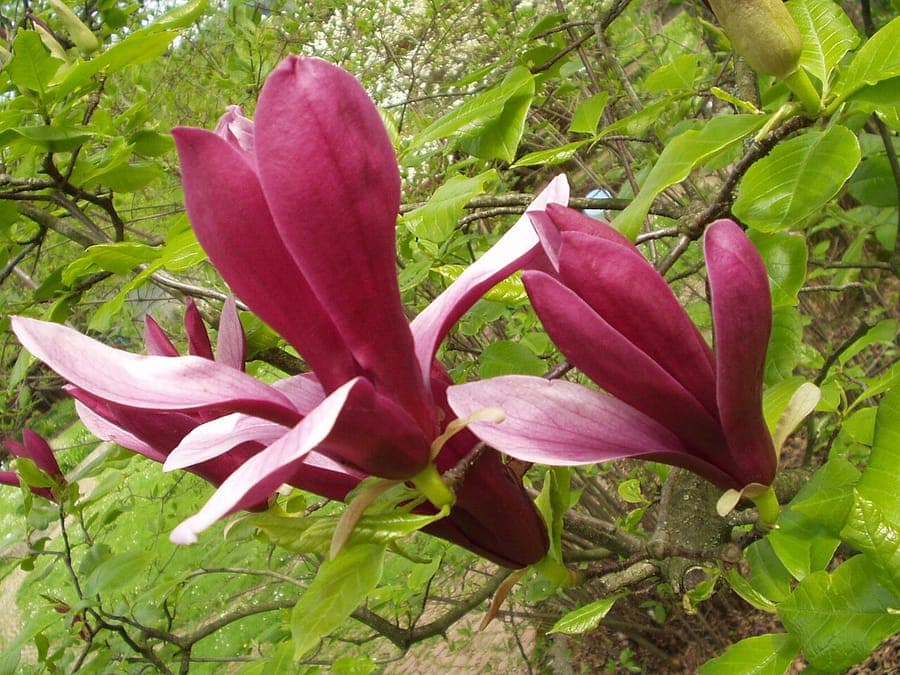
Magnolia liliiflora, also known as purple magnolia or lily magnolia, is a compact, elegant magnolia species native to China (Hubei, Yunnan, Hunan, Fujian). This shrub to small tree reaches 3-5 meters in height and is renowned for its bicolored flowers combining white exterior with purple-toned inner tepals. For garden designers seeking refined floral display with less monumental proportions than white magnolias, Magnolia liliiflora serves as an ideal choice plant combining elegant architecture with extended and repeated flower production.
Distinguishing features fundamentally separate Magnolia liliiflora from larger magnolia species. Growth habit is more compact, more shrubby, and substantially better suited to mid-sized gardens and formal compositions. Flowers are smaller (5-8 centimeters) yet more numerous than white magnolias, and appear in two waves: first in April (before foliage) and again in July-August (between-leaf blooming).
This dual-season blooming cycle makes Magnolia liliiflora exceptionally valuable for designers seeking extended color accents. In temperate climates, this magnolia can provide 6-8 weeks of continuous floral display through dual flowering cycles.
Appearance and Bloom
Magnolia liliiflora develops regular, rigidly upright-spreading silhouette with more horizontal branching than vertical magnolias. The plant typically reaches 3-5 meters, occasionally to 7 meters under optimal conditions. Bark is smooth and grayish, remaining attractive throughout winter months.
Foliage emerges late in spring (May), displaying elliptic-lanceolate morphology measuring 6-12 centimeters in length. Leaf color is bright green, transitioning to yellow-green in autumn.
Flowers constitute the major attraction. Magnolia liliiflora produces bicolored flowers measuring 5-8 centimeters across, tulip-shaped. Outer tepals are white to very pale purple, while inner tepals display deep purple. This two-tone effect creates elegant contrast against leafless backgrounds. Flowers appear in two periods: primary April-May (before foliage fully emerges) and secondary July-August (between-leaf period).
Primary bloom period is typically most spectacular: numerous purple-and-white flowers against still-dark branches. Secondary summer flowering is more abundant (greater flower number) but less visually dramatic against green foliage backdrop.
Diseño gratis
¿Quieres ver Purple magnolia: complete guide en tu jardín? Crea un diseño gratis ahora.
Ideal Location
Optimal locations combine full-sun to half-shade positions (minimum 4-6 hours direct daily sun). Magnolia liliiflora thrives in southeast-oriented gardens where morning sun minimizes flower damage. Sheltered locations preferred, as wind can damage delicate blooms.
The plant tolerates greater shade than Magnolia denudata (to 2-3 hours sun), although flowering productivity reduces substantially in heavy shade.
Soil Quality
Soils must provide excellent drainage and consistent moisture availability. Drainage preference: mildly acidic to neutral soils (pH 6.0-7.5). In calcareous regions iron deficiency may develop. Moisture retention proves crucial - Magnolia liliiflora performs better in moderately moist soils than in dry sand.
Watering and Moisture Management
During first two seasons apply 2-3 centimeters water daily. Once established (after 2-3 years) rainfall and soil moisture suffice in temperate climates. In dry summers supplement with 30-40 millimeters weekly.
Pruning and Formation
Magnolia liliiflora requires minimal pruning. Weakly-growing branches may be carefully thinned during early summer. Following bloom (May and September) remove dead material.
Maintenance Calendar
April-May: Primary bloom period. No maintenance; enjoy flowers.
May-June: Foliage expansion. Standard moisture management.
July-August: Secondary bloom period. Continue moisture management. Deadheading optional.
August-October: Foliage maturation. Autumn coloration. No maintenance required.
November-March: Dormant period. Minimal activity.
Winter Hardiness
Magnolia liliiflora is hardy through USDA zone 5 (-28°C). In Dutch, Belgian, and German climates, the shrub survives all winters. Flowers may incur frost damage during returning frost periods (April).
Companion Plant Selection
Clematis montana (Mountain clematis): White flowers May-June; vigorous vines on support structures.
Liriope muscari (Lilyturf): Violet-purple, August-October; low-growing, excellent foreground.
Chionanthus virginicus (Fringe tree): White, June; larger, good height variation.
Concluding Remarks
Magnolia liliiflora offers refined beauty and dual-season blooming in more compact form. For mid-sized gardens and formal compositions where delicate elegance is desired, this magnolia proves an ideal choice. Discover additional inspiration on www.gardenworld.app. With proper placement and moisture management, you'll enjoy years of this elegant shrub.
¿Quieres ver Purple magnolia: complete guide en tu jardín? Crea un diseño gratis ahora.
Sube una foto, elige un estilo y obtén un diseño fotorrealista con lista de plantas en menos de un minuto.
Más de 10.000 jardines diseñados
Sin tarjeta de crédito


Plantas similares
White magnolia: complete guide
Magnolia denudata
Discover Magnolia denudata, a spectacular spring-blooming tree with large pure white flowers. Essential for garden structure and early seasonal color on gardenworld.app.
Two-leaved Solomon's seal: complete guide
Maianthemum bifolium
Discover Maianthemum bifolium, a delicate woodland floor plant with tiny white flowers. Perfect for shade gardens, forest understory, and groundcover on gardenworld.app.