
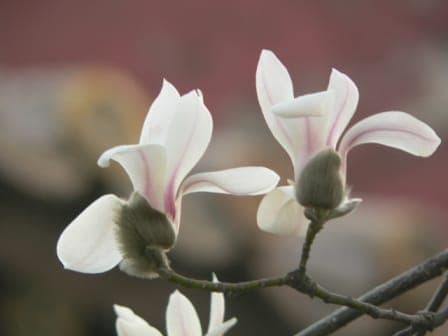
The original uploader was Yongxinge at English Wikipedia. / CC BY-SA 3.0, via Wikimedia Commons
White magnolia: complete guide
Magnolia denudata
¿Quieres ver White magnolia: complete guide en tu jardín?
1 minuto, sin tarjeta de crédito
Overview
Magnolia denudata, commonly known as white magnolia or lily-tree, is a magnificent magnolia species native to eastern and southern China. This spectacular shrub to small tree reaches 7-10 meters in height and is renowned for its massive, pure white flowers appearing in early spring (March-April in temperate zones) before foliage fully emerges. For garden designers seeking strong architectural elements with early seasonal color display, Magnolia denudata serves as an irreplaceable specimen tree combining botanical beauty with structural significance to garden compositions.
This magnolia distinguishes itself through its regular, upright branching habit and strongly vertical growth pattern maintained as the tree matures. Flower production is overwhelming: a ten-year-old specimen generates hundreds of simultaneous flowers, resulting in visually spectacular spring moments. Pure whiteness of flowers combined with silky luster creates a garden monument unto itself.
Within garden landscapes, Magnolia denudata establishes an essential connection between winter dormancy and explosive spring awakening. The tree functions as architectural beacon and structural anchor point providing vertebral support to overall garden composition, visible across substantial landscape distances.
Appearance and Bloom
Magnolia denudata develops regular, stiffly upright branching with decidedly vertical growth orientation. The tree typically reaches 7-10 meters, though older specimens may grow to 15 meters. Bark is smooth and grayish-brown in youth, becoming rougher and darker with age. Branches are stiffly upright and symmetrically grouped, creating characteristic neat pyramidal silhouette.
Foliage emerges later in spring (April-May), displaying elliptic-lanceolate morphology measuring 8-15 centimeters in length with acute apices. Leaf color is bright green, progressing to deeper green in summer, fading to pale yellow-green in autumn.
Flowers constitute the entire purpose of this tree. Magnolia denudata produces enormous pure white flowers measuring 7-10 centimeters across, formed as elegant tulip or lily-like shapes. Flowers comprise 6-9 overlapping bracteoles and tepals (no distinct calyx and corolla structures, characteristic of Magnoliaceae family). Flowers appear March-April before foliage has fully expanded, resulting in spectacular white displays against dark branches.
Each flower persists only 7-10 days, but the tree produces successive blooms across 2-3 weeks, yielding prolonged white display. Flowers emit light fragrance, particularly during morning and afternoon hours.
Ideal Location
Optimal locations require full-sun to half-shade conditions (minimum 4-6 hours direct daily sun). The tree thrives in southeast-oriented garden compartments where morning sun minimizes frost damage to flowers. Preference for sheltered locations with limited wind exposure, as wind can damage delicate blooms and shorten their display lifespan.
Although the tree tolerates light shade, full shade proves unacceptable - flowering proliferation reduces dramatically in shade conditions, and vertical branching habit deteriorates as Magnolia denudata reaches toward light sources.
Landscape placement must optimize sightline benefits. Position the tree where early spring flowers remain clearly visible from inhabited garden spaces, terraces, and transit routes. The tree achieves maximum spectacular impact in solitary specimen settings where it can be backlit against dark backgrounds (conifers, hedges, buildings).
Diseño gratis
¿Quieres ver White magnolia: complete guide en tu jardín? Crea un diseño gratis ahora.
Soil Quality
Magnolia denudata requires well-draining soil with excellent aeration and consistent moisture availability. The plant tolerates mildly acidic to neutral soils (pH 6.0-7.5) but grows poorly in highly alkaline conditions (pH > 8.0). In calcareous regions (such as southern German and French gardens), iron deficiency (chlorosis) may occur - foliage yellows while veins remain green.
Ideal soil combines sand, silt, and clay with 5-10% organic humus content. During planting, incorporate garden peat, leaf mold, and sand to improve structure and maintain moisture retention.
Avoid waterlogging - Magnolia roots rot rapidly in permanently wet conditions. The tree performs poorly in low-lying depressions where rainwater stagnates.
Watering and Moisture Management
Immediately following transplantation, the tree merits careful water management. During the first two growing seasons, apply 2-3 centimeters water daily (morning preferred). This supports robust root development and extensive branch proliferation.
Once established (after 2-3 years), rainfall and natural soil moisture reserves suffice in temperate climates. During dry summers (less than 50 millimeters monthly rainfall, May-August), supplement with 30-40 millimeters water weekly.
Mulch application (5-8 centimeter depth) aids moisture retention, temperature buffering, and organic matter input.
Pruning and Formation
Magnolia denudata requires minimal pruning. However, selective interventions enhance form and flowering productivity.
During young plant phase (years 1-3), the tree naturally develops into the desired pyramidal silhouette. Overlapping or weakly-growing branches may be carefully thinned during early summer by cutting at the base.
Once flowering maturity is reached (typically after 5-7 years), pruning becomes unnecessary. Remove only dead material immediately following bloom (April).
Maintenance Calendar
February-March: Flowering period begins. No maintenance required; enjoy blooms.
April-May: Bloom concludes. Foliage emergence period. Remove weakly-growing branches as needed.
May-July: Growth phase. Manage moisture carefully (watering in dry periods). No fertilization needed.
August-October: Foliage maturation. Autumn colors develop. No maintenance required.
November-February: Dormant period. Winter sleep. Minimal activity.
Winter Hardiness
Magnolia denudata is completely hardy through USDA zone 5 (-28°C). In Netherlands, Belgium, and Germany, the tree survives all natural winter temperatures, although early spring flowers sometimes incur frost damage during periods of returning frost (April).
Frost damage to flowers is more likely in northern locations or lowland situations where night frost risk proves greater. In southern German and Belgian lowland gardens, frost risk remains minimal.
Companion Plant Selection
Prunus serrulata (Japanese ornamental cherry): Blooms April-May with pink flowers; follows beautifully after Magnolia denudata's white display.
Rhododendron spp. (diverse cultivars): Blooms May-June; lower stature; provides excellent underplanting.
Helleborus niger (Christmas rose): Blooms February-March; extremely low-growing; white-green flowers complement Magnolia denudata's white composition.
Narcissus 'Thalia' (Triandrus daffodil): White, February-April; underplanting adding botanical interest.
Concluding Remarks
Magnolia denudata represents a masterpiece of garden architecture and natural beauty. This tree offers what few plant specimens achieve: strong structural presence, immediate aesthetic beauty, and decades of performance with minimal intervention. For garden designs where spring transformation and architectural significance prove central, Magnolia denudata remains nearly indispensable. Discover additional garden inspiration on www.gardenworld.app where professional designers create spectacular compositions. With proper site selection, moisture management, and garden positioning, you will enjoy decades of this spectacular flowering tree.
¿Quieres ver White magnolia: complete guide en tu jardín? Crea un diseño gratis ahora.
Sube una foto, elige un estilo y obtén un diseño fotorrealista con lista de plantas en menos de un minuto.
Más de 10.000 jardines diseñados
Sin tarjeta de crédito


Plantas similares
Purple magnolia: complete guide
Magnolia liliiflora
Discover Magnolia liliiflora, an elegant spring shrub with purple-pink flowers in two seasons. Perfect for garden design, containers, and extended early bloom on gardenworld.app.
Two-leaved Solomon's seal: complete guide
Maianthemum bifolium
Discover Maianthemum bifolium, a delicate woodland floor plant with tiny white flowers. Perfect for shade gardens, forest understory, and groundcover on gardenworld.app.