
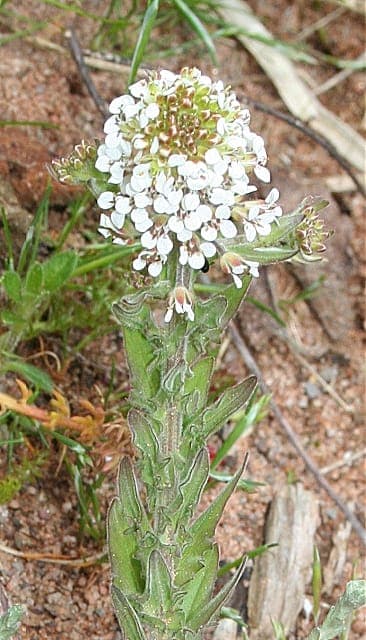
Anne Burgess / CC BY-SA 2.0, via Wikimedia Commons
Smith's pepperwort: complete guide
Lepidium heterophyllum
¿Quieres ver Smith's pepperwort: complete guide en tu jardín?
1 minuto, sin tarjeta de crédito
Overview
Smith's pepperwort (Lepidium heterophyllum) is a compact perennial from the Brassicaceae family, native to Western Europe. This plant is distinguished by its attractive rosette form and variable leaf shapes, with the botanical name "heterophyllum" meaning "of different leaves." It's an excellent choice for space-limited gardens and rock gardens.
Appearance and Bloom
Smith's pepperwort grows as a compact rosette 25-35 cm tall and 30-45 cm wide. The basal leaves form a dense, attractive pattern, while stem leaves gradually diminish. This distinctive "heterophyllous" leaf pattern is characteristically attractive. In May and June, small white flowers appear in dense clusters on slender stems. The blooms are modest yet elegant.
Ideal Location
Smith's pepperwort thrives in sunny to partially shaded locations with at least 4-5 hours of direct sunlight. The plant tolerates light shade well, making it versatile. It grows perfectly in rock gardens, screes, or borders. Using gardenworld.app, design your garden with this adaptable plant.
Soil
Excellent drainage is essential. Sandy, gravelly, or chalky soils are ideal. Heavy clay must be significantly amended. A pH of 6.0-7.5 is good; alkaline soils are even better. The plant tolerates dry and poor soils well, making it perfect for challenging garden spots.
Watering
Once established, Smith's pepperwort is very drought-tolerant. Provide consistent moisture at the beginning of the growing period. After establishment, water minimally. Overwatering is worse than underwatering. In winter, water sparingly to prevent root rot.
Diseño gratis
¿Quieres ver Smith's pepperwort: complete guide en tu jardín? Crea un diseño gratis ahora.
Pruning
Minimal pruning is needed. Remove dead or damaged leaves regularly. In June, remove spent flower stems. The plant naturally forms attractive rosettes, so don't interfere with its natural form. Replacing completely withered rosettes is the only major intervention.
Maintenance Calendar
- March-April: Check for winter damage, remove dead leaves
- May-June: Enjoy the blooms, remove spent flowers
- July-September: Minimal care, water only in extreme drought
- October-February: Prevent wet feet, no water unless absolutely necessary
- March: Restart cautious watering
Winter Hardiness
Smith's pepperwort is hardy to -20°C (USDA zone 5b), though this is borderline. In wet winter regions, drainage is crucial. Protection from snow and rain is sometimes beneficial. In very cold regions, provide grit drainage around the plant.
Companion Plants
Smith's pepperwort pairs nicely with:
- Maiden pink (Dianthus deltoides): similar size
- Thyme (Thymus): compatible watering needs
- Saxifraga: same drainage preference
- Granite pink (Dianthus graniticus): texture contrast
- Sedum: excellent durable partner
Avoid moisture-loving or vigorous groundcover plants.
Conclusion
Smith's pepperwort deserves more attention as a compact plant for limited spaces. Its distinctive leaf pattern and elegant flowers make it worthwhile. For gardeners with space constraints, rock gardens, or dry borders, visit gardenworld.app for more designs where Smith's pepperwort shines.
Where to Buy
Smith's pepperwort is sometimes available at garden centers specializing in compact perennials or rock gardens. Ask for healthy rosette plants with intact foliage.
¿Quieres ver Smith's pepperwort: complete guide en tu jardín? Crea un diseño gratis ahora.
Sube una foto, elige un estilo y obtén un diseño fotorrealista con lista de plantas en menos de un minuto.
Más de 10.000 jardines diseñados
Sin tarjeta de crédito


Plantas similares
Heart-pod hoary cress: complete guide
Lepidium draba
Master the care of heart-pod hoary cress with this comprehensive guide. Growing tips, maintenance schedule, and perfect companion plants.
Tall pepperwort: complete guide
Lepidium graminifolium
Discover the elegance of tall pepperwort with this detailed care guide. Growing tips, propagation, and Mediterranean landscape design.