
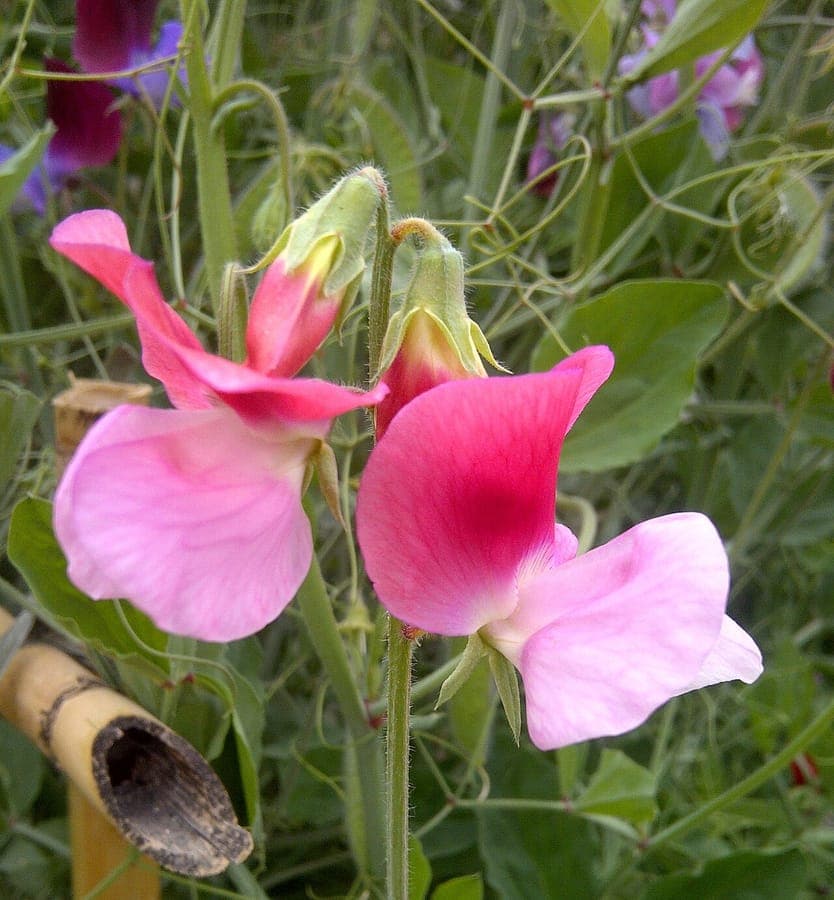
Aftabbanoori / CC BY-SA 3.0, via Wikimedia Commons
Sweet pea: complete guide
Lathyrus odoratus
¿Quieres ver Sweet pea: complete guide en tu jardín?
1 minuto, sin tarjeta de crédito
Overview
The sweet pea (Lathyrus odoratus) is a refined climbing plant that has enchanted gardens since the 17th century with its captivating fragrance and delicate, multicolored flowers. Native to southern Italy and Sicily, this annual or tender perennial has established itself as a worldwide gardening favorite. Flowers appear in abundant varieties - from pure white to deep purple, pink, red, and bicolor - all with a sweet, intoxicating perfume that wins the heart of every gardener.
What makes the sweet pea extraordinary is the perfect union of pure beauty and fragrance. Unlike many scented flowers with faint or unpleasant odors, the sweet pea offers both rich color and intense perfume. With gardenworld.app, you can position sweet peas perfectly along a pergola, garden wall, or trellis, where these elegant climbers command full attention through summer and spring.
Appearance and bloom
The sweet pea grows as a slender, delicate-looking climber reaching 2 meters or higher with support, with fine, blue-green tendrils emerging from the leaf axils. The foliage is pinnate - two pairs of blue-green leaflets with a tendril at the apex that enables climbing. This light, transparent leaf structure ensures you maintain sight lines and prevent a dense green wall.
The flowers are the absolute highlight. They appear from May through October in dense clusters, each flower approximately 3-4 cm across, with five petals arranged in the characteristic butterfly shape (papilionaceous). Blooms grow singly or in groups on long stalks. Colors range from white ('Dorothy Eckford'), pink ('Matucana'), deep purple ('Midnight'), red ('Lady in Red') and numerous bicolor combinations. Nearly all varieties emit an intense, sweet vanilla fragrance, especially on warm, sunny mornings.
Following bloom, narrow seed pods develop, ripening in August and September. Seeds can be dried and resown the following year - a centuries-old gardening practice.
Ideal location
The sweet pea thrives in full sun (at least 6-8 hours direct sunlight daily). In shadier spots, flowering will be significantly reduced. Position it against a south-facing wall, light pergola, or sunny fence where it can bloom abundantly.
The plant appreciates good air circulation to prevent fungal disease. Avoid enclosed corners or heavy walls without ventilation. In garden designs using gardenworld.app, you might position sweet peas against an open garden gate, along a pergola, or in a sunny border where climbing plants are welcome.
Soil and nutrition
Sweet peas grow best in fertile, well-drained soil with pH 6.0-7.5. Work compost or well-rotted manure into the soil before planting for humus-rich conditions. As a legume (Fabaceae), this plant fixes its own nitrogen but appreciates some nutrition in poor soils.
Apply slow-release fertilizer at planting. If you continue deadheading to maintain blooming through summer, mid-season feeding with a low-nitrogen formulation (emphasizing potassium and phosphate, not nitrogen - which promotes excess foliage) helps sustain flowers.
Diseño gratis
¿Quieres ver Sweet pea: complete guide en tu jardín? Crea un diseño gratis ahora.
Watering
Sweet peas appreciate consistent moisture without waterlogging. During the initial growth phase (May-June), water regularly. As plants mature and temperatures rise, water deeply 2-3 times weekly, especially during dry periods. Mulching the base (5 cm) helps retain moisture and keeps roots cool.
In rainy summers, reduce watering. Water early morning at the base; avoid wetting foliage to prevent fungal diseases.
Pruning and maintenance
Sweet peas grow quickly and require regular care. Remove spent flowers consistently (deadheading) - this stimulates continuous blooming and prevents seed formation. As long as you harvest flowers, the plant blooms until October. Once you allow it to set seed, flowering stops.
Bind climbing shoots regularly to supports using soft ties. Ensure the plant grows neatly along its trellis without becoming tangled. If the lower portions become bare, you can prune away lower foliage while maintaining upper leaf clusters for structural support.
Maintenance calendar
April-May: Sow directly in loose soil or pre-start in pots. Direct sow outdoors after last frost.
May-June: Transplant outdoors; water regularly. Establish supports; tie in young shoots.
June-October: Flowering season. Deadhead for continuous blooms. Water consistently.
September-October: Seed pods ripen. Harvest pods or allow to mature for next year's seed.
October-November: Frost kills annual growth. Clear away. Store seeds in cool, dry place.
Winter hardiness
The sweet pea is grown as an annual in temperate climates and is not winter-hardy. Following first frost in November-December, it dies back. However, you can save seed and resow the following year - a wonderful annual cycle.
In warmer climates (USDA zones 9-10), it may persist as a tender perennial. In temperate regions, remove frost-damaged growth and resow.
Companion planting
Sweet peas pair beautifully with:
- Other climbing plants: Clematis, Trachelospermum jasminoides, or foliage climbers create layers of texture.
- Base plantings: Lavender, sedum, or perennials at the base provide structure when sweet peas fade.
- Contrast plants: Dark-leaved Heuchera or silver-leaved Artemisia offer color contrast.
- Early bloomers: Plant tulips and narcissus around the base; their spring display precedes the fragrant summer climber.
On gardenworld.app, visualize these layers perfectly in 3D garden design.
Final tips
The sweet pea is an enchanting plant filling your garden with fragrance and color. Sow in early spring on-site or pre-start in pots - both methods work well. Remember: deadhead consistently, water regularly, and enjoy the fragrance on warm mornings.
For a perfectly laid-out garden design with sweet peas positioned ideally, create a design on gardenworld.app. With photorealistic 3D visualization, see how they climb your pergola and which plant combinations complement them. Design now and create your dream garden with fragrant summer bloomers.
¿Quieres ver Sweet pea: complete guide en tu jardín? Crea un diseño gratis ahora.
Sube una foto, elige un estilo y obtén un diseño fotorrealista con lista de plantas en menos de un minuto.
Más de 10.000 jardines diseñados
Sin tarjeta de crédito


Plantas similares
Everlasting pea (Lathyrus latifolius): complete guide
Lathyrus latifolius
Learn all about everlasting pea (Lathyrus latifolius), a strong climber with pink and purple flowers. Ideal for pergolas, garden walls and borders. Sowing, planting and care.
Narrow-Leaf Everlasting-Pea: complete guide
Lathyrus sylvestris
Learn about Narrow-Leaf Everlasting-Pea (Lathyrus sylvestris): growing, care, and tips for this hardy climbing perennial.
Meadow vetchling (Lathyrus pratensis): complete guide
Lathyrus pratensis
Discover meadow vetchling, a vital host plant for butterflies. Growing tips, June-July bloom, and role in biodiversity gardens.