
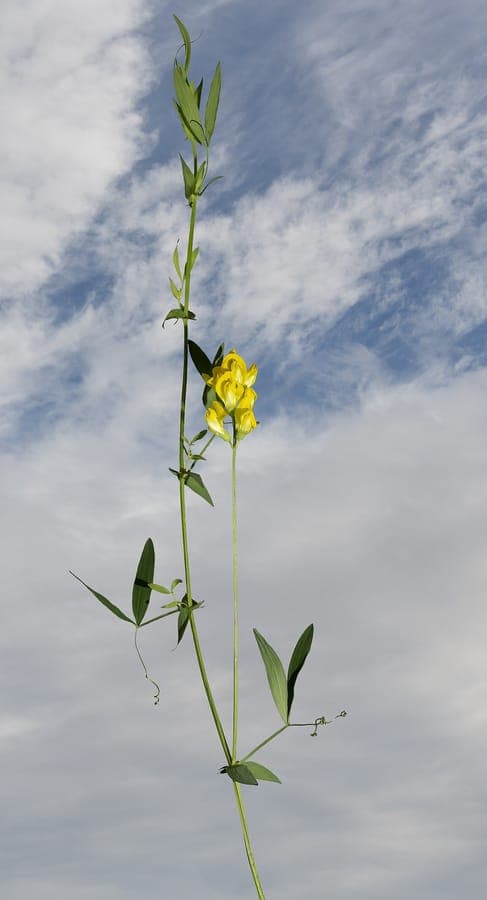
Didier Descouens / CC BY-SA 4.0, via Wikimedia Commons
Meadow vetchling (Lathyrus pratensis): complete guide
Lathyrus pratensis
¿Quieres ver Meadow vetchling (Lathyrus pratensis): complete guide en tu jardín?
1 minuto, sin tarjeta de crédito
Overview
Meadow vetchling (Lathyrus pratensis), also called Meadow pea, is a vibrant, multifaceted wild plant from the legume family (Fabaceae). This perennial is native across Europe to Mongolia and the Himalayas, growing wild in grasslands, meadows, and woodland edges.
This plant is exceptional for its bright yellow flowers that attract bees and butterflies, and especially for its role as host plant for numerous butterfly caterpillars. It is an ecosystem-critical component in natural gardens, meadows, and wildlife management.
Appearance and Bloom
Meadow vetchling grows as a sprawling, weakly climbing plant 30-80 cm tall with distinctive compound leaves featuring a terminal leaflet and two opposite wings. Stems are hollow, soft, and gracefully trailing with silvery-gray tint.
Bloom period: June to August. Flowers are small (1.5-2 cm), bright yellow, borne in dense many-flowered clusters of 5-15 blooms per truss. This yellow is unmistakable and highly attractive to diverse insect fauna.
Fruit: After flowering, hairy seed pods (2-3 cm) develop containing black seeds.
Ideal Location
Meadow vetchling thrives in:
- Light: Full sun (6+ hours direct light) to half-shade
- Microclimate: Moderately moist grassland, not drought-stressed
- Position: Among wildflowers, along borders, meadow edges
- Soil: Species-rich grassland, pasture, woodland margin
Less suited to:
- Very dry sandy sites
- Deep shade
- Waterlogged, boggy soils
- Intensively managed turf (too much mowing)
Tip: Meadow vetchling is a butterfly plant: several butterfly species use it as caterpillar food plant. Avoid pesticides.
Soil
Meadow vetchling makes moderate demands:
- Soil type: Sandy to loamy; ideal for species-rich grassland
- Drainage: Good; waterlogging is unfavorable
- pH: Neutral to slightly acidic (6.0-7.2)
- Fertility: Low to moderate; it thrives in nutrient-poor meadow soils
- Organic matter: Compost aids establishment; then minimal
Preparation: For meadow integration: light soil scarification, weed removal, direct sowing.
Watering
Meadow vetchling is moderately drought-tolerant:
Establishment (first year):
- Regular watering during very dry spells (>3 weeks without rain)
- After 8-10 weeks: minimal supplementation
- In-ground plants usually receive adequate natural rainfall
Mature plants (year 2+):
- Virtually no supplemental water needed
- Only during extreme drought: occasional watering
- Plant prefers moderately moist conditions
Diseño gratis
¿Quieres ver Meadow vetchling (Lathyrus pratensis): complete guide en tu jardín? Crea un diseño gratis ahora.
Pruning and Maintenance
Meadow vetchling requires minimal work:
Growing season:
- No pruning
- Deadheading (removing spent flowers) slightly encourages more bloom
- Allow some roughness; caterpillars eat leaves
After seed set:
- Plant dies back late autumn
- Seeds fall to ground; self-seed next year
- Remove unwanted seedlings
Disease management:
- Very disease-free
- Rarely: aphids, but natural predators (ladybugs) provide control
- No pesticide spraying: kills caterpillar food
Maintenance Calendar
April-May: Plant/sow, growth begins June-August: Bloom peak, insect visitation August-September: Seed pod maturation October-November: Seed ripens, plant goes dormant December-March: Dormancy; seed in soil April (year 2+): Self-seeded volunteers bloom
Winter Hardiness
Meadow vetchling is moderately hardy (USDA Zone 5, to -18°C). No issues in temperate regions.
Winter care:
- Mature plants: no protection needed
- Seed overwinters in soil
- No frost damage occurs
Companion Planting
Meadow vetchling pairs beautifully in species-rich meadow schemes:
Good companions:
- Other host plants: Bindweed (Convolvulus), clover (Trifolium)
- Wildflowers: Meadow sage (Salvia), bird's-foot trefoil (Lotus)
- Grasses: Creeping soft grass (Holcus), golden oat grass (Trisetum)
- Herb mix: Sedges (Carex), selfheal (Prunella)
Poor companions:
- Vigorous growers: Reed canary grass, strong competitors
- Formal gardens: Better suited to wild, natural settings
Closing Remarks
Meadow vetchling is a critical host plant for butterflies, especially species like Small Copper, Common Blue, and many others. This plant provides food for caterpillars throughout May-July.
Integration into meadows, woodland edges, and grassland strips supports butterfly ecosystems. It is essential for biodiversity projects and wildlife-friendly management.
Supporting meadow vetchling means supporting entire butterfly populations. Place this plant centrally in your butterfly garden.
Plan your butterfly garden via gardenworld.app for optimal host plant selection. With meadow vetchling, you create habitat for generations of butterflies.
For more butterfly gardening tips and host plant advice: visit gardenworld.app.
¿Quieres ver Meadow vetchling (Lathyrus pratensis): complete guide en tu jardín? Crea un diseño gratis ahora.
Sube una foto, elige un estilo y obtén un diseño fotorrealista con lista de plantas en menos de un minuto.
Más de 10.000 jardines diseñados
Sin tarjeta de crédito


Plantas similares
Tall Silky Lupine: complete guide
Lupinus elatus
Tall silky lupine is a fast-growing Californian perennial with silvery foliage and blue-purple flower spikes, ideal for a prairie-style garden.
Garfield Lupine: complete guide
Lupinus garfieldensis
The Garfield lupine is a rare, fast-growing American perennial for alkaline, dry grassland gardens, with striking blue flower spikes.
Lupinus elegans: complete guide
Lupinus elegans
Lupinus elegans, the elegant lupine, is a spectacular blooming plant from Mexico with blue flower spikes. Care, cultivation and garden use.