
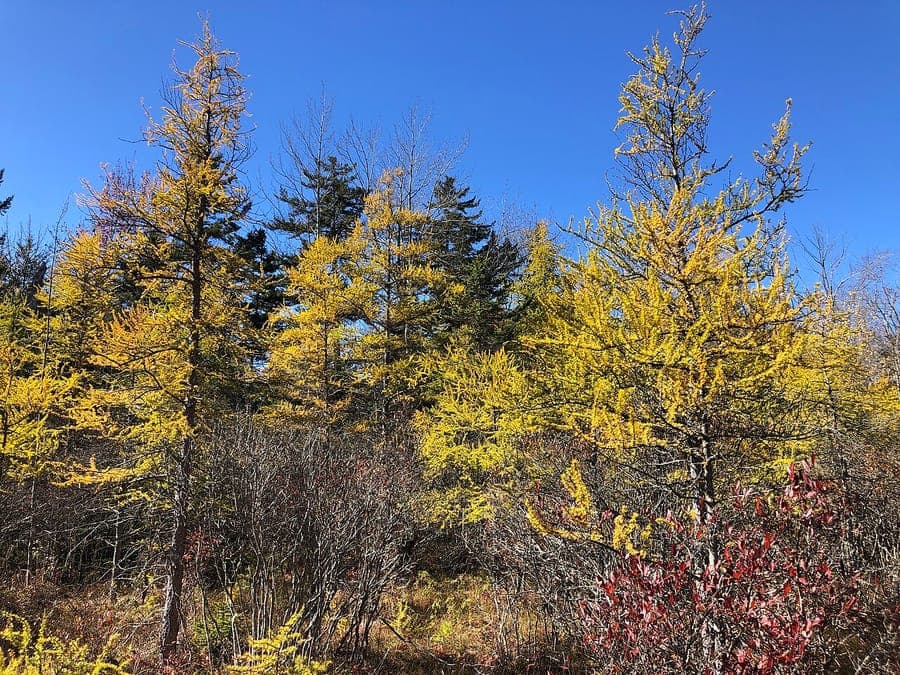
Famartin / CC BY-SA 4.0, via Wikimedia Commons
Eastern larch (Tamarack): complete guide
Larix laricina
¿Quieres ver Eastern larch (Tamarack): complete guide en tu jardín?
1 minuto, sin tarjeta de crédito
Overview
The Eastern larch (Larix laricina), commonly known as tamarack in North America, is an exceptionally resilient deciduous conifer native to subarctic and arctic regions. This tree is unique among conifers in its ability to flourish in boggy, waterlogged soils. The tamarack is well-adapted to harsh environments and plays a vital ecological role in northern forest ecosystems.
Appearance and bloom
The Eastern larch reaches 15-20 meters under optimal conditions, occasionally stretching to 24 meters in highly favorable settings. The tree displays a regular, conical form with spreading branches. The needles are extremely fine (1.5-3 cm), soft, and green, arranged in clustered bundles. Early spring brings pink female cones and yellow male flowers. Autumn reveals golden-yellow needles.
Ideal location
The Eastern larch flourishes in full sun with at least 6 hours of direct sunlight. This is the only conifer that thrives in boggy, waterlogged ground. Plant it in locations with poor drainage where many trees fail. This tree is extremely hardy (USDA zones 2-5) and tolerates extreme cold exceptionally well.
Soil
The Eastern larch is unique because it grows exceptionally well in wet, muddy, and boggy soils. It also accepts acidic water and low-nutrient peat soils. On normal soils, it grows adequately without specific preferences. The tree tolerates extremely low pH (3.5-5.5) that most other trees cannot withstand.
Diseño gratis
¿Quieres ver Eastern larch (Tamarack): complete guide en tu jardín? Crea un diseño gratis ahora.
Watering
On wetland locations, you essentially do not water - the tree grows in semi-permanently wet conditions. On normal soils, water regularly for the first two years, approximately 2-3 liters weekly during dry spells. After establishment, minimal watering is needed.
Pruning
The Eastern larch requires minimal pruning. Remove only dead or severely damaged branches in late winter. Avoid forcing artificial shaping; this tree maintains its natural symmetry best when left alone.
Maintenance calendar
- April-May: Plant in wetland locations or on dry soils
- June-August: Water regularly on dry soils; no maintenance on wet sites
- September-October: Needles turn golden-yellow; no action needed
- November-March: Winter period; no maintenance
Winter hardiness
The Eastern larch is extremely hardy down to -45°C (USDA zones 2-5). This is the most cold-tolerant larch species. The tree thrives in harsh climates and tolerates extreme temperature fluctuations.
Companion plants
The Eastern larch combines well with other wetland plants such as bog birches and bog myrtles. Surround with moisture-loving shrubs. On dry soils, it pairs well with other conifers like spruce and fir.
Closing
The Eastern larch is a natural wonder for those needing a tree for wet, boggy terrain. While not the most ornamental conifer, it is absolutely the most practical for problem soils. For garden solutions in challenging sites, explore options at gardenworld.app. Get inspired for water-wise and ecological gardens on gardenworld.app.
¿Quieres ver Eastern larch (Tamarack): complete guide en tu jardín? Crea un diseño gratis ahora.
Sube una foto, elige un estilo y obtén un diseño fotorrealista con lista de plantas en menos de un minuto.
Más de 10.000 jardines diseñados
Sin tarjeta de crédito


Plantas similares
Dahurian larch: complete guide
Larix gmelinii
Dahurian larch (Larix gmelinii) is an elegant deciduous conifer with soft needles turning golden in autumn. Perfect for large gardens with cold winters.
Japanese larch: complete guide
Larix kaempferi
Japanese larch (Larix kaempferi) is a refined conifer with delicate feathery needles. The tree sheds needles in autumn with stunning golden-yellow hues.
Siberian larch: complete guide
Larix sibirica
Siberian larch (Larix sibirica) is a majestic deciduous conifer with elegant branches and fine needles. This tree offers golden-yellow autumn color in large gardens.