
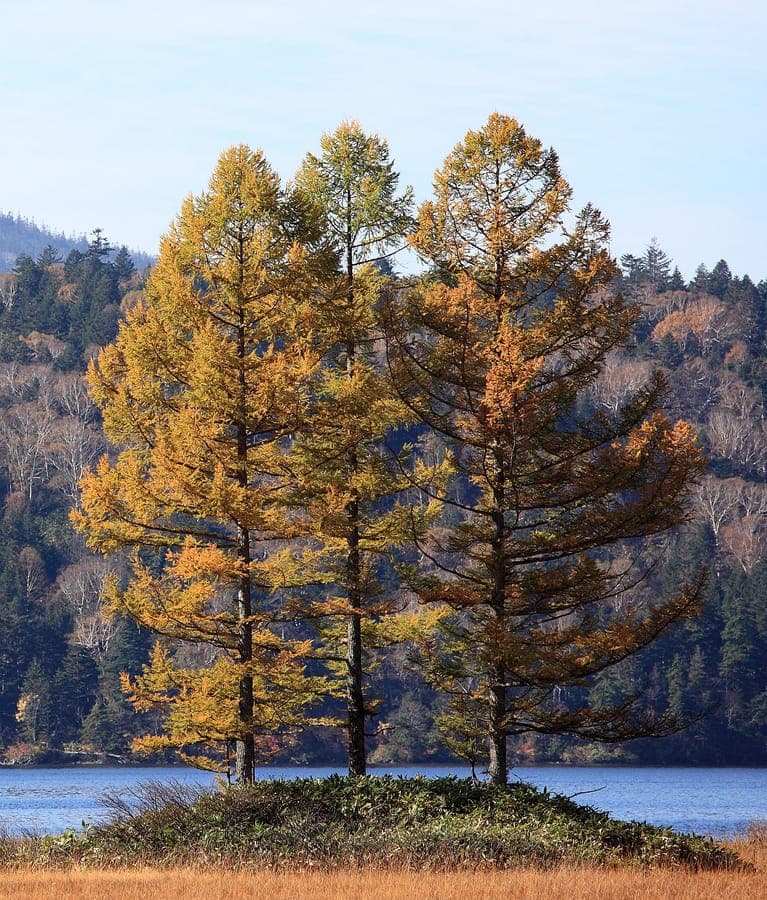
Tanaka Juuyoh / CC BY 2.0, via Wikimedia Commons
Japanese larch: complete guide
Larix kaempferi
¿Quieres ver Japanese larch: complete guide en tu jardín?
1 minuto, sin tarjeta de crédito
Overview
The Japanese larch (Larix kaempferi), native to central Japan, is a refined deciduous conifer with characteristic fine-textured needles. This tree is renowned for its delicate needle structure and spectacular autumn transformation. The Japanese larch is a popular choice in European gardens due to its compact form and adaptability.
Appearance and bloom
The Japanese larch typically reaches 12-18 meters in garden settings. The tree exhibits a regular, pyramidal form with dense branching. The needles are exceptionally fine (1-2 cm long), soft, and create a woolly appearance. Early spring brings female cones with red-purple scales. Male flowers appear golden on older spurs. Autumn coloration ranges from golden-yellow to orange-gold.
Ideal location
The Japanese larch flourishes in full sun with at least 6 hours of direct daily light. Choose a location where the autumn color display can be fully appreciated. This tree is hardy in USDA zones 4-7 and tolerates frost-prone areas effectively. Wind exposure is less critical than with other larch species.
Soil
The Japanese larch thrives in sandy, loamy, and clayey soils. It prefers well-draining conditions with pH 5.5-7.0. This is one of the least demanding species regarding soil quality. Heavy, compact soils should be amended with organic material.
Watering
Water regularly during the growing season, especially the first three years after planting. Provide approximately 2-3 liters weekly during dry spells. Once established, the Japanese larch shows good drought tolerance. Winter watering is unnecessary unless extremely dry conditions prevail.
Diseño gratis
¿Quieres ver Japanese larch: complete guide en tu jardín? Crea un diseño gratis ahora.
Pruning
The Japanese larch requires minimal pruning. Remove branches showing damage or crossing in late winter (February-March). Avoid forcing artificial forms; allow the tree to retain its natural symmetry. Young trees benefit from light shaping to improve branching.
Maintenance calendar
- February-March: Inspect winter damage; prune broken branches
- April-May: Planting or transplanting recommended; begin watering
- June-August: Regular watering during dry periods; apply fertilizer
- September-October: Continue watering; needles turn yellow-orange
- November-January: Natural dormancy period; no maintenance
Winter hardiness
The Japanese larch is hardy down to -25°C (USDA zones 4-7). This makes it more reliable than many exotic conifers. Early spring needle emergence can be frost-sensitive, but permanent damage rarely occurs.
Companion plants
The Japanese larch combines beautifully with blue spruces (Picea pungens) and dwarf conifers. Underplant with hardy shrubs like Ilex or Buxus. In mixed borders, azaleas and hydrangeas provide supportive color.
Closing
The Japanese larch is ideal for gardeners seeking a conifer with refined, elegant characteristics. The golden autumn transformation is always a seasonal highlight. For more garden ideas and personalized designs, visit gardenworld.app. Discover how to integrate this beautiful specimen into your garden on gardenworld.app.
¿Quieres ver Japanese larch: complete guide en tu jardín? Crea un diseño gratis ahora.
Sube una foto, elige un estilo y obtén un diseño fotorrealista con lista de plantas en menos de un minuto.
Más de 10.000 jardines diseñados
Sin tarjeta de crédito


Plantas similares
Dahurian larch: complete guide
Larix gmelinii
Dahurian larch (Larix gmelinii) is an elegant deciduous conifer with soft needles turning golden in autumn. Perfect for large gardens with cold winters.
Siberian larch: complete guide
Larix sibirica
Siberian larch (Larix sibirica) is a majestic deciduous conifer with elegant branches and fine needles. This tree offers golden-yellow autumn color in large gardens.
Eastern larch (Tamarack): complete guide
Larix laricina
Eastern larch (Larix laricina), also called tamarack, is a hardy deciduous conifer that thrives in wet, boggy soils. Ideal for difficult wet locations.