
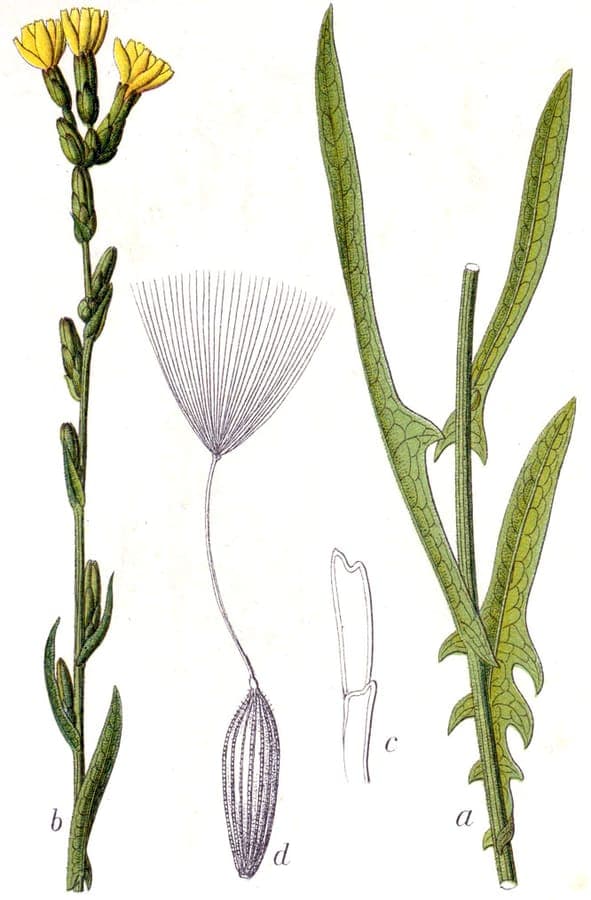
Johann Georg Sturm (Painter: Jacob Sturm) / Public domain, via Wikimedia Commons
Least lettuce: complete guide
Lactuca saligna
¿Quieres ver Least lettuce: complete guide en tu jardín?
1 minuto, sin tarjeta de crédito
Overview
Least lettuce (Lactuca saligna), also called Willow-leaved lettuce or Slender lettuce, is an elegant annual wild plant from the Asteraceae family. Native to South and Central Europe, North Africa, and the Near East, this plant grows in extremely arid, often abandoned landscapes. What distinguishes least lettuce is its remarkably slender, willow-like leaves and its exceptional drought-endurance - properties making it invaluable in increasingly arid regions and water-conscious garden design.
The plant grows compact and finely-branched, often no more than 30-60 cm tall, producing countless small yellow flowers from July through September. Least lettuce pairs perfectly with other drought-loving plants in xeriscaping and ecological gardens. On gardenworld.app, least lettuce can feature in sustainable garden designs that thrive in dry climates and moisture-poor soils.
Appearance and bloom
Least lettuce grows as a slender, upright annual, typically 20-60 cm (8-24 inches) tall, with thin, branched stems and light, open form. The foliage is highly distinctive: narrow, linear to willow-like, yellowish-green to grayish-green, and less toothed than most lettuce species. This leaf morphology gives the plant a refined, subtle appearance.
Flowers appear from July through October, in loose, yellowish clusters along the stems. Each flower is extremely small (mere millimeters), but abundantly massed. The yellow color is soft and pastel - not vivid, but pleasant against the grayish-green foliage. Following bloom, light-weight, feathered seed-heads develop.
Ideal location
Least lettuce thrives in full sun on dry, moisture-poor sites. This is not a plant for damp, nutrient-rich soils; rather, it flourishes where many other plants fail. Position it in a sunny, arid corner of your garden - on gravel pads, dry borders, or rocky slopes.
The plant tolerates temperature fluctuations and windy conditions better than many garden plants. In gardenworld.app designs, least lettuce occupies climate-conscious, drought-tolerant borders alongside other xeriscape plants.
Soil and nutrition
Least lettuce grows in extremely nutrient-poor, sandy, gravelly soils - precisely habitats where most plants falter. The plant tolerates alkaline, neutral, and even weakly acidic soils. pH can range anywhere between 6.0 and 8.0.
Supplemental feeding is not only unnecessary but actually undesirable. In nutrient-rich soils the plant produces excessive foliage and reduced flowering. Allow the plant to grow on lean, arid soils; here it appears at its best.
Diseño gratis
¿Quieres ver Least lettuce: complete guide en tu jardín? Crea un diseño gratis ahora.
Watering
Once established, least lettuce requires virtually no water. Rainfall suffices; in most years even minimal precipitation is adequate. Even in exceptionally dry years, single watering is not critical. This plant is among the most drought-tolerant annuals available.
Water well after planting (first week of establishment), but thereafter minimize intervention. In containers more attention may be required, but in open ground drought-tolerance is remarkable.
Pruning and maintenance
Least lettuce demands zero maintenance. The plant self-maintains and requires no pruning. Allow fallen foliage to remain; it protects the plant and feeds soil organisms. You can remove seed-heads to prevent unwanted seeding, or allow natural spread.
After bloom you can remove dried stems if neat appearance is desired, but this is not biologically necessary.
Maintenance calendar
April-May: Direct sow in full ground.
June-July: Seedlings grow rapidly; water only if extremely dry.
July-September: Flowering reaches peak. Bees and butterflies visit abundantly.
October-November: Seeds ripen. Harvest or allow for next-season sowing.
December: Plant dies after first frost (annual behavior).
Winter hardiness
Least lettuce is not winter-hardy - it dies after the first hard frost. Sowing occurs in spring (April-May) for bloom in the same growing season. In very mild climates (zones 9-10), the plant may occasionally overwinter and flower for two seasons, but this is rare.
For repeated blooms, resow each spring.
Companion planting
Least lettuce pairs beautifully in xeriscape gardens with:
- Other summer bloomers: Anemone hupehensis or Eryngium maritimum share the same drought preference.
- Silvery-foliage plants: Senecio jacobaea or Artemisia create light-against-gray contrast.
- Stone-dwelling succulents: Sedum and Sempervivum form textural groupings.
- Gray-foliage plants: Santolina chamaecyparissus offers foliage contrast.
On gardenworld.app, these combinations would create a sustainable, drought-tolerant garden with minimal water consumption.
Final tips
Least lettuce is an elegant and remarkably efficient plant for dry gardens and future water-conscious garden design. Sow directly in full ground in April-May. Allow the plant to self-seed for repeated blooms in subsequent years.
For a sustainable garden design that addresses climate change and water scarcity through intelligent plant selection, create a design on gardenworld.app. With visualization you'll see how drought-loving plants create texture and bloom with minimal water use - and receive recommendations for other hardy plants that thrive in future climates. Sow now and create a climate-resilient garden.
¿Quieres ver Least lettuce: complete guide en tu jardín? Crea un diseño gratis ahora.
Sube una foto, elige un estilo y obtén un diseño fotorrealista con lista de plantas en menos de un minuto.
Más de 10.000 jardines diseñados
Sin tarjeta de crédito


Plantas similares
Wall-lettuce: complete guide
Lactuca muralis
Wall-lettuce (Lactuca muralis) is an elegant wild plant with delicate purple flowers. Learn everything about this versatile herb and how to use it in garden design.
Blue lettuce: complete guide
Lactuca perennis
Blue lettuce (Lactuca perennis) is a remarkable perennial mountain plant with blue flowers. Learn everything about growing this stunning plant and incorporating it into gardens.
Endive: complete guide
Cichorium endivia
Learn how to grow Endive (Cichorium endivia) successfully in your garden. From planting to harvest – all you need to know in one detailed overview.