
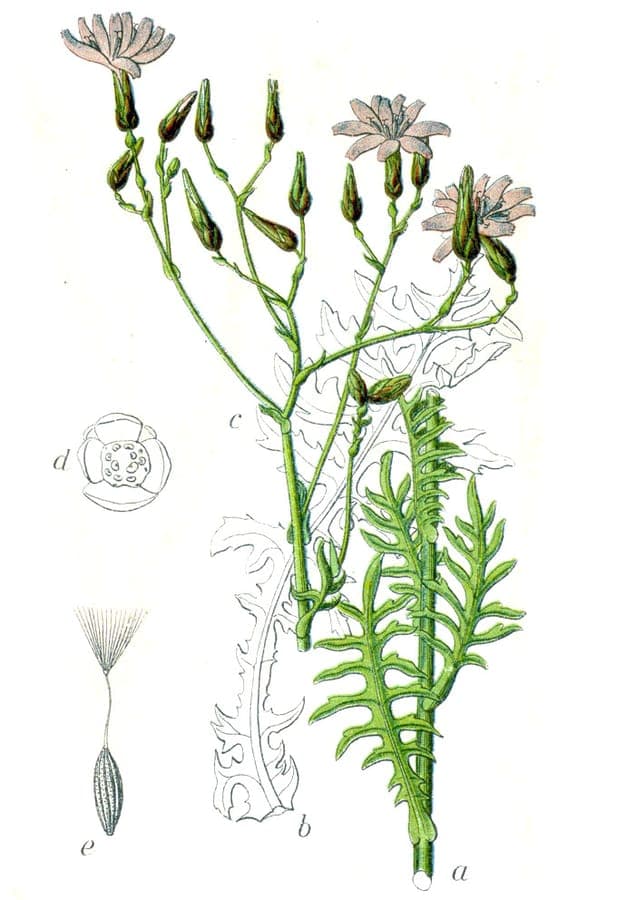
Johann Georg Sturm (Painter: Jacob Sturm) / Public domain, via Wikimedia Commons
Blue lettuce: complete guide
Lactuca perennis
¿Quieres ver Blue lettuce: complete guide en tu jardín?
1 minuto, sin tarjeta de crédito
Overview
Blue lettuce (Lactuca perennis), also called Mountain lettuce or Perennial lettuce, is a fascinating perennial alpine plant from the Asteraceae family (the same as lettuce and chicory). This plant grows wild in mountain regions throughout Europe, particularly in the Alps, Pyrenees, and other ranges. What distinguishes blue lettuce from its annual relatives is its permanent life cycle: it persists year after year, offering bright blue flowers annually from May to July.
The flowering display of blue lettuce is remarkably striking: bright blue flowers - a true rarity in garden flora - in dense, branched clusters rising above fine, grayish foliage. This combination makes blue lettuce a premier plant for alpine gardens, rock gardens, and high borders where lean conditions dominate. On gardenworld.app, blue lettuce functions as a visual anchor in rock-plant borders, positioned high in garden designs where texture and blue tones are paramount.
Appearance and bloom
Blue lettuce grows as a compact, perennial alpine plant, typically 30-80 cm (12-32 inches) tall, with thin, branched stems and dense habit. The foliage is finely lobed to toothed, greenish-gray, and persists throughout the season. The basal rosette forms the foundation from which flowering stems emerge in May.
The flowers are the celebrated feature: bright cobalt to pale blue - exceedingly rare in the plant world. They appear in loose, branched inflorescences from May through July. Each flower is small but abundantly massed, so the upper portion of the plant becomes a cloud of blue. Following bloom, feathered seed-heads develop and remain decorative in their own right.
Ideal location
Blue lettuce thrives in full sun to light dappled shade. Position it where it receives at least 6 hours direct sunlight; flowering will be less abundant in deeper shade. The plant loves alpine, well-drained positions, such as rock gardens or dry borders.
Most critical is excellent drainage and prevention of waterlogging. Blue lettuce performs best on poor, drained soils rather than nutrient-rich, wet sites. Ideal at the edge of a rock garden or in a very well-draining border. In gardenworld.app designs, blue lettuce is used for color in lean, exposed garden sections.
Soil and nutrition
Blue lettuce thrives in poor to moderately nutrient-rich soils. It grows perfectly in sandy, gravelly, and loamy soils, provided drainage is excellent. Waterlogging is fatal to this plant; always ensure very good drainage. Soil pH can be neutral to slightly alkaline (6.5-7.5).
Extra feeding is unnecessary and even undesirable. Nutrient-rich soils encourage excess foliage and reduced flowering. Apply no fertilizer; allow the plant to grow on lean soils where it displays its maximum beauty.
Diseño gratis
¿Quieres ver Blue lettuce: complete guide en tu jardín? Crea un diseño gratis ahora.
Watering
Once established, blue lettuce is extremely drought-tolerant. Rainfall suffices in temperate climates. Only during exceptionally dry years and summers might supplemental water help. In containers, more active watering is required.
Waterlogging must be absolutely avoided - this is the most common cause of death. Ensure excellent drainage; after thorough watering at planting, supplemental irrigation is rarely needed thereafter.
Pruning and maintenance
Blue lettuce requires minimal maintenance. Remove dead stems in autumn and damaged sections as needed. After flowering, you can remove seed-heads to direct energy to root growth, or allow them for seed spread.
The plant rarely produces excess growth; staking is seldom needed. Dead foliage in autumn can remain for protection. No intensive pruning or shaping required.
Maintenance calendar
March-April: Young growth begins. Check drainage and weed.
May-June: Flowering reaches peak. Bees visit abundantly.
July-August: Bloom fades. Seeds ripen.
September-October: Plant invests in roots for next season.
November-February: Winter dormancy. Plant can dry excessively; light watering in dry winters.
Winter hardiness
Blue lettuce is reliably winter-hardy in USDA zones 5-8, tolerating temperatures down to approximately -20°C (-4°F). Throughout the Netherlands, Belgium, France, and Germany, winter protection is unnecessary. The perennial nature means the plant returns year after year.
Companion planting
Blue lettuce pairs beautifully in alpine gardens with:
- Yellow alpine bloomers: Helianthemum or Genista create warm yellow-blue contrast.
- Silvery foliage plants: Artemisia 'Powis Castle' offers foliage contrast.
- Other alpine plants: Geranium sanguineum or Echinacea provide textural peace.
- Gray succulents: Sempervivum adds textural contrast.
On gardenworld.app, these combinations would create authentic alpine garden character.
Final tips
Blue lettuce is a rare jewel of alpine gardens - one of few permanently blue-flowering perennials. Provide excellent drainage, full sun, and poor soil for best results. The plant is readily seed-propagated in spring.
For an alpine garden design featuring blue lettuce as a central blue accent, create a design on gardenworld.app. Visualize how blue shines against gray stone and silvered foliage - and receive plant recommendations for other alpines that harmonize perfectly. Design now and create authentic alpine garden character.
¿Quieres ver Blue lettuce: complete guide en tu jardín? Crea un diseño gratis ahora.
Sube una foto, elige un estilo y obtén un diseño fotorrealista con lista de plantas en menos de un minuto.
Más de 10.000 jardines diseñados
Sin tarjeta de crédito


Plantas similares
Wall-lettuce: complete guide
Lactuca muralis
Wall-lettuce (Lactuca muralis) is an elegant wild plant with delicate purple flowers. Learn everything about this versatile herb and how to use it in garden design.
Belgium endive: complete guide
Cichorium intybus
Everything you need to know about growing Belgium endive: light, soil, watering, pruning and seasonal care. Ideal for cottage and wildlife gardens.
Tragopogon porrifolius: complete guide
Tragopogon porrifolius
Master Tragopogon porrifolius, purple salsify. Learn cultivation, harvesting roots, and growing this nutritious vegetable plant.