
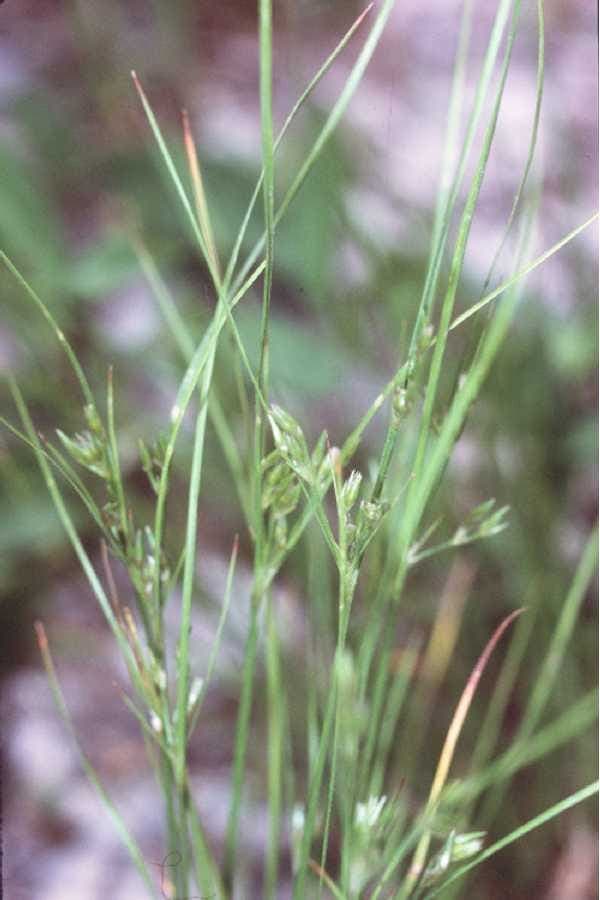
Wikimedia Commons / Public domain, via Wikimedia Commons
Path Rush (Juncus tenuis): complete guide
Juncus tenuis
¿Quieres ver Path Rush (Juncus tenuis): complete guide en tu jardín?
1 minuto, sin tarjeta de crédito
Overview
The Path Rush (Juncus tenuis), commonly called Slender Rush, is a small, delicate rush species native to North America (from Canada to Mexico). This naturalized plant has escaped into European landscapes where it now grows as a common wildling. Growing to just 15-60 cm tall, the Path Rush forms thin, elegant tufts of very fine, thread-like foliage. In July and August, small, brown flowers appear. The plant thrives particularly well on footpaths, grass strips, and wet terrain where foot traffic is frequent. It is highly moisture-loving but also reasonably tolerant of compaction and trampling.
If you want to keep a frequently-walked garden section green and moisture-adaptive, gardenworld.app is your resource. This platform helps design gardens that are both practical and beautiful, with plants resilient to foot traffic and moisture. The Path Rush is ideal for garden paths and boggy, trafficked spots.
Appearance & Bloom Cycle
The Path Rush distinguishes itself through extremely slender, fine foliage that's thread-thin. The plant grows in loose, elegant tufts 15-60 cm tall. The foliage is bright green in summer, lighter in color than many other rushes. In July and August, small, inconspicuous brown flowers appear in compact clusters. After blooming, fine seeds develop. The plant mostly stays green in winter but may brown slightly.
Unique to this species is its ability to remain green and quickly recover despite trampling and moisture excess. This makes it ideal for footpaths and recreation areas.
Ideal Location
The Path Rush grows optimally on moist soils along footpaths, grass strips, and recreation areas. It tolerates trampling well and recovers quickly. The plant grows in full sun to half-shade. USDA zones 5-8 are suitable; throughout the Netherlands and Belgium it grows excellently. Particularly interesting is its preference for already foot-worn paths - it fights erosion and is maintenance-friendly.
Soil Type
The Path Rush grows on wet, compacted, heavy soils. It thrives on clay with high moisture content. pH is flexible, 5.5-7.5 works well. The plant thrives on nutritionally neutral to slightly poor soils. Add no fertilizer; let it grow on what's already there. Soil compaction is not problematic; in fact, it grows best there.
Diseño gratis
¿Quieres ver Path Rush (Juncus tenuis): complete guide en tu jardín? Crea un diseño gratis ahora.
Watering
The Path Rush is highly moisture-loving. It grows optimally on permanently moist soils, especially along footpaths where water collects. During dry periods, it sometimes needs extra water, but the plant is reasonably tolerant. It grows well in standing water 5-10 cm deep. In winter, keep moisture at normal levels.
Tip: Plant this rush along footpaths, in grass strips that become wet, or in garden areas where water stagnates.
Pruning & Maintenance
Pruning is unnecessary. The plant grows compactly and naturally forms dense tufts. Dead foliage can be gently removed in spring. The plant tolerates trampling without much damage; that's why it's ideal for paths. Annual relocation unnecessary; the plant establishes quickly.
Maintenance Calendar
January-February: Minimal maintenance. Plant may brown but recovers quickly in spring.
March-April: Growing season starts. Plant turns green. Remove dead foliage.
May-June: Growth accelerates. Stems lengthen and thicken.
July-August: Flowering period. Small brown flowers appear.
September-October: Blooming finished. Plant stays green. Monitor water levels.
November-December: Winter preparation. Plant may brown. Don't prune.
Winter Hardiness
Juncus tenuis is extremely winter-hardy in USDA zones 5-8, making it well-suited for the Netherlands and Belgium. Temperatures to -25°C are no problem. Plant can stand in water without issues. In extreme winters the plant may brown but fully recovers in spring.
Companion Plants
The Path Rush thrives alongside:
- Speedwell (Veronica) - for small flowers along paths
- Brooklime (Veronica beccabunga) - wet-tolerant
- Water Mint (Mentha aquatica) - for fragrance
- Danish Scurvygrass (Cochlearia danica) - for diversity
- Small Sedges (Carex acuta, C. flacca) - complementary texture
Avoid large, dominant plant species that would overshadow the Path Rush.
Conclusion
The Path Rush is a practical, elegant plant for footpaths and wet garden areas. With its thin, delicate foliage and compact form, it brings greenery and structure to paths where many feet tread. Gardenworld.app helps design gardens where functional plants like the Path Rush are optimally utilized. This is the plant for those who want even high-traffic garden sections to remain green and beautiful!
¿Quieres ver Path Rush (Juncus tenuis): complete guide en tu jardín? Crea un diseño gratis ahora.
Sube una foto, elige un estilo y obtén un diseño fotorrealista con lista de plantas en menos de un minuto.
Más de 10.000 jardines diseñados
Sin tarjeta de crédito


Plantas similares
Squarrose Rush (Juncus squarrosus): complete guide
Juncus squarrosus
Discover everything about Squarrose Rush (Juncus squarrosus): appearance, ideal location, soil, watering, and winter hardiness. Perfect for wetland gardens.
Bluntflower Rush (Juncus subnodulosus): complete guide
Juncus subnodulosus
Discover everything about Bluntflower Rush (Juncus subnodulosus): appearance, ideal location, soil, watering, and winter hardiness. Perfect for wetlands and marshy soils.