
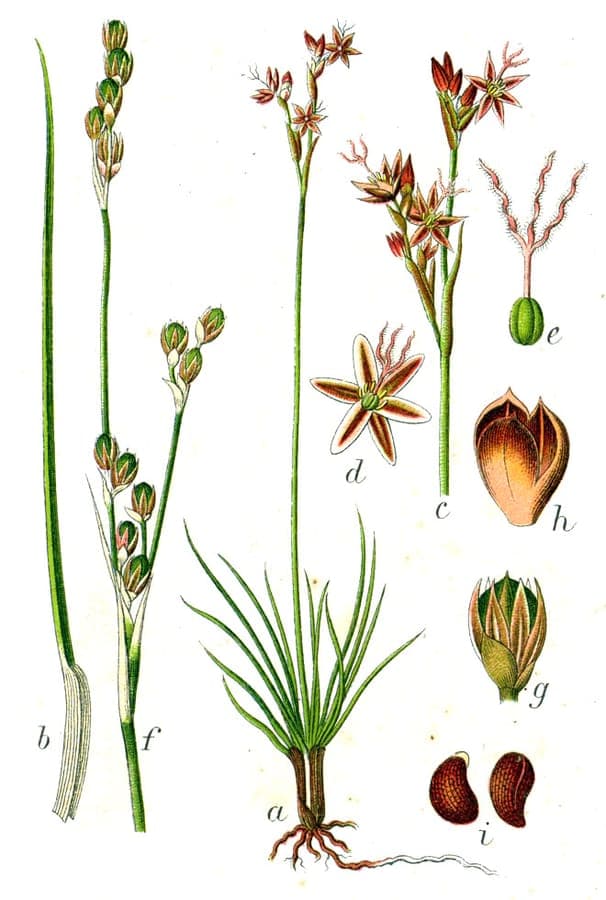
Johann Georg Sturm (Painter: Jacob Sturm) / Public domain, via Wikimedia Commons
Squarrose Rush (Juncus squarrosus): complete guide
Juncus squarrosus
¿Quieres ver Squarrose Rush (Juncus squarrosus): complete guide en tu jardín?
1 minuto, sin tarjeta de crédito
Overview
The Squarrose Rush (Juncus squarrosus), commonly known as Heath Rush, is a distinctive native plant naturally occurring throughout Europe, from Britain to Morocco. This grass-like species from the Juncaceae family (rushes) distinguishes itself through rigid, angular upright foliage that stands erect like small arrows. Growing to approximately 20-50 cm tall, the Squarrose Rush forms compact, dark-green cushions that display interesting brownish flowering during the growing season (April to June). This plant is a moisture-lover that thrives on nutrient-poor, wet or marshy soils - precisely where many garden plants struggle.
If you want to add an authentic, ecologically valuable element to your garden, gardenworld.app is your destination. This platform helps you design gardens where wetland elements and moisture-loving plants like the Squarrose Rush truly excel. Moreover, the plant contributes to biodiversity, benefiting birds, insects, and other garden inhabitants.
Appearance & Bloom Cycle
The Squarrose Rush is immediately recognizable by its dense, upright, dark-green foliage that grows almost vertically from the ground. The leaves are typical of rushes: round and hollow, with diameters of just a few millimeters, yet firm and rigid. The plant forms compact, tight cushions or mounds up to 50 cm high. During the growing season (April to June), small, striking brown flowers appear nestled between the leaves, densely packed in flower clusters. After flowering, inconspicuous seeds develop that disperse via wind and water.
The Squarrose Rush remains green year-round, providing structural interest even in winter. Its dark-green color and upright growth habit make it ideal as an accent in wet areas, along pond edges, or on difficult, wet locations.
Ideal Location
The Squarrose Rush is not a plant for dry locations. It thrives optimally in moist to wet, acidic soils (pH 4.5-6.5) and performs poorly on alkaline ground. The plant prefers half-shade to full sun conditions. Zones with standing water, pond margins, or lightly inundated gardens are ideal.
Geographically, the Squarrose Rush is perfectly suited to temperate climates. In the Netherlands and Belgium (USDA zones 7-8), it grows excellently when the soil provides sufficient moisture.
Soil Type
The Squarrose Rush prefers nutrient-poor, wet soils. Heavy clay with high water content is perfect; sandy and peaty soils are also suitable. Importantly, maintain a pH between 4.5 and 6.0. Add no fertilizer - the plant actually thrives through nutrient absence. Drainage is unnecessary; moisture retention is essential. Mulching is not recommended in very wet environments, though thin sand coverage may help.
Diseño gratis
¿Quieres ver Squarrose Rush (Juncus squarrosus): complete guide en tu jardín? Crea un diseño gratis ahora.
Watering
The Squarrose Rush is highly moisture-loving. During the growing season (April to October), the soil should remain continuously moist. Never let soil dry out completely, except possibly during very dry summers. In spring and fall, water needs decrease slightly but never dramatically. In winter, less water is needed due to reduced evaporation, though soil should ideally remain moist.
Tip: Plant the Squarrose Rush near rain gardens or in areas where water naturally accumulates. This minimizes artificial irrigation needs.
Pruning & Maintenance
Pruning is usually unnecessary. The Squarrose Rush grows compactly and naturally forms dense cushions. Dead foliage can be gently raked out in early spring to prevent rot. Avoid heavy interventions. Transplanting can occur in March or October, but not every two years - allow the plant minimum 3-4 years in the same location for optimal development.
Maintenance Calendar
January-February: Minimal maintenance. Plant is dormant. Monitor water levels.
March-April: Growing season begins. Remove previous year's dead foliage. Ensure consistent moisture.
May-June: Flowering period. Enjoy the blooms. Maintain normal watering levels.
July-September: Summer months. Plant stays green and compact. Continue watering during dry spells.
October-November: Winter preparation. Gradually reduce watering.
December: Winter dormancy. Minimal maintenance. Check drainage of excess water.
Winter Hardiness
Juncus squarrosus is highly winter-hardy in USDA zones 3-8, tolerating temperatures down to -40°C. In the Netherlands and Belgium (zone 7-8), winter protection is unnecessary. Don't remove dead foliage in winter; it aids insulation. In extremely wet environments, excess water may freeze; ensure slight elevation to prevent ice formation.
Companion Plants
The Squarrose Rush thrives alongside other moisture-loving, acid-soil plants:
- Sphagnum Moss - forms attractive underlayer
- Scheuchzeria - similar growth habit
- Saint John's Wort (Hypericum) - provides color
- Small Sedges (Carex nigra, C. dioica) - complementary texture
- Marsh Marigold (Caltha palustris) - yellow spring bloomers
Avoid heavy, nutrient-rich plants suited to neutral-alkaline soils.
Conclusion
The Squarrose Rush is a native plant with character that transforms wet areas into interesting, biodiverse garden elements. While not spectacular in bloom, its compact form and deep-green foliage provide valuable additions to water gardens and wetland areas. With gardenworld.app, design a garden where the Squarrose Rush reaches its full potential alongside other wetland elements creating authentic, natural aesthetics. Choose this plant if you have moisture challenges - it will reward you!
¿Quieres ver Squarrose Rush (Juncus squarrosus): complete guide en tu jardín? Crea un diseño gratis ahora.
Sube una foto, elige un estilo y obtén un diseño fotorrealista con lista de plantas en menos de un minuto.
Más de 10.000 jardines diseñados
Sin tarjeta de crédito


Plantas similares
Bluntflower Rush (Juncus subnodulosus): complete guide
Juncus subnodulosus
Discover everything about Bluntflower Rush (Juncus subnodulosus): appearance, ideal location, soil, watering, and winter hardiness. Perfect for wetlands and marshy soils.
Path Rush (Juncus tenuis): complete guide
Juncus tenuis
Discover everything about Path Rush (Juncus tenuis): appearance, ideal location, soil, watering, and winter hardiness. Perfect for footpaths and wet areas.