
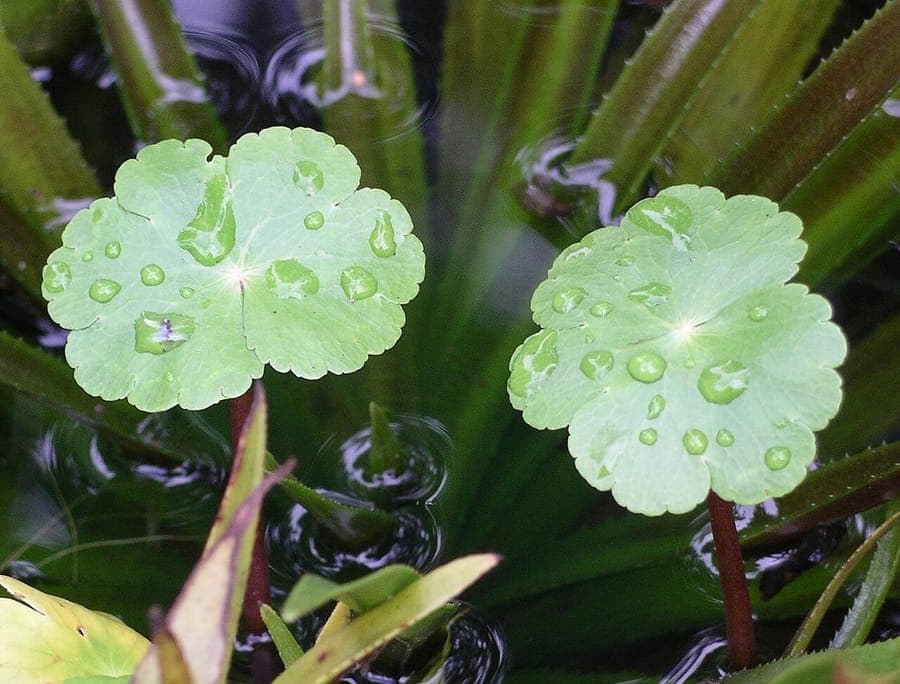
No machine-readable author provided. Velela assumed (based on copyright claims). / Public domain, via Wikimedia Commons
Floating pennywort: complete guide
Hydrocotyle ranunculoides
¿Quieres ver Floating pennywort: complete guide en tu jardín?
1 minuto, sin tarjeta de crédito
Overview
Hydrocotyle ranunculoides, better known as Floating pennywort, is an exotic water plant originating from America that has remarkably adapted to European water systems in recent decades. This plant from the Araliaceae family (carrot family) originally grew along slow-flowing river banks in South and Central America. Today it is cultivated both in aquariums and garden ponds because of its attractive fine foliage and rapid growth.
At gardenworld.app, we frequently recommend Hydrocotyle ranunculoides in aquatic design because it's both decorative and functional - it absorbs excess nutrients, provides shelter for aquatic insects and fish, and grows fast enough for quick visual results.
Appearance and flowering period
Hydrocotyle ranunculoides grows as an elegant water plant with extremely small, round leaves reaching 0.3-1 cm in diameter. The leaves are bright green with a characteristic lotus-shaped structure featuring a central leaf stalk. Stems grow upright or floating depending on conditions; submerged it forms compact branching, while floating it produces more distributed leaves.
In aquariums and ponds, the plant rarely to never flowers - flowers develop only under very specific conditions outside water. The plant's appearance is therefore primarily the fine leaves that together create an almost festive light-scattering effect.
Ideal location
Hydrocotyle ranunculoides grows in both aquariums and ponds, either submerged or floating. For optimal growth, choose a location with plenty of light (8-10 hours daily in aquariums, full sun in ponds). More light produces more compact, fuller growth.
In ponds, prefer locations without strong currents but with gentle water movement (pumps help). In aquariums, position it front or center to utilize aquarium lighting well. Avoid dark corners; stems become thin and sparse here.
Water and substrate
Hydrocotyle ranunculoides thrives in both soft and moderately hard waters with pH 5.5-7.5. Temperature: 15-28°C optimal; growth continues below 10°C but very slowly. For aquariums: without artificial CO₂ injection it grows reasonably, but with CO₂ injection growth speed doubles.
Substrate is unnecessary - the plant lightly roots in gravel or sand but grows well floating too. In aquariums, you can plant stem cuttings and new roots develop within 2-3 weeks. In ponds, plant a few stems in marshy areas where they spread.
Watering and growth
As an aquatic plant, Hydrocotyle ranunculoides needs abundant water - it's its living environment. Growth is fast: under good light and CO₂ conditions, it grows 5-10 cm weekly. This makes it excellent for rapid aquascaping but requires regular thinning.
Growth rate in ponds is slightly slower (2-3 cm weekly) but still impressive. In both environments, monthly monitoring of expansion is essential.
Diseño gratis
¿Quieres ver Floating pennywort: complete guide en tu jardín? Crea un diseño gratis ahora.
Maintenance and pruning
Maintenance is simple but requires regularity. In aquariums, regularly remove the longest stems - this promotes branching and fuller appearance. Trim 1-2 cm above a leaf node and the plant forms two new stems there.
In ponds, monitor the plant monthly; if growing excessively, remove branches at edges. For die-off prevention: always maintain at least 30 cm water in ponds and avoid water-temperature swings greater than 5°C daily.
Aquarium maintenance calendar
Weekly: water changes (25-30%), check for algae on leaves
Monthly: pruning, check CO₂ levels, thin dense spots
Seasonal: reduce light in winter (if temperature drops), maintain 18-20°C
Pond maintenance calendar
May-June: plant material placement, first growth check
July-August: weekly inspection, regular thinning
September-October: winter preparation, final pruning
November-March: minimal maintenance, keep ice-free
Winter hardiness
Hydrocotyle ranunculoides tolerates frost poorly. In ponds with temperatures below 5°C, the aboveground plant dies back, but if roots don't freeze, it can regrow. For reliable survival in cold winters, keep a few stems in an indoor aquarium (18-22°C).
In aquariums (heated environments) no winter problems. USDA zone: 9-12 (subtropical-tropical).
Companions and associations
Floating pennywort feels at home among other fast-growing aquatic plants. Combine it with:
- Ludwigia repens (red ludwigia)
- Alternanthera reineckii (red water plant)
- Riccia fluitans (crystalwort)
- Hemianthus callitrichoides (pearlweed)
In ponds it pairs well with other weedy aquatic plants that purify water. Ensure at least 50% of water surface remains clear for gas exchange.
Warning: invasive potential
Important note: Hydrocotyle ranunculoides is listed as an invasive species in various countries (including Netherlands, Belgium, France). Never dispose of trimmed plant material in natural waters. Always discard via compost or household waste. In aquariums it's safe; in garden ponds be careful and regularly check it doesn't reach adjacent natural waters.
Preparation for gardenworld.app design
When designing your aquatic landscape on gardenworld.app, use Hydrocotyle ranunculoides as a fast-growing vertical accent, background vegetation, or decorative floating mass in the mid-background. Its fine leaves contrast beautifully with larger aquatic plants like echinodorus or cryptocoryne.
Conclusion
Floating pennywort is one of the most rewarding aquatic plants for beginners and experienced aquarists. With minimal maintenance, rapid growth, and attractive appearance, it provides years of enjoyment. Remember its invasive potential and manage it responsibly. Design your aquatic paradise on gardenworld.app with this versatile plant.
¿Quieres ver Floating pennywort: complete guide en tu jardín? Crea un diseño gratis ahora.
Sube una foto, elige un estilo y obtén un diseño fotorrealista con lista de plantas en menos de un minuto.
Más de 10.000 jardines diseñados
Sin tarjeta de crédito


Plantas similares
European frog's-bit: complete guide
Hydrocharis morsus-ranae
Everything about European frog's-bit (Hydrocharis morsus-ranae): care, cultivation in garden ponds, blooming periods. Tips for integrating this floating water plant into aquatic ecosystems.
Marsh pennywort: complete guide
Hydrocotyle vulgaris
Everything about Marsh pennywort (Hydrocotyle vulgaris): native water plant, cultivation along water margins. Tips for care and integration into wet habitats.