
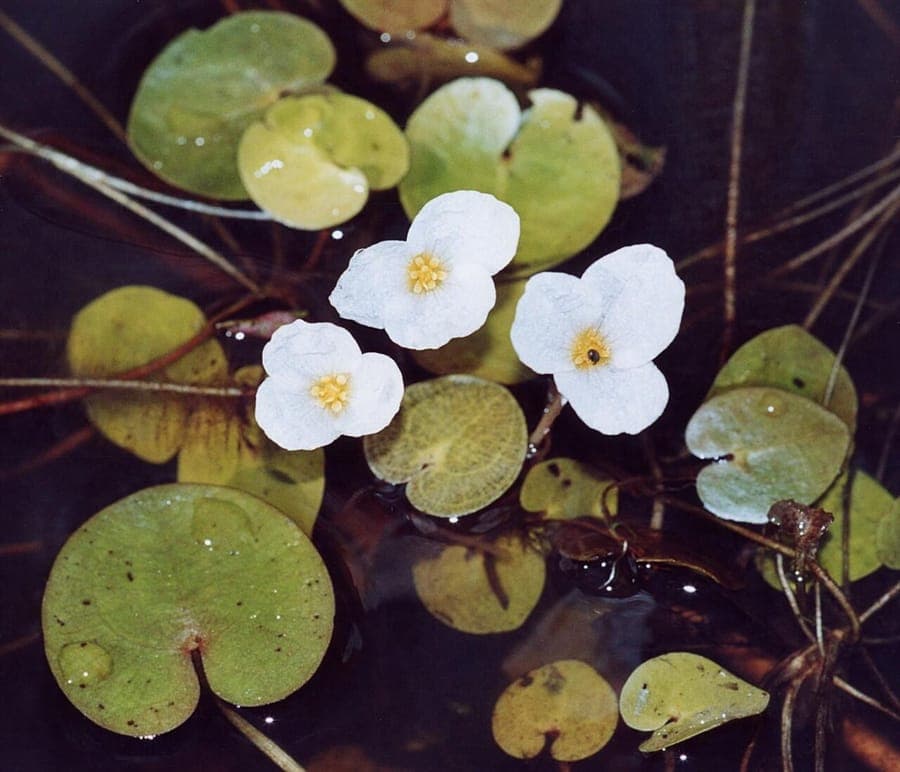
Christian Fischer / CC BY-SA 3.0, via Wikimedia Commons
European frog's-bit: complete guide
Hydrocharis morsus-ranae
¿Quieres ver European frog's-bit: complete guide en tu jardín?
1 minuto, sin tarjeta de crédito
Overview
European frog's-bit (Hydrocharis morsus-ranae) is a native and elegant floating water plant that thrives in garden ponds, ditches, and wetlands. This free-floating aquatic plant belongs to the Hydrocharitaceae family and is naturally distributed from Europe to the Caucasus and North Africa. In the Netherlands, it is a protected species frequently found in still waters along the coast and in polders.
The plant gets its common name from its distinctive small, round leaves that grow in rosettes. For gardeners looking to enhance their water features, Hydrocharis morsus-ranae offers the perfect balance between surface decoration and ecological value. At gardenworld.app, we help you design spaces where aquatic plants like this play a starring role in sustainable water ecosystems.
Appearance and flowering period
Hydrocharís morsus-ranae grows as an elegant raft of dark green, glossy leaves measuring 2-4 cm in diameter. The leaves form rosettes connected to the mother plant by thin petioles, creating an avian-like structure. White flowers appear from July to September, featuring three petals with yellow central markings that attract insects. Each bloom opens for just one day, but continuous new flower production ensures a prolonged flowering season.
The plant survives winter by forming turions - small leafless compact structures that sink to the muddy bottom and overwinter there. This fascinating mechanism protects the species during freezing winters: the colder the season, the more turions form.
Ideal location
Hydrocharís morsus-ranae thrives in still or very slow-moving water with minimum 30 cm depth. Sunny is better than shade - while the plant grows in partial shade, it flowers much more abundantly in full sun. A wind-sheltered water surface promotes stable growth.
For garden ponds, choose a location where you can admire the plant and where the white flowers stand out against the water background. Avoid spots where leaves and organic debris accumulate excessively, as this creates nitrogen-rich conditions unsuitable for the plant.
Water chemistry and substrate
European frog's-bit is not fussy about water chemistry. It grows in both soft (low salinity) and slightly harder water. The pH range is broad: 6.5 to 7.5 is ideal, but the plant tolerates somewhat acidic water. Being a free-floating plant, it requires no soil substrate - water itself provides essential nutrients.
Moderate nitrogen and phosphate concentration is important. Excessive nutrients promote algae growth that reduces light and suffocates the plant. For garden ponds: perform partial water changes monthly (10-15%) and add aquatic plant fertilizer only in nutrient-poor conditions.
Diseño gratis
¿Quieres ver European frog's-bit: complete guide en tu jardín? Crea un diseño gratis ahora.
Watering and growth
Being free-floating, traditional "watering" doesn't apply - the plant floats or lightly roots in mud. Growth is rapid: under favorable conditions, the number of leaf rosettes doubles every 3-4 weeks. This requires monthly inspection to prevent pond overgrowth.
At full growth, a single plant can spread over 1 meter in width. For smaller ponds (under 3 square meters), specimens are regularly removed. For larger ponds (over 5 square meters), the plant can grow freely through summer and be gradually trimmed in autumn.
Maintenance and pruning
The plant requires simple maintenance. Dead leaves are regularly removed - they weaken the whole and suffocate the water. If leaves are yellow or brown, gently pull them to the surface and remove them.
During summer, monitor expansion: if growing too vigorously, gently scoop out plants, ensuring at least one healthy rosette remains or the plant dies. In September, gradually remove more specimens so the plant doesn't overgrow the entire water surface and block sunlight for other aquatics.
Critical: never use toxic pesticides. For pest control (undersaturated oxygen sometimes causes aphids), a strong water jet or introducing macrofauna predators like dragonflies and aquatic beetles suffices.
Maintenance calendar
May: first inspection, count plant material
June-July: growth and bloom monitoring, monthly water checks
August-September: gradual thinning, leaf removal
October: final maintenance, winter preparation
November-March: minimal maintenance, monitor turion formation
Winter hardiness
Hydrocharís morsus-ranae is fully winter-hardy to USDA zone 5 (-28°C minimum). Thanks to turion formation, even very cold winters are survived. However, if your pond freezes solid, adult plants die. The turions in the mud, however, grow again the following spring.
For winters with severe frost (below -15°C for weeks), place a few plants in a bucket of water in a shed. Position this bucket in a bright, cool location (5-8°C) and keep the water slightly moist. After frost, return them to the pond.
Companions and associations
European frog's-bit feels at home among other floating water plants and marginal plants. Combine it with:
- Blue water vegetation (Pontederia cordata)
- Azolla species (small water fern)
- Pistia stratiotes (water lettuce)
- Margin herbs (Iris laevigata, Acorus gramineus)
Always ensure at least 30% of the water surface remains free for gas exchange and flower visibility. At gardenworld.app, we help you design a water feature where plant, water, and surroundings harmonize perfectly.
Conclusion
European frog's-bit is more than a mere plant - it's an ecological ambassador proving that water ponds need not be artificial. With its white flowers, round leaves, and uncomplicated cultivation, it provides years of water garden beauty without fuss. Whether you have a small balcony pond or a large garden pond, Hydrocharis morsus-ranae deserves a place. Design your aquatic paradise now on gardenworld.app and watch this native water plant transform your pond into a natural ecosystem.
¿Quieres ver European frog's-bit: complete guide en tu jardín? Crea un diseño gratis ahora.
Sube una foto, elige un estilo y obtén un diseño fotorrealista con lista de plantas en menos de un minuto.
Más de 10.000 jardines diseñados
Sin tarjeta de crédito


Plantas similares
Floating pennywort: complete guide
Hydrocotyle ranunculoides
Everything about Floating pennywort (Hydrocotyle ranunculoides): care in aquariums and ponds. Growth tips, optimal conditions and integration into aquatic landscapes.
Marsh pennywort: complete guide
Hydrocotyle vulgaris
Everything about Marsh pennywort (Hydrocotyle vulgaris): native water plant, cultivation along water margins. Tips for care and integration into wet habitats.
Water-aloe: complete guide
Stratiotes aloides
Discover the Water-aloe (Stratiotes aloides), a unique floating aquatic plant with aloe-like leaves and white flowers. Learn about pond cultivation, care, and ideal water conditions.